BANGUI
No sooner had the Central African Republic (CAR)'s interim President Catherine Samba Panza left after a special ceremony to welcome back army deserters, than hundreds of army personnel dragged a civilian from the crowd and lynched him on suspicions that he was a former seleka fighter.
"They first threw a large rock over his head and then cut his body apart," Peter Bouckaert, emergencies director for Human Rights Watch, who was present at the scene, told Anadolu Agency.
"They then set his body on fire, while everybody around was laughing and taking photos with their mobile phones," he added.
Bouckaert saw the soldiers celebrate as the man's body roasted in the flames for more than 15 minutes.
Children, together with hundreds of other onlookers, laughed.
"They said we can eat the body of the man after it gets cooked," he said, quoting one of the children as telling his friends as they rejoiced at the burning body.
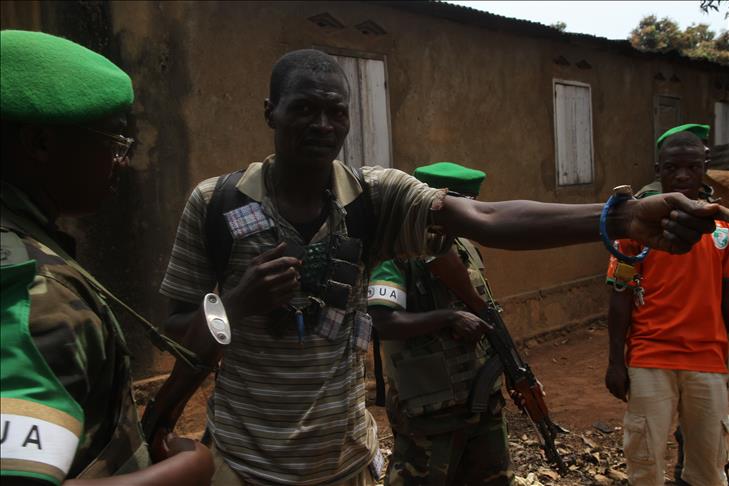
Bouckaert said that all this happened under the eyes of African peacekeepers deployed in the area.
He asserted that none of the peacekeepers did anything to help the victim.
Bouckaert said the African troops only approached the body some 15 minutes later.
A young man, however, suddenly stepped in carrying one of the man's legs and threw it in the fire, he added.
CAR descended into anarchy in March 2013 when Seleka rebels – said to be mostly Muslim – ousted Francois Bozize, a Christian, who had come to power in a 2003 coup, and installed Michel Djotodia as interim president.
For months, the country has been plagued by tit-for-tat sectarian violence between the anti-balaka and former seleka fighters.
In January, Samba-Panza, mayor of capital Bangui, was sworn in as new interim president replacing Djotodia, the country's first Muslim president since its 1960 independence from France, who had stepped down under international and regional pressure.
Recurring
Wednesday should have been a day of celebration, but the lynching of the suspected seleka militant offered insight into the bitterness of the struggle in this resource-rich but turmoil-stricken African country.
Bouckaert asserted that the horrific incident was by no means exceptional. He reported witnessing similar attacks five or six times over the past few days.
Bouckaert was driving on the way to Bangui a few days ago when he saw a man being chased down the street by dozens of people.
The crowd suspected the man was a former seleka fighter and kept beating him.
"He said, 'Look, I'm Christian, not Muslim'," Bouckaert recalled. "They, however, did not care, and kept beating him, not giving him a chance to utter a word."
Muslims have increasingly been targeted since Samba-Panza, a Christian, assumed the presidency.
In a recent report, Amnesty International said that more than 50 Muslims had been killed by Christian anti-balaka militias in two separate attacks northwest of Bangui.
The rights watchdog said that anti-balaka fighters had stopped a truck transporting refugees in the town of Boyali, some 130km northwest of the capital.
According to Amnesty, the militiamen then used machetes and knives to kill their captives – who included three women and three children – in the street outside a local mosque.
The second attack, the rights group said, occurred on January 16 in the town of Bossembele, some 30km north of Boyali, where 25 bodies were found inside a local mosque and another 18 were found strewn in nearby streets.
International humanitarian group Save the Children earlier confirmed the murder of at least 23 Muslims, including three children, in an attack on a refugee convoy.
englishnews@aa.com.tr