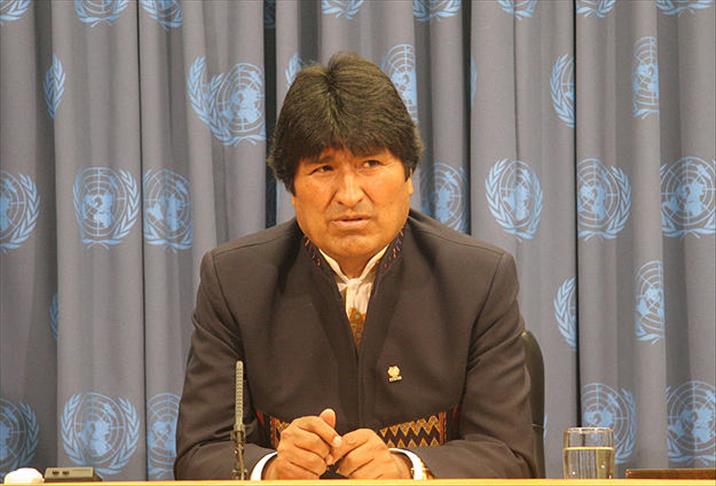
SÃO PAULO (AA) – Six nations of the Union of South American Nations (UNASUR) have demanded an apology from the governments of four European nations caught up in a diplomatic spat involving Bolivian President Evo Morales’s plane, which was forced to land in Austria on Wednesday, while en route from Russia to Bolivia.
The UNASUR bloc convened an emergency meeting on Thursday to discuss the incident issued a statement denouncing "the flagrant violation of international treaties."
The incident arose amid allegations that fugitive NSA whistleblower Edward Snowden – on the run from the United States authorities – was on board.
The Bolivian president had been attending a meeting of gas exporting nations in Moscow.
The plane, which had been set to travel from Russia to Portugal for refueling, before heading on to South America, was forcibly grounded in Austria and held for thirteen hours before being given the all-clear. The plane then sought an alternative route via the Canary Islands.
The emergency meeting, also attended by leaders of Venezuela, Ecuador, Suriname, Argentina and Uruguay, ended with a demand that the four European countries which had closed their airspace to Morales’s plane – France, Spain, Portugal and Italy – apologize for their actions.
Only France has so far expressed regret over the incident.
In a statement issued by UNASUR Secretary General Ali Rodríguez Araque ahead of Thursday’s meeting said that the bloc "rejected the dangerous actions of France and Portugal" over "malicious information" that the former NSA contractor was on the flight, and that considered the event "strange" when "all the EU governments have expressed concern about the scope of the spying program conducted by the government of the United States on their people."
Spain’s Foreign Minister José Manuel García-Margallo stopped short of an apology, as he said Spain’s airspace had never been closed to the plane, but did shed light on the European nations’ actions by saying the countries had received urgent information that Snowden was on board the plane – the only official comment by Europe so far to link the plane’s detention with the fugitive whistleblower who is wanted by the United States.
Mr. García-Margello, who did not divulge who had given out the information, said the countries acted quickly as there was not time to verify the claim. Economic ties between Spain and South America run deep and the admission has been seen as an attempt aimed at damage limitation to safeguard bilateral trade.
- Apology not enough
However, President Morales was clear a simple apology was insufficient: "Apologies are not enough because the stance is that international treaties must be respected."
He also claimed the US pressured the European nations into denying his plane permission to fly over their territories, and even questioned whether the US Embassy in La Paz would be allowed to remain open: "We met with the leaders of my party and they asked us for several measures and if necessary, we will close the Embassy of the United States," Morales said on Thursday, adding Bolivia "did not need the embassy."
A statement issued at the end of the summit demanded answers only from the four European nations embroiled in the diplomatic row, and not from the US or Austria.
- Snowden’s asylum options narrow
Edward Snowden - who is reportedly still in the international transit zone of Moscow’s Sheremetyevo Airport - has made applications for asylums to over twenty of countries to gain protection from the United States’ attempts to detain him to face charges over his divulging of classified information over the country’s surveillance programs.
One of these is the South American nation of Ecuador, which has previously granted asylum to Wikileaks founder Julian Assange, who has been holed up in the Ecuadorian Embassy in London for a year.
However, Snowden’s list of options is growing shorter by the day, as more and more countries deny him asylum, many on the grounds that he is not in that country’s territory.
According to Morales, Bolivia was not among the countries to have received a formal request for asylum, but should such a request be made, it would be considered. Other Latin American countries to which formal applications have been made, including Ecuador, have not yet come to a decision.