SAO PAULO, Brazil
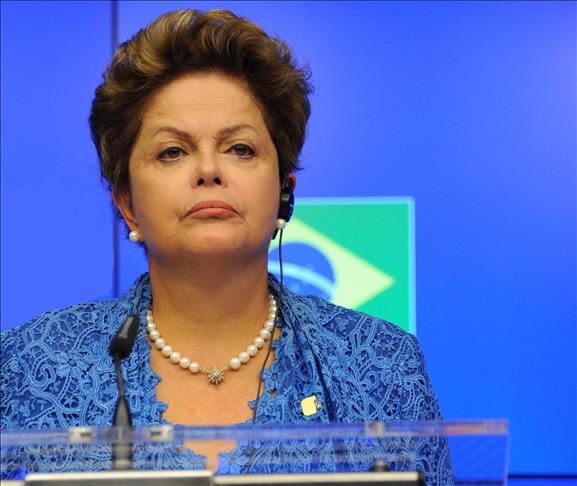
The latest poll of voters' intentions ahead of Brazil's upcoming general elections released late Thursday suggests that while incumbent president Dilma Rousseff remains in the lead by a comfortable margin, a second round will be required and is currently too close to call.
The latest Datafolha poll showed Rousseff, presidential hopeful for the leftist Workers' Party, had fallen two points since the last poll at the beginning of July, with 36 percent of respondents' votes.
Aecio Neves, Rousseff's nearest rival from the right-leaning Brazilian Social Democracy Party, again garnered 20 percent of votes, ranking him second, with third place going to Brazilian Socialist Party candidate Eduardo Campos who dropped one point, to eight percent.
Some 14 percent of those surveyed also said they were still undecided; commentators say those on the fence are likely to pick their allegiances as the campaigns heat up. A further 13 percent said they would either spoil or annul their compulsory vote.
Rousseff's 36 percent is the same as all her opponents combined, but still not break through the fifty-percent threshold required to win the first round of voting, set for October 5.
However, votes for a potential second round between Rousseff and Neves gave the candidates 44 percent and 40 percent, respectively. Given the poll's margin of error of two points in either direction, this results in a technical tie.
Andre Borges de Carvalho, associate professor at the University of Brasilia's Institute of Political Science, tells Anadolu Agency that a second round for Rousseff would be challenging:
"Firstly, due to the high level of voter rejection towards Rousseff, which would tend not to favor her in a two-candidate runoff scenario. Secondly, because in previous elections the Workers' Party has benefited from third-place votes, as this year those voting for Campos are likely to opt for Neves in an eventual second round."
- Traditional politics rejected
There was also bad news for Rousseff's government overall: the poll showed that approval has dropped from 35 percent to 32 percent, and outright rejection was also up four points to 29 percent.
This latest Datafolha poll, which surveyed 5,377 eligible voters in 223 towns and cities, is the first to be conducted since the end of the World Cup on July 13 and the start of the parties' election campaigns on July 6.
"We conducted polls before, during and after the World Cup, and we learned that Brazilians were more optimistic and more positive towards President Dilma during the World Cup; however, that has passed and we are now back to where we were before the tournament," Mauro Paulino, Datafolha director-general, told AA.
Paulino said a "rejection to the traditional political discourse" among Brazilians was in evidence, and that, barring very few exceptions, politicians of any party were "unwelcome":
"We have record proportion of the electorate -- 67 percent -- who do not support any party, particularly in bigger cities, and a third of people are spoiling or voiding their ballot, or not voting at all. There is a need for innovative political debate," he concluded.
The Datafolha boss said parties now had to approach the electorate with a manifesto they could fulfill, rather than a raft of empty promises that could well turn off even more voters.
- Party election campaigns start
With the World Cup over and the main period of campaign ahead of the elections beginning, the government released a slew of positive figures about the tournament earlier this week to bolster support for the ruling parties, the G1 news portal reports.
"The expectation was that Dilma [Rousseff] would be cut some slack in this poll, after the World Cup, but that increase was not backed up by the numbers," political commentator Gerson Camarotti wrote in a Globo blog post. "Internally, there is recognition that after the humiliation of the Brazilian team at the game with Germany, a negative outlook has spread through Brazilians."
And indeed the Datafolha poll showed that a majority of Brazilians now believe the World Cup brought the country more minuses than pluses, up eight points to 54 percent.
However, while some commentators have said the World Cup could sway voters in October, others have urged caution over such assessments:
"I do not believe that the World Cup has had an impact on voters' intentions," Borges said. "On one side, the event was better organized than expected, but the poor performance of the economy is far more important when it comes to understanding voters' behavior at the polls."
Rousseff's opponents have sought to underline the poor state of the economy, which was firing on all cylinders in 2010, when the president was elected, with growth of 7.5 percent that year. This year, Brazil is forecast to see growth of around 1.6 percent, and rivals are blaming the president's fiscal policies for ending her first term in office with a lackluster economy.
In cities like Sao Paulo, Brazil's business powerhouse, it means the Workers' Party are certainly going to have their work cut out, with Neves's Social Democracy Party viewed as more pro-business, and an experienced member, Geraldo Alckmin, vying to stay on as the state's governor already way ahead in the polls.
New figures published Thursday also showed that the number of new jobs created in June was the worst for years. Given the hugely important role that jobs and unemployment play in election campaign, Rousseff will be hoping for some better economic news in the coming months, or else could face a uphill struggle for re-election to a second term in office.
news_share_descriptionsubscription_contact