By Okech Francis
JUBA
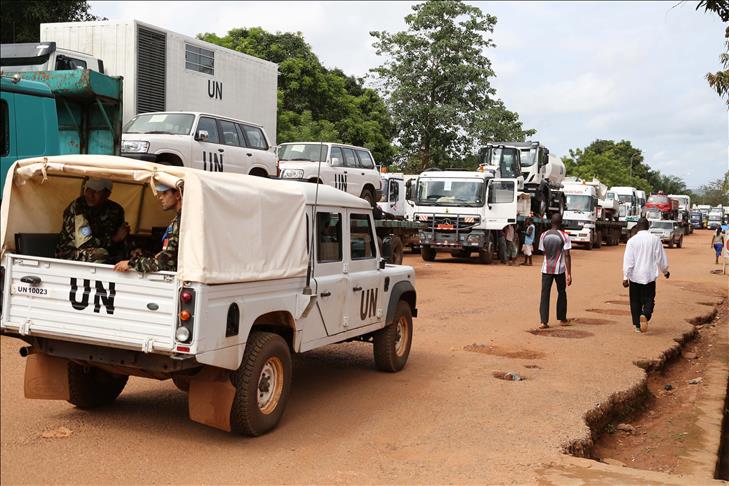
Everywhere in South Sudan, United Nations peacekeepers are not only protecting civilians, but also providing social services and building infrastructure in the war-ravaged country.
"There is an acute shortage of roads in South Sudan, particularly in Jonglei State," Joseph Contreras, spokesman for the United Nations Missions in South Sudan (UNMISS), told Anadolu Agency in an exclusive interview.
He said Jonglei was the largest state with a poor road network, especially the road linking it to capital Juba.
"The U.N. has been hearing of this problem for years," said Contreras.
U.N. peacekeepers are currently building a 220-kilometer road between Juba and Jonglei State capital, Bor.
Contreras said UNMISS was covering the entire cost of the project, which began on September 1, including materials and logistics.
"This is part of the peacekeepers' response to those pleas [for better roads]," he explained, stopping short of providing the exact cost of the project.
The spokesman said Bangladeshi peacekeepers were working on the section of the road from Juba to Mangalla (a recently created county in the area of Central Equatoria State carved out of Juba County), while South Korean peacekeepers were working on the section linking Bor to Mangalla.
"Bangladeshi peacekeepers are expected to finish by mid-March. As of today, they have already completed 25km [of road]," he noted.
"The South Koreans are also doing a fine job and are expected to complete [their section] by March of next year," he added.
The trip from Bor to Juba currently takes over eight hours due to poor road conditions and costs about 200 South Sudanese pounds (roughly $63) – prohibitively expensive for most of those who fled the conflict in Bor earlier this year.
The UNMISS spokesman said that, when complete, the road would go a long way towards improving overall services for the people of Jonglei State.
"It will cut down the time it takes to travel," said Contreras. "It is also going to facilitate the U.N. mission and humanitarian organizations in getting services as quickly as possible to people."
South Sudan has been shaken by violence since late last year, when President Salva Kiir accused Riek Machar, his sacked vice president, of plotting to overthrow his regime.
Hundreds of thousands of South Sudanese have since been displaced in fighting between the two rivals, leading to an increasingly dire humanitarian situation for much of the population.
UNMISS currently has 14,000 personnel from over 50 countries deployed in South Sudan, including military, police and civilian staff. Of these, the military accounts for 10,500 and police just under 1,000, while the rest are civilians.
Social services
Jonglei State Information and Communication Minister Judy Jonglei Boyoris said the road upgrades would also serve to improve security.
"After the construction of this road, if anything happens to us in Bor, security [forces] can come to us very quickly instead of [taking] two or three days," he told AA.
"This will also reduce prices in the market, since transportation will be very cheap because the road will be smoother," the minister added.
"I think, by the end of November, people of Jonglei State – and our traders and visitors to Jonglei – will enjoy the fruits of this road," he asserted.
The Public Transport Drivers' Union in Juba, for its part, is no less pleased about the road project.
"We have [long] been calling on the government to rehabilitate the roads, but there has been no response," Hassan Doka Raba, interim chairman of the union's chapter in Central Equatoria State, told AA.
"This will [facilitate] people travelling on the road," he said. "We also know that insecurity between Juba and Bor will be reduced when this road is completed."
"Drivers will drive faster and reach Bor in three hours because now they are taking eight hours and some cars sleep on the road. It's very risky," explained Raba.
Construction aside, U.N. peacekeepers are providing other services to the people of South Sudan.
"We have offered… veterinary services in the communities," Contreras told AA, adding that Indian peacekeepers were also providing medical services to local communities in many places.
Contreras added, however, that the U.N. mission's "vision" was for a peaceful and prosperous South Sudan.
"The first step is to end this fighting, restore peace, restore good governance and rule of law, and account for all criminal actions," he told AA.
He added: "After this, ultimately, we will all want to see South Sudan live in peace."
www.aa.com.tr/en