BANGKOK
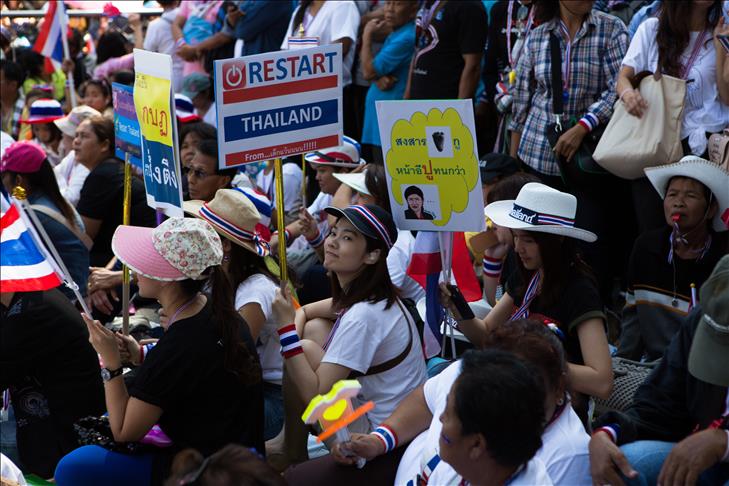
Protesters blocked polling stations, threatened voters and stole ballot players as they tried to stop Thailand's democratic process Sunday. In some instances, station directors resigned just before the election opened, or officials didn't turn up to staff polling booths.
“Many people came to vote, but the officials are not here. It is as if they don’t want the people to vote," a visibly upset female voter in eastern Bangkok told the Anadolu Agency on Sunday. "If they act like this, it is just because they are accomplices of the anti-government mob.”
Voter frustration frequently threatened to boil over, with only one of the Watana district office's four stations open because officials had failed to turn up.
According to an official announcement by the election commission, the vote to renew the country's 500-member National assembly could not proceed in nine of 76 provinces.
"The anti-government mob" are a group affiliated to the opposition Democrat Party who call themselves the People’s Democratic Reform Committee (PDRC).
The PDRC has taken to the streets to demand Prime Minister Yingluck Shinawatra - who they accuse of massive corruption - step down and an unelected "people's council" run Thailand until the political system is reformed.
The government has stood firm, protesters turning their attention to callling for a boycott of the vote, blocking polling stations, marching through central Bangkok and trying to stop others getting to the polls.
In the past week, they have surrounded some Bangkok district offices to pressure officials not to distribute ballot papers and boxes. In one instance Saturday, demonstrators were challenged by a group of government supporters - shots were fired, small bombs exploded and six people, including two journalists, were wounded.
At another Bangkok polling station on Sunday, another voter also expressed frustration at the lack of people officiating and the election boycott.
“The Democrat party is boycotting because it is afraid to lose," the woman - who did not wish to be identified - said. "They have not won an election for 20 years. It is as if we are under a dictatorship. If we were a democracy, we would be able to vote”.
Of the Kingdom's 49 million registered voters, 4.6 million are in Bangkok.
The polls were also disrupted in Thailand's south, where elections failed to take place in 28 constituencies because anti-government demonstrators had blocked voters’ registration 10 days ago.
In Songkhla province, a majority Muslim area close to the Malaysian border, the election was cancelled because polling stations did not receive ballot papers in time, according to the provincial election chief, who said ballot papers and boxes had been seized by opposition demonstrators.
Voting was also cancelled in four other provinces for the same reason or because of a lack of staff.
The disruption of the polls puts into question the possibility of convening Thailand's National assembly, as the constitution requires that at least 95 percent of the house's seats are occupied.
Somchai Srisuthiyakorn, a member of the election commission, said this week that it could take four to six months to reorganize the disrupted by-elections and complete the process.
He added Sunday that the Constitutional court could possibly cancel the whole election if it considered that the constitutional requirements for the polls to be valid were not met.
Thailand’s political crisis started in November when the government pushed through an amnesty bill which would have lifted a conviction against Yingluck Shinawatra's brother, Thaksin – a deeply-divisive figure who led the country from 2001 to 2006 before being found guilty of abuse of power.
Thaksin, who is said to still exert strong influence on the government, fled before the judgment and has been living in exile, mostly in Dubai.
Confronted by protests, the government withdrew the bill, but the dissatisfied PDRC - led by opposition MP, Suthep Thaugsuban - has alleged massive corruption by the government and Shinawatra family.
A state of emergency was declared January 21 with the country lurching from crisis to crisis, including shootings, demonstrations, bomb blasts, and killings.
In response to protests, Shinawatra dissolved parliament, and called the new elections.
The election commission was not expected to announce any results on Sunday evening or even in coming days as it says it does not want to influence voters behavior in any of the reorganized by-elections.
englishnews@aa.com.tr