One month after a disrupted legislative election, re-runs were held smoothly Sunday in five Thai provinces as anti-government protesters in Bangkok cleared several protest sites to regroup in a public park.
The re-runs took place in areas where voting could not be completed February 2 due to election officials resigning or protesters blockading polling stations.
In provinces in Thailand's south, however, the Election Commission said re-runs would be held gradually according to the situation. Voting could not initially take place in the region - an opposition fiefdom - as protesters stole ballot papers and blocked all polling stations.
Since the beginning of November, violent political protests have rocked Thailand, leaving 22 people and over 700 injured, according to the Erawan Emergency Service, an independent organisation. In the last 10 days alone, attacks have left five people dead and nearly 70 injured.
All was quiet Sunday, apart from one minor incident when around 20 anti-government protesters blew whistles violently at voters at a polling station in Petchaburi province, southwest of Bangkok, but voting still took place.
Protesters are calling for the resignation of Prime Minister Yingluck Shinawatra, who they accuse of corruption and of being under the influence of her brother, Thaksin, a former head of government and a deeply divisive figure in the country.
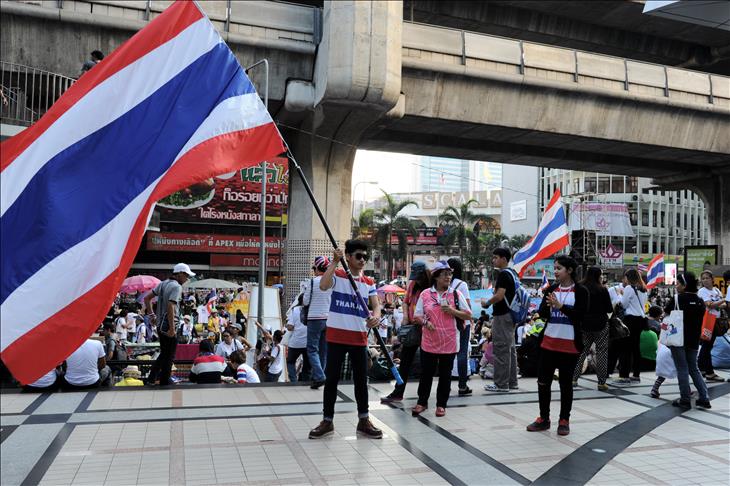
As voting took place Sunday, anti-Thaksin demonstrators cleared several protest sites in downtown Bangkok and regrouped in the capital's largest park, Lumpini, which is dotted with lakes and jogging lanes. Thai national flags - red, white and blue - fluttered in the warm breeze as hundreds of tents were pitched under palm trees to accommodate protesters from the south of the Kingdom who have spent several weeks in the city.
On Friday evening, the leader of the People’s Democratic Reform Committee (PDRC) had made a surprise announcement that the protest movement would “consolidate” all protest sites into one location, recognizing the inconvenience they had caused to small businesses.
“There have been complaints to the PDRC every day about the business impact from the setting up of PDRC stages," the Nation newspaper quoted an unnammed "highly-placed" source as saying "The big business who are affected can endure it but the small business cannot handle it because the rents have not been reduced. They can’t sell goods.”
The prime minister is facing a wave of opposition after her government pushed through an amnesty which would have lifted a conviction against Thaksin, whose Thai Rak Thai (Thai love Thai) party led the country from 2001 to 2006 until he was overthrown in a coup and then found guilty of abuse of power.
Confronted by massive protests, the government withdrew the bill, but the opposition has alleged massive corruption by the government and Shinawatra family.
Yingluk dissolved parliament December 9 and called the February 2 elections, which were disrupted by protesters who want an unelected “people’s council” to run Thailand until the political system is reformed in a way which would limit the influence of elected governments and increase the powers of control of independent agencies appointed by magistrates.
Yingluck is also facing charges of negligence of duty filed by the opposition at the National Anti-Corruption Commission in relation to a rice-subsidies scheme – a process which could eventually lead to her impeachment.
englishnews@aa.com.tr