TOKYO
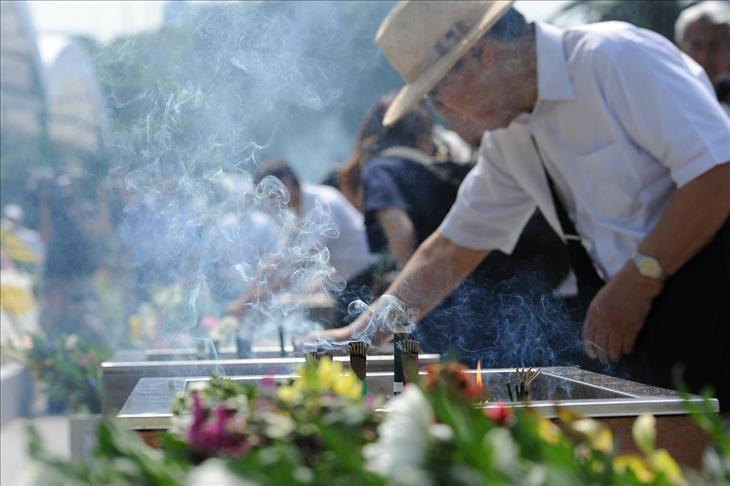
Japanese Prime Minister Shinzo Abe marked the 70th anniversary of the U.S. atomic bombing of Nagasaki by pledging Sunday that the country would lead in international nuclear disarmament efforts.
“Seventy years have passed since the atomic bomb dropped that day reduced Nagasaki to ashes, devoid even of any vegetation,” he said in his speech at a memorial ceremony in Nagasaki’s Peace Park.
“I have also renewed my determination for Japan, as the only country to have ever experienced the horror of nuclear devastation in war, to take the lead in the international community's nuclear disarmament efforts,” he added.
He underlined that the country’s "Three Non-Nuclear Principles" would be upheld while working toward “the realization of a world free of nuclear weapons.”
The anniversary comes amid public concerns that proposed security bills could lead to a shift in Japan’s post-World War II defense posture after Abe’s cabinet “re-interpreted” the pacifistic constitution last year to permit closer cooperation with allies like the U.S.
The legislation, which has led to widespread criticism and protests, is currently in parliament’s upper chamber after being pushed through the lower house last month by the ruling coalition.
Nagasaki Mayor Tomihisa Taue referred to the "widespread unease" over the recent developments in his Peace Declaration at Sunday’s ceremony, calling for "careful" deliberations on the bills.
"For the sake of Nagasaki, and for the sake of all of Japan, we must never change the peaceful principle that we renounce war," Kyodo News quoted him as saying.
He underlined that the pacifism of Japan’s post-war constitution had been a product of "painful and harsh experiences" of the atomic bombings and "reflection upon the war."
A "pledge for peace" was also presented by 86-year-old Sumiteru Taniguchi, whose back was severely burned in the bombing, with him criticizing the security legislation for running counter to survivors’ wishes.
"This security bill the government is pursuing will lead to war,” he said. “It is an attempt to overturn the nuclear abolition activities and wishes held and carried out by the hibakusha [survivors] and those multitudes of people who desire peace. We cannot accept this."
On Thursday, Hiroshima marked the 70th anniversary of the bombing of the city, the first to be subjected to the use of nuclear weapons.
Mayor Kazumi Matsui had urged world leaders to renew their resolve to abolish nuclear weapons, according to Kyodo.
After the memorial, representatives of local atomic bomb survivors' groups directly had called on Abe to retract the security bills.
"We want you to immediately withdraw the policy to allow the use of the right to collective self-defense, which would draw our people into war," one of the groups said in a statement.
Abe, however, insisted in a meeting with them that the legislation was essential to "preventing war," and assured that Japan’s "course as a peaceful state will never change."
The Aug. 6, 1945 bombing of Hiroshima left an estimated 140,000 people dead by the end of the year, while the atomic bomb dropped on Nagasaki three days later killed an estimated 74,000 people.
Japan surrendered six days after the bombing of Nagasaki.
On the anniversary of the surrender next week, Abe is set to deliver a speech amid demands by China and South Korea that Japan apologize for its past imperialist aggression.
Government sources cited by Kyodo have said that Abe will not visit the Yasukuni Shrine for Japan’s war dead on the Aug. 15 anniversary.
Japan’s neighbors view visits by officials to Yasukuni, where 14 of the war dead are war criminals convicted by the Allies in post-WWII trials, as a sign of Tokyo’s failure to atone. Conservative politicians in the country have been accused of repeatedly downgrading previous statements of apology.
Abe is however expected to send a ritual offering to the shrine.