TOKYO
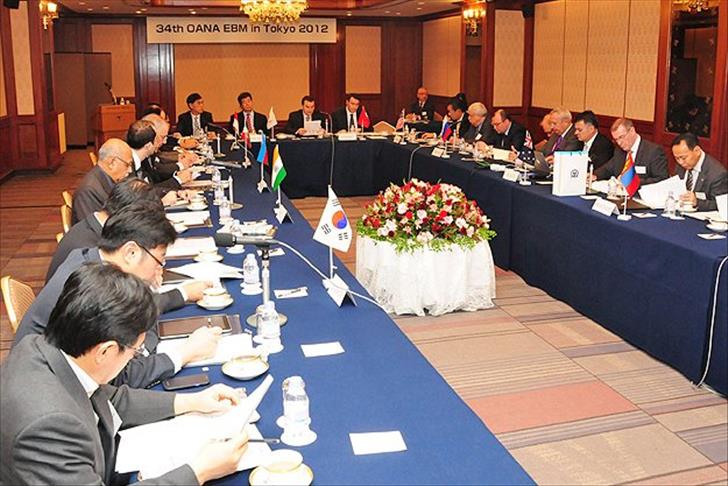
Board Chairman and Director General of The Anadolu Agency Kemal Ozturk addressed on Thursday the 34th edition of the executive board meeting of the Organization of Asia-Pacific News Agencies in Tokyo which was hosted by Japan's Kyodo News Agency.
"OANA has grown to become the largest regional news agency alliance in the world with 44 national news agencies in it. They share their top stories, pictures and video as well as knowledge and experience and deepen their cooperation," Ozturk told the the executive board meeting.
Ozturk said social media networks became more important with each passing day, adding that the Internet and social media could be used as "a supporter to be heard and seen all over the world."
"The big shift in the media industry does not mean the end for news agencies. Although social media is a great tool to gather and disseminate news, it has some innate problems. It's a minefield where there are a lot of hoaxes, fake identities, false stories, slanders, disinformation, unethical and graphic pictures of indecency. People hardly stick to media ethics and guidelines on social platforms. As news agencies we know our own strength that we still have a lot of influence and guiding power on the media in general," Ozturk said.
Ozturk warned that OANA members should remain alert to avoid broadcasting news and images that could shock people and lead them to feelings of hatred, hostility and discrimination against one another.
"I believe that OANA should have ethical guidelines. I am proud to submit the OANA Ethical Guidelines Declaration to your approval which we have agreed on as one of the most important milestones of our organization," Ozturk said.
Ozturk said the declaration would make sure that public could reach to accurate and reliable information as well as showing the will to uphold ethical values in media sector.
Ozturk expressed hope that the executive board meeting would be "a valuable asset to look forward to our certain goals as OANA."
Thursday's meeting also agreed to hold a technical committee meeting in Istanbul in April as well as discussed several issues such as the future of the news agencies, news sharing and cooperation.
The ethical guidelines proposed by Ozturk will be put to discussion in a General Assembly meeting of the OANA at the end of next year in Moscow.
The proposed Ethical Guidelines for OANA include the following principles:
1. To act responsibly in covering terrorism, acts of violence and natural disasters bearing in mind the public interest in full and accurate reporting, universal human rights, national security and public order;
2. to take great care about the quality and style of its stories that they do not encourage violence, spread fear, traumatise, damage the principles of equality and justice, degrade human dignity and foster discrimination;
3. To avoid publishing stories or visual material that will be deemed discriminatory on the basis of class, race, language, religion, gender, and region that will generate feelings of hostility among people and further incite them to violence and terror.
4. To accept the sanctity of human life and to avoid running pictures or video footage that will hurt the dignity of victims and cause further suffering to their families;
5. To respect - in covering wars, conflicts, terrorism and disasters - the privacy and dignity of the dead regardless of who they are;
6. To avoid publishing graphic pictures and video of executions, killing of people and transmitting close-up shots of dead or wounded and mutilated bodies, limbs degrading human dignity and causing psychological distress in public.
The executive board meeting in Tokyo also agreed to add an extra principle to make sure journalists who had not undergone war-journalism training will not be assigned to duties in war zones.