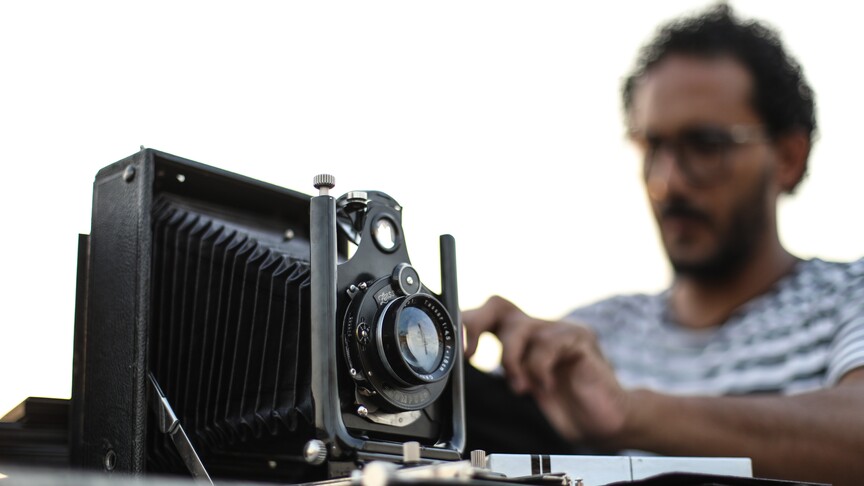
Surrounded by photographers carrying some of the world’s most advanced digital equipment, Egyptian photojournalist Fareed Kotb stood out at the 2026 FIFA World Cup with a camera that belonged to a very different era.
Kotb documented the tournament using a nearly 96-year-old Zeiss Ikon Ideal 250/11 folding camera, manufactured in 1930, the same year the inaugural World Cup was held in Uruguay.
His experiment, which he named Project 1930, attracted considerable attention at stadiums during the month-long tournament co-hosted by the US, Canada and Mexico.
“My goal was not simply to use an old camera,” Kotb told Anadolu.
“I wanted to recreate the experience of photography in its early years and connect the first World Cup with the latest edition through a piece of equipment produced during the same period.”
Kotb has worked as a photographer for the Confederation of African Football since 2019 and previously covered the 2018 World Cup in Russia, the 2022 World Cup in Qatar and the Olympic Games.
But for his third World Cup, he wanted to approach the assignment differently.
His search for a working 1930 camera lasted an entire year.
“I eventually found a professional camera,” he said. “Then I began researching how to operate it.”
-Bringing a historic camera back to life
Finding the camera was only the beginning. Its original system recorded images on glass plates, meaning Kotb had to adapt it to use negative film.
“Thankfully, I succeeded,” he said.
He first used the restored camera at the Portugal-Croatia match in Canada and later at the Colombia-Switzerland game.
The unusual sight of a photographer operating a large folding camera beneath a black focusing cloth quickly drew interest from spectators, officials and other members of the media.
Kotb said he developed a strong personal attachment to the camera during the project.
“I feel that it has become a part of me and that there is a strong harmony between us,” he said.
“When I travel with it, I feel as though I am taking my young son out to see the world. It had been shut away for such a long time.”
The experience also transported him beyond the atmosphere of a modern sporting event.
“When I look at my camera during a match, I feel happy. It is as though I have arrived from another time,” Kotb said.
“It is almost as if the camera suddenly finds itself surrounded by modern technology and looks around in astonishment.”
One minute for a single photograph
The greatest difference between Kotb’s antique camera and the digital equipment used by most sports photographers is speed.
Modern cameras can capture decisive moments in a fraction of a second and produce rapid sequences of images with one press of the shutter.
Kotb’s process took approximately one minute for every photograph.
“First, I open the camera and the image appears upside down,” he explained.
“I then compose the frame and place a black cloth over my head so I can see the image more clearly. After that, I insert the film and switch the camera from viewing mode to shooting mode. The entire process takes about a minute for a single photograph.”
That slow and deliberate method transformed the way he covered a football match.
Unlike photographers using lightweight digital cameras, Kotb could not immediately turn his lens toward a player or follow the ball as it moved across the pitch.
Instead, he had to choose a particular part of the field, prepare the camera and wait for the action to come to him.
“I select a specific area of the pitch and wait to see what happens there,” he said.
“It may be a corner kick or an attacking move in front of the goal. It was a major challenge for me, but thankfully, I eventually achieved good results.”
The restrictions required patience, anticipation and an understanding of how a match might unfold. Every frame had to be considered carefully because there was little room for correction once the moment had passed.
Connecting two eras of football
For Kotb, the project was not an attempt to suggest that old equipment could replace modern sports photography. Instead, it was designed to examine what remains essential to a strong photograph, regardless of the technology used to create it.
“This project was an experiment intended to show that the value of a powerful photograph is not determined solely by technological development,” he said.
“It is also determined by the idea, the patience involved and the photographer’s way of seeing.”
After each match, the negatives were sent to specialists for development. The completed photographs were then scanned so they could be digitized and shared with a modern audience.
The process brought together two periods separated by nearly a century: the black-and-white photographic era surrounding the first World Cup in 1930 and the highly digitized environment of the 2026 tournament.
Amid high-speed cameras capable of producing thousands of images during a single match, Kotb’s folding camera offered only a limited number of carefully planned frames.
Yet that contrast was precisely the purpose of Project 1930: to revisit the patience and uncertainty of early photography while documenting the world’s biggest football tournament with a camera dating back to the year it began.