By Hajer M'tiri
PARIS
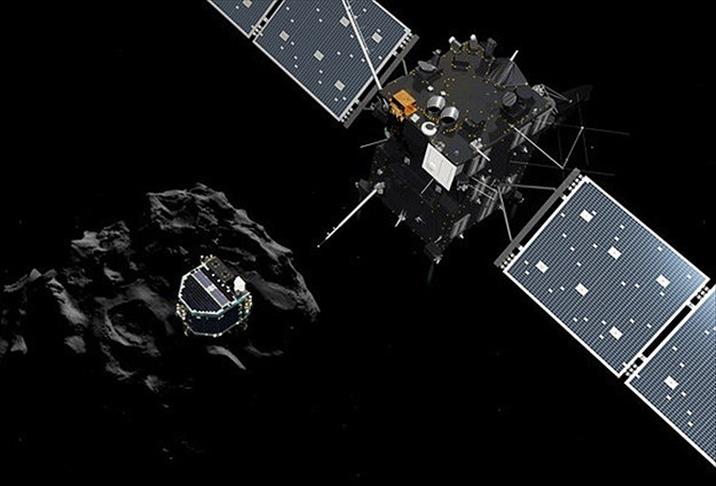
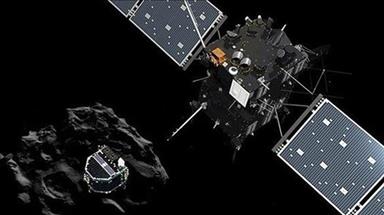
After its historic landing on the comet 67P, robot probe Philae went down in the early hours on Saturday, officials said.
The robot probe's core battery died, and its solar batteries couldn't be re-charged, the French National Center for Space Studies announced.
"Loss of signal. No more communication with Philae 2014. All science data successfully downloaded," said the European Space Agency, on its official twitter account.
Philae managed to operate for 57 hours on the comet before losing power as a result of its solar panels not getting enough light, the agency said.
However it "completed its primary science mission before hibernation," the agency said in a press release.
"Prior to falling silent, the lander was able to transmit all the scientific data demanded by the mission," says Stephan Ulamec, Philae lander manager at the German aerospace agency.
"This machine performed magnificently under tough conditions, and we can be very proud of the incredible scientific success Philae has delivered," he added.
The agency reported that Philae lost its communication with the lander as it lost power, yet the lander was able to send all the data gathered since it landed on Comet 67P/Churyumov-Gerasimenkoduring on Wednesday.
The probe kept sending data and pictures until 1:36 a.m. Central European Time (00:36GMT) on Saturday.
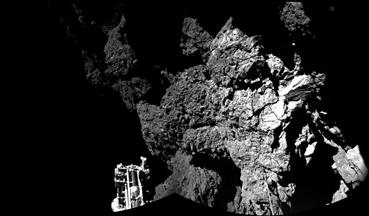
The photos sent by Philae show that the surface of the comet is covered by dust and debris that is up to a meter in size, and the panoramic images showed layered walls of harder-looking material.
The science teams are now studying their data to see if they have sampled any of this material with Philae’s drill and to to try to identify the probe's exact position on the comet.
With its batteries depleted and not enough sunlight available to recharge, Philae has fallen into "idle mode" for a potentially permanent silence.
'It's not over yet'
In this mode, all instruments and most systems on board are shut down, the agency says.
Philae's main battery is drained and it was unable to recharge its solar batteries, once the probe got stuck in shadow of a cliff where it gets sunlight for only three hours a day. The lander requires a recharging period of up to seven hours.
The lander's original battery life was 60 hours. Once it ran out, the solar batteries were supposed to take over and allow Philae to keep functioning for months.
"So much hard work...getting tired... my battery voltage is approaching the limit soon now," tweeted Philae.
However the lander managed to turn itself around, and to continue sending data to his mothership Rosetta, until the power ran out.
"Thank you, Rosetta! I did it! I became the first spacecraft to land on a comet and study it! But it’s not over yet…," tweeted Philae as he used up all his power.
"We are happy," Ulamec said. "We even can watch it falling asleep, which is a little bit sad, but it has given us data that we want to have."
The sun will rise on Philae at about 6:00 a.m. Central European time (05:-00GMT). However, Ulamec said that even if the solar panel is in a better position, "it's quite possible that Philae won't wake up, but could recharge over days, wake later."
The next possible communication slot begins on Nov. 15.
According to the agency, the lander might reawaken when there is more light for its solar panels, possibly around the time when the comet approaches the Sun. The closest approach is next August.
"My life on a comet has just begun, Rosetta. I'll tell you more about my new home, comet #67P soon… zzzzz ...," was the last tweet sent by the lander robot.
"It has been a huge success, the whole team is delighted," added Ulamec.
'Hello world'
The Rosetta probe was launched on March 2, 2004, from Kourou in the French Guiana, and covered a distance of approximately 3.7 billion miles (six billion kilometers).
It chased Comet 67P/Churyumov-Gerasimenko around the solar system before finally reaching the giant lump of ice and dust on August 6
The spacecraft famously "woke up" in January after a 31-month-long hibernation period to save energy, tweeting: "Hello World."
Matt Taylor, Rosetta project scientist, said: "Rosetta is trying to answer the very big questions about the history of our Solar System. What were the conditions like at its infancy and how did it evolve? What role did comets play in this evolution? How do comets work?"
The mission is scheduled to end in December 2015, when the comet heads out of the inner Solar System.
The comet will reach its closest distance to the Sun on August 13, 2015, at about 185 million kilometers (114.9 million miles), and between the orbits of Earth and Mars.
Rosetta will follow it throughout the remainder of 2015, as it heads away from the sun and its activity nears an end, according to the agency.
"The data collected by Philae and Rosetta is set to make this mission a game-changer in cometary science," said Taylor.
Rosetta is the first spacecraft to rendezvous with and orbit a comet and has already returned critical scientific data.
The probe is named after the Rosetta stone, an Egyptian historic monument engraved in three languages, and the probe is named after Philae, an island in Lake Nasser, Egypt.
www.aa.com.tr/en