CAIRO
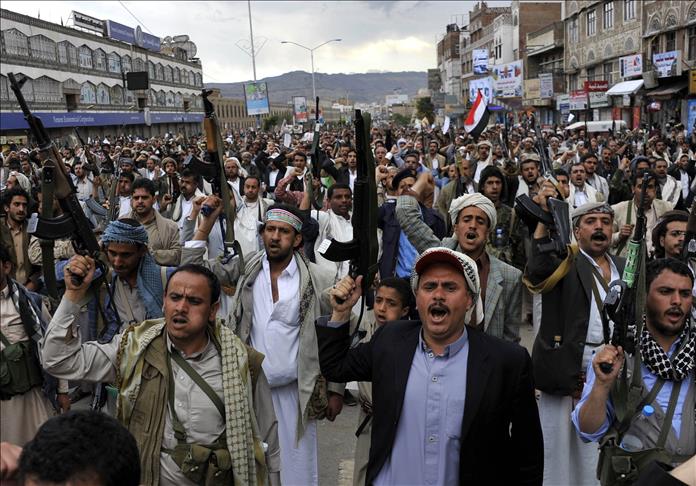
Despite its abrupt launch early Thursday, the Saudi-led military campaign against Yemen's Houthi militant group appears to be the product of several factors that raised alarm bells in the Gulf over the Shiite group's meteoric rise.
On Wednesday night, Saudi Arabia and several Arab states launched a string of airstrikes on Houthi positions in Sanaa and other parts of Yemen.
The move followed a Houthi advance on Aden, where the embattled president, Abd Rabbuh Mansour Hadi, had fled after the Houthis took over government institutions in Sanaa last month.
The Anadolu Agency has observed seven main developments in recent months that appear to have culminated in the Saudi-led campaign.
Political deadlock
The Houthis rallied against a 2011 Gulf initiative for Yemen, by which Yemen's autocratic president, Ali Abdullah Saleh, was removed and replaced by Hadi.
Last September, the Shiite group seized key government institutions in Sanaa, irking Hadi's government and the new president's Gulf backers.
The Houthis then consolidated their grip on power in late February, issuing a constitutional declaration dissolving parliament and establishing a new "transitional council."
The declaration, however, was rejected by most of Yemen's political forces – along with some neighboring Gulf countries – who described the move as a "coup against constitutional legitimacy."
Fearing Daesh
Al-Qaeda's Yemen affiliate stepped up its militant activity in the wake of the 2011 popular uprising that led to Saleh's ouster the following year.
Attacks by Al-Qaeda, whose focus had shifted towards Yemen's southern provinces, raised fears that the militant group – against which the Houthis had fought for control of the south – could provide Daesh militants with a safe haven in Yemen.
Fearing US-Iran accord
The Gulf States were also vexed by a series of moves by Washington, their longtime ally, to warm up to Shiite Iran, their regional nemesis.
Washington has expressed a desire to reach agreement with Tehran over the latter's nuclear program.
Moreover, earlier this year, the U.S. Central Intelligence Agency (CIA) removed Iran – and its ally, Lebanon's Hezbollah – from its list of "terrorism threats."
Houthi-Iran axis
There was a marked increase in the number of Houthi delegations visiting Iran after direct flights were introduced between Sanaa and Tehran late last month.
In late February, the Houthis signed a memorandum of understanding with Tehran by which 28 direct flights between the two capitals would be operated each week.
Some observers have voiced fears that the flights could be used to transfer arms from Iran to the Houthis.
Houthi war games
Earlier this month, the Houthis conducted military exercises in a Yemeni town on the Saudi border.
The Houthis, who accuse Riyadh of funding their opponents inside Yemen, said that the exercises were intended to "send a message to whoever tries to meddle with Yemen's security."
The six-nation Gulf Cooperation Council responded by asserting that the Houthi influence in Yemen had come to represent a "full-fledged threat to regional and international security."
Houthi advance
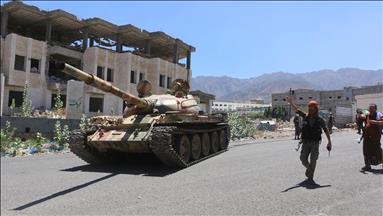
On March 19, pro-Houthi forces struck Hadi's headquarters in Aden and seized several parts of the southern port city, tightening the noose around Hadi and his Gulf supporters who had relocated their respective embassies there.
Hours before the announcement of the anti-Houthi campaign, Saudi Defense Minister Mohamed bin Salman said he had warned former president Saleh – thought to be allied with the Houthis – against any attempt to take Aden.
Threatening House of Saud
Earlier this week, Houthi leader Mohamed al-Bekheiti explicitly warned: "The regime of the House of Saud will be brought down if Riyadh carries out any attacks on Yemeni territory."
Al-Bekheiti's statements were viewed as a marked escalation in the ongoing war of words between the Iran-backed Houthis and the Gulf powers.
On Tuesday, Saudi Arabia deployed troops along its border with Yemen – as the Houthis advanced in force on Aden – before announcing the military campaign late Wednesday night.
The following morning, five Gulf States – Saudi Arabia, the United Arab Emirates, Bahrain, Qatar and Kuwait – said the campaign had come "in response to a request by President Hadi to protect Yemen from the aggression of Houthi militias."
The statement went on to accuse the Houthis of being "the tool of foreign powers who seek to harm Yemen's security and stability."
Egypt and Pakistan, too, have signaled their readiness to contribute ground forces to the campaign.
The United States, for its part, has offered logistical and intelligence support for the ongoing anti-Houthi offensive.