BRASILIA, Brazil
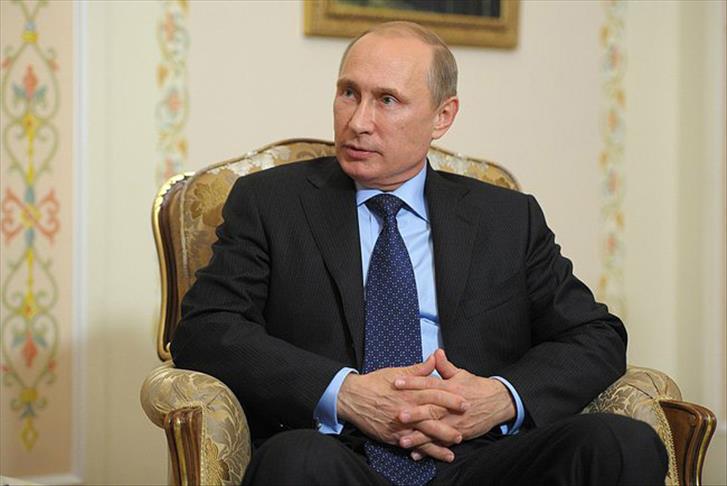
Russian President Vladimir Putin has met South American leaders at the sixth BRICS summit in Brasilia to flex his geopolitical muscle and take steps to build new alliances in the region following his diplomatic break with the US and Europe over Ukraine.
Since Russia was expelled from the G-8 grouping in March after annexing Crimea, Putin has made a series of geopolitically charged overtures to South America.
Carlo Gallo, director of analysis firm Enquirisk, told Anadolu Agency on Wednesday: “Russia is seeking to sell mostly weapons and to strike partnerships in energy in South America and elsewhere.
“Some of this makes commercial sense, some is arguably mostly geopolitical-alliance building - for example, relations with Venezuela and Cuba - to annoy the US.”
Brazilian President Dilma Rousseff invited South America’s 11 heads of state to the third day of the VI BRICS Summit, as well as the five leaders of Brazil, Russia, India, China and South Africa.
During the first two days of the summit, in the north-eastern Brazilian city of Fortaleza, BRICS leaders agreed on the details of a new $100 billion BRICS development bank and a $100 billion currency reserve fund, to act as counterweights to western-led institutions the International Monetary Fund and World Bank.
- 'Uncomfortable' US
Putin has ramped up joint military exercises with Venezuela, and earlier this month he wrote off most of Cuba’s debt and promised to help the small Caribbean state surmount its longstanding US trade blockade.
Putin and Cuban leader Rául Castro inked energy deals and Putin said Russia would look into installing stations for its GLONASS satellite navigations system in the island state.
As signals go, this is a strong one: Russian defense communications equipment based on Cuba, a potent historical symbol of the Cold War and just 145 km from US mainland, will make the US very uncomfortable.
A few days later, Putin turned his attention to Europe.
At a dinner with Argentinian President Cristina Fernandez de Kirchner, he criticized Britain’s role in the long-running Falkland Islands dispute, alluding to “double discourse” in international affairs.
Kirchner had previously accused Britain of hypocrisy over its criticism of Crimea’s vote to secede from Ukraine.
- Tacit support
Last year, Britain argued that a referendum in which Falkland residents voted to remain British vindicated its long rule over the distant archipelago.
Putin has been well received in South America, most recently agreeing to cooperate with Brazil on defense systems and nuclear power, and signing health, technological and economic deals.
Despite its diplomatic repercussions in Europe and the US, Putin’s BRICS allies gave tacit support to his annexation of Crimea, rejecting Western sanctions of Russia.
With Putin benefitting from residual anti-Americanism in some quarters of South America, and from a more relaxed attitude towards borders than that of Europe, the issue is unlikely to cause friction, said Alexander Baunov, an expert on Russian-South American relations and editor of Slon.ru.
“Even if questions are raised over the recent annexing of Crimea from Ukraine, [Putin] will frame it such a way to show that Russian influence was merely ejecting an unwanted American advancement into Ukraine,” Baunov told AA, referring to the 2004 Orange Revolution protests that helped bring pro-Western President Viktor Yushchenko to power.
“[Putin] is keen to have friends who are less concerned by changing borders – something that is sacrosanct and unalienable in Europe,” Baunov added.
- Poor relations
Baunov added that while overtures to Cuba were a "slap in the face to the US", he did not believe Putin’s meetings with more important leaders, Rousseff and Kirchner, could seriously worsen already chilly US-Russia relations.
“Meetings with leaders such as Rousseff and Kirchner, which are deemed far more respectable by the US, are unlikely to make relations worse than they currently are,” Baunov said.
Ahead of his visit to South America, Putin spoke warmly of summit-host Brazil, alluding to its role in an evolving global balance that rejected Western economic and geopolitical dominance.
"This powerful and fast-developing country is destined to play an important role in the emerging poly-centric world order," he told the ITAR-tass news agency.
The creation of the BRICS New Development Bank, with $100 billion subscribed capital and a currency reserve fund of $100 billion, has been widely interpreted as an alternative for developing countries to US-based Bretton Woods institutions like the International Monetary Fund and the World Bank.
- Brazil's choice
Some experts also see geopolitical maneuvering in Brazil’s decision to invite all South American leaders to the third day of the summit.
Oliver Stuenkel, who focuses on emerging powers as assistant professor of International Relations at the Getúlio Vargas Foundation, recently called it “a shrewd attempt to position itself as the region's leader and representative”.
Even so, Stuenkel does not see, in Brazil’s embrace of South American leadership and lean toward the BRICS, a necessary shift away from the US.
He wrote: “For Brazil, the BRICS platform is a useful way to facilitate the diversification of its partnerships and to adapt to a more multipolar global order.
“Brazil no longer needs to choose between leaning more towards the United States or the developing world - it must have strong ties to both established and emerging powers alike."
news_share_descriptionsubscription_contact