By Ilgin Karlidag
BRUSSELS
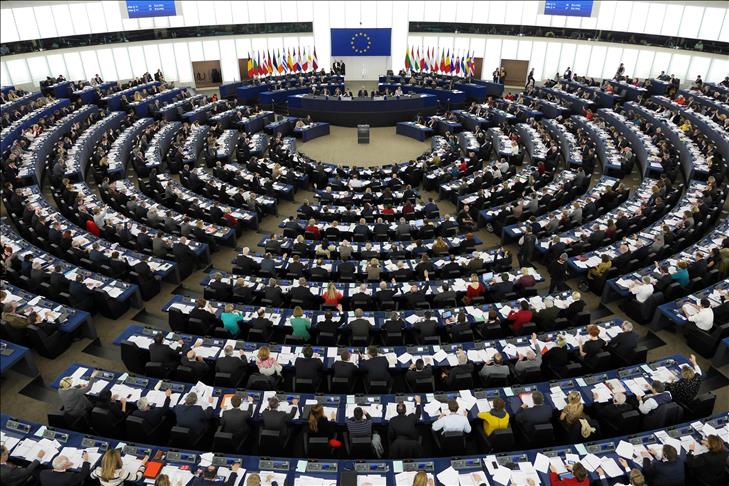
The European Parliament has been criticized for refusing to hold a photo exhibition that shows victims allegedly tortured by the Bashar al-Assad regime in Syria.
The College of Quaestors, a five-member European Parliament body, had unanimously voted on June 9 against exhibiting the photos because they were deemed as "too disturbing".
But Alyn Smith, Member of the European Parliament for the Greens and the European Free Alliance, told Anadolu Agency that he would appeal the decision to European Parliament President Martin Schulz.
"The photos are absolutely very very difficult to see, they are real evidence of what has been happening within Syria," Smith said.
"I think it’s important to ask people dealing with Syria that we do not close our eyes to the realities of that is happening," he said.
He added that the parliamentarians who ruled against the exhibition were "overcautious and shying away from controversy."
According to diplomatic sources, organizers had offered to remove the most graphic photos, but still the College of Quaestors refused to hold the exhibition.
Catherine Bearder, Member of the European Parliament for the Liberals and Democrats of Europe, the Qaestor in charge of exhibitions, told Anadolu Agency in a written statement: "[we] unanimously decided that these photos were too disturbing to be displayed in a public place where they could be inadvertently viewed by passers-by, including children."
"The public areas of the parliament are open to many visitors and it would be impossible to warn them of the graphic nature of these photographs," Bearder said.
"The MEPs arranging the exhibition have instead been advised to use a committee room where the pictures will be publicly available to those who wish to view them," she said.
However, Mouaffaq Nyrabia, Syrian National Coalition's Representative to the Benelux and EU, urged the European Parliament to exhibit the photos to document and not ignore the war crimes committed allegedly by the Assad regime.
"The series of photographs taken by the Syrian regime defector 'Caesar' present clear and compelling evidence - endorsed by the UN - of Assad's systematic campaign of murder and torture, and are important testimony to the suffering of Syrians at the hands of this brutal dictatorship," Nyrabia said in a written statement to Anadolu Agency.
"The situation in Syria is now a global crisis whose impact upon Europe has repeatedly been made clear," he said.
"Europe can and must play a more proactive role in achieving a political transition in Syria, and accountability must be central to these efforts," Nyrabia added.
In January 2014, a team of six forensic experts, led by Desmond Lorenz de Silva, the former United Nations Chief War Crimes Prosecutor in Sierra Leone, concluded in a report that the photos, leaked by an alleged Syrian defector with the code name "Caesar" were "direct evidence" of torture by the Assad regime.
The code name was given on the pretext of protecting the identity of the source, who reportedly smuggled the pictures on a memory stick during his time when he worked with the regime’s military police.
The United Nations in March exhibited 30 photographs out of around 55,000 released by Caesar.
More than 210,000 people have been killed in the Syria civil war, prompting a refugee crisis, which has made Turkey the world's largest refugee-hosting country with up to million Syrian refugees.