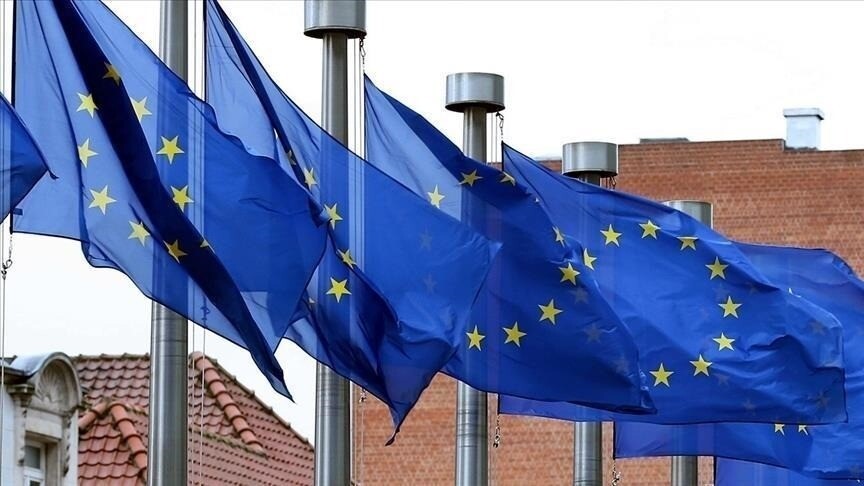
Several European leaders on Wednesday welcomed the newly announced two-week ceasefire between the US and Iran.
"The U.S.–Iran agreement on a ceasefire is a step back from the brink after weeks of escalation," EU foreign policy chief Kaja Kallas wrote on the US social media platform X.
She noted that the ceasefire creates a "much-needed chance to tone down threats, stop missiles, restart shipping, and create space for diplomacy towards a lasting agreement."
She also thanked Pakistani Foreign Minister Ishaq Dar for mediation efforts.
"The door to mediation must remain open, as the underlying causes of the war remain unresolved. The EU stands ready to support those efforts and is in touch with partners in the region," Kallas added.
European Commission President Ursula von der Leyen also welcomed the ceasefire and thanked Pakistan.
"It brings much-needed de-escalation. (...) Now it is crucial that negotiations for an enduring solution to this conflict continue. We will continue coordinating with our partners to this end," she wrote on X.
European Council President Antonio Costa also applauded the agreement, urging all parties to respect its terms, stating on X that he welcomed the two-week ceasefire and that the EU stands ready to support ongoing efforts while thanking Pakistan and other mediators.
Sweden’s Foreign Minister Maria Malmer Stenergard welcomed the ceasefire, saying on the same social media platform that all parties must exercise restraint to protect regional security and global supply chains and civilians and work toward a long-term solution.
- 'Very good thing'
French President Emmanuel Macron also welcomed the ceasefire as a "very good thing."
"It is indeed through negotiation that we can provide the security guarantees necessary for stability across the entire region," he said ahead of a defense council.
He reiterated the need to fully uphold commitments made on the ground in the days ahead.
Macron highlighted that Lebanon's inclusion in the ceasefire is also critical, warning that the situation remains critical.
"Hezbollah made a strategic mistake by attacking Israel and drawing Lebanon into the regional crisis. However, what we are witnessing today – both the strikes and the occupation of southern Lebanon by Israel – cannot be a sustainable response," he added.
French Prime Minister Sebastien Lecornu said the ceasefire "goes in the right direction" but stressed that its implementation over time remains key.
"The issue is its respect, its respect over time, and that this time is used to achieve a much more lasting resolution to the crisis," he said, warning that reopening the Strait of Hormuz and ensuring freedom of navigation would be critical in the coming days.
German Chancellor Friedrich Merz also welcomed the ceasefire, stressing that the aim is now to negotiate a lasting end to the war.
"I welcome the ceasefire agreement reached overnight, which will bring a moment of relief to the region and the world. Together with our partners we must do all we can to support and sustain this ceasefire, turn it into a lasting agreement and re-open the Strait of Hormuz," British Prime Minister Keir Starmer said on X.
Media reports later revealed, citing his office, that Starmer will travel to the Gulf countries to meet regional leaders and show his support for the ceasefire.
"Ceasefires are always good news. Especially if they lead to a just and lasting peace. But this momentary relief cannot make us forget the chaos, the destruction, and the lives lost," Spanish Prime Minister Pedro Sanchez also wrote on X.
He, however, refused to applaud "those who set the world on fire just because they show up with a bucket."
"What’s needed now: diplomacy, international legality, and PEACE," Sanchez added.
- Support for efforts to end war
Norwegian Foreign Minister Espen Barth Eide said the ceasefire gives diplomacy a chance, "at a moment when the world stood on the brink of a dangerous escalation."
He thanked Pakistan, Türkiye, and Egypt for their efforts for dialogue.
Irish Justice Minister Helen McEntee said the ceasefire marks "a potentially important turning point" after the recent escalation.
"This offers a critical opportunity to reduce tensions and will bring relief to millions affected by conflict," she said in a statement, calling for a comprehensive ceasefire including Lebanon and urging all parties to uphold international law.
"We continue to support all the efforts to end the war and to build this ceasefire into a more permanent arrangement in the Strait of Hormuz and in the whole Middle East," Finnish President Alexander Stubb also wrote on X.
Portugal's Foreign Ministry called the ceasefire "a decisive first step toward a lasting and sustainable diplomatic solution to the conflict." It voiced support for a diplomatic path.
"Latvia welcomes the ceasefire agreement reached by the US and Iran last night. Its implementation is key to achieving long-lasting peace in the region," Latvian Prime Minister Evika Silina also stated on X.
US President Donald Trump announced Tuesday that he agreed "to suspend the bombing and attack of Iran for a period of two weeks."
Pakistani Prime Minister Shehbaz Sharif, who played a key role in brokering the ceasefire, announced on X that he invited Iranian and US delegations to Islamabad on Friday and said Washington and Tehran, along with their allies, have agreed to an immediate ceasefire across all conflict zones, including Lebanon.
Regional tensions escalated since the US and Israel launched a joint offensive against Iran on Feb. 28, killing more than 1,400 people to date, including then-Supreme Leader Ayatollah Ali Khamenei.
Iran retaliated with drone and missile strikes targeting Israel as well as Jordan, Iraq, and Gulf countries hosting US military assets. It has also restricted the movement of ships through the Strait of Hormuz.