Screenwriter and director Omer Yildirim said the research and preparation process for his award-winning short film Silent Plan gave him a deeper understanding of the deaf community and became a major source of motivation during production.
The Turkish short film centers on four deaf youths chosen to participate in an experimental program that promises to let them hear for the first time. After spending years preserving recordings of their loved ones’ voices in anticipation of that moment, they are unexpectedly excluded from the project, pushing them into an emotional struggle over loss, identity, and belonging.
“I sat down with deaf people and tried to communicate with them, and there were so many things I did not know. That constantly motivated me,” Yildirim told Anadolu.
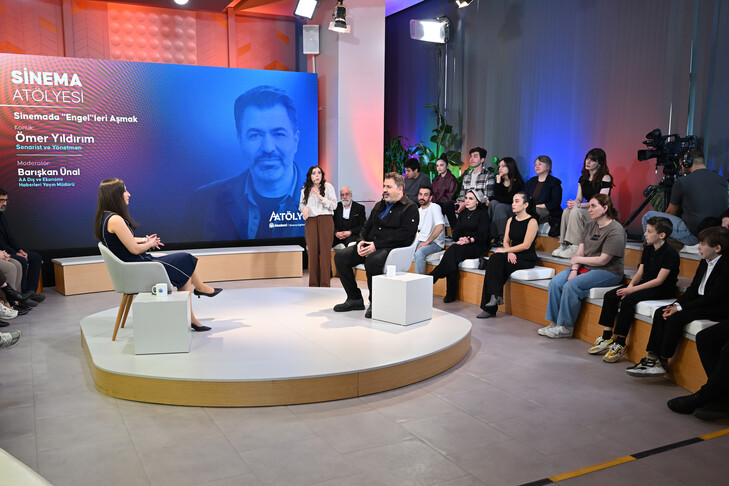
Yildirim attended the Cinema Workshop titled “Overcoming ‘Barriers’ in Cinema,” organized by Anadolu Academy at Anadolu’s Istanbul International News Center, where behind-the-scenes footage from the film was screened.
Anadolu’s Foreign and Economy News Publishing Manager Bariskan Unal also spoke at the event and shared details about Anadolu’s Eller Konusur (Hands Speak) project, which aims to provide hearing-impaired individuals with fast and accessible news coverage.
Unal stressed the importance of films centered on deaf and disabled individuals and praised the film’s natural portrayal of deaf characters.
“What I liked about your film was that although deaf individuals played the leading roles and the subject was related to hearing, it did not feel like a ‘disability.’ It felt like a natural part of the film’s flow,” she said.
‘I wanted young deaf people to be the lead characters’
Yildirim said he did not personally know any deaf individuals before writing the screenplay.
“When writing a story, it never occurred to me to distinguish between tall, short, elderly, children, blind or deaf people. I simply said: ‘I will make a film and deaf young people will be the lead characters,’” he said.
The director said he initially used the term “disabled” frequently in the script before learning from members of the deaf community that the term could be uncomfortable.
“We were warned that the term should not actually be used. While trying to sound polite, I learned how disturbing that expression could be. We then changed the script and understood that we should specifically use the word ‘deaf,’” he said.
Yildirim said the screenplay evolved significantly after consultations with deaf participants.
“I sat down with deaf people and tried to communicate with them. There were so many things I did not know, and that kept motivating me. The script went through many stages and changed a lot before reaching its final form,” he added.
‘A story everyone can experience equally’
Yildirim said one of the film’s central ideas emerged from a line spoken by a character played by actor Muslum Tamer.
“In the film, he is asked: ‘Are you promising people the ability to hear with a device, or a lifetime of dependence on a device?’ He says no and reminds us that all of us communicate through devices in one way or another,” Yildirim said.
“We talk on phones and use microphones and speakers to make ourselves heard. That became a powerful starting point for me. I realized that, in a sense, we all hear through devices, and there is an equality in that,” he added.
Yildirim said another key question behind the story was: “If all sounds disappeared one day, which sound would you miss the most?”
“The idea of four young deaf people preserving the voices of their loved ones was born from that question. The foundation of the film rests on these two ideas,” he said.
“Our main motivation was to tell a story that everyone could experience under equal conditions. Deaf actors appear in 60% of the film and subtitles are used during those scenes. This allows audiences anywhere in the world to experience the film under the same conditions,” he added.
Yildirim also said certain filming techniques had to be adjusted during production to accommodate sign language communication.
“When communicating with our deaf friends, we had to position our camera framing accordingly. While we initially thought of close-up shots, we realized we needed to carefully select compositions because they communicate through their hands,” he said.
‘The text must be simple and clear’
Anadolu’s Discrimination Line Director Tufan Aktas also discussed the importance of language in sign-language journalism and shared details about the Eller Konusur project.
Aktas said inverted sentence structures and overly complex wording should be avoided in content prepared for deaf audiences.
“The text has to be so simple and clear that it can be translated quickly and fluently. When we use inverted sentences or complicated expressions, confusion occurs,” he said.
He noted that some words can also create confusion among deaf audiences because of differing interpretations.
Aktas said Anadolu’s sign-language news initiative mirrors the role the agency has historically played in Turkish journalism.
“When a new foreign term enters the language, Anadolu’s editorial team creates a Turkish equivalent and then other media outlets begin using it. We have now taken on a similar role in sign language,” he said.
He added that the project could help establish standardized sign-language equivalents for words and contribute to a broader sign-language ecosystem through documentaries, long-form videos and academic engagement.
The workshop, which was simultaneously translated into sign language, also featured members of the film’s cast and crew discussing their experiences during production.