- Nearly 19 million voters will head to the polls on Thursday in Nepal’s first election since last year’s mass protests
KATHMANDU, Nepal
In Nepal’s far northern district of Humla, exercising one’s right to vote can mean days of travel through snow-covered mountain passes.
This week, a group of residents from the high-altitude village of Limi returned home days ahead of Nepal’s parliamentary election, clearing snow from recently opened tracks to ensure villagers could reach their polling stations.
The group, led by Paljor Tamang, had landed at the small mountain airport in Simkot after flying from Kathmandu via Nepalgunj, a regional hub in western Nepal. From there, the journey was only halfway complete.
After arriving in Simkot, the group spent four days acclimatizing to the high altitude before beginning the final leg of the trip. Winter snow had yet to melt, and recently opened vehicle tracks remained impassable. To reach Limi, they arranged an excavator to clear snow along the route.
“We returned home early to vote,” Tamang, ward chairperson of Limi, told Anadolu by phone. “The snow that piled up in the winter hasn’t yet melted. So, we moved ahead by clearing snow with excavators.”
Voting means returning home
Every winter, residents of Limi – located at an altitude of about 3,700 meters (over 12,100 feet) near the Chinese border – descend to lower elevations to escape extreme cold. The village remains snowbound and inaccessible for months, and most residents do not return until late March.
This year would have been no different had elections not been announced.
Nepal’s electoral law does not allow out-of-district or overseas voting. Citizens must cast their ballots in the constituency where they are registered – often their ancestral village.
That requirement disproportionately affects residents of mountain districts such as Humla, Mugu, Dolpo, Mustang and Manang, which together make up about 18% of Nepal’s territory.
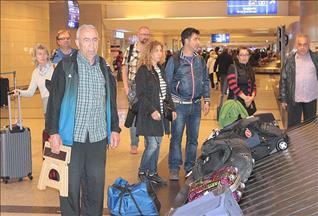
As a result, thousands of migrants from Nepal’s trans-Himalayan districts are now rushing home weeks earlier than planned to vote in parliamentary elections scheduled for March 5 – the first national polls since mass youth-led protests shook the country last September.
The burden falls heaviest on mountain communities, where voters must spend more time and money, and sometimes risk their lives, to exercise their democratic rights.
Wealthier voters charter helicopters. Others fly to the nearest airstrip and walk from the last bus stop.
“Local leaders and campaigners are arriving first and clearing the way, so other voters can also return in time,” said Narjan Tamang, a Humla resident. “Other villagers are also returning on small planes as the road connections are unreliable and it takes several days to get here from Kathmandu.”
Logistical rush
On Thursday, about 18.9 million registered voters are expected to elect a 275-member parliament, paving the way for the selection of a new prime minister.
Election officials say preparations are complete. Poll officers have reached even the most remote stations, ballot boxes and papers have been delivered, and security forces are deployed nationwide.
“Under our existing election rules, voters have to be at the polling station of their home constituency, so you can see a massive flow of people moving from one place to another,” said Narayan Prasad Bhattarai, a spokesperson for Nepal’s Election Commission.
Observers, however, say the rushed election has come at a cost. Nepal has again failed to introduce long-promised diaspora and out-of-district voting, leaving millions effectively excluded.
“An estimated 2 million voters live outside of their birthplaces. They either have to reach their home villages or be deprived of their voting rights,” Gopal Krishna Siwakoti, president of the National Election Observation Committee, told Anadolu.
For voters from districts like Humla, the cost of returning home is at least 100,000 Nepalese rupees ($648), he added.
“About 6 million eligible voters won’t be able to vote again,” said Siwakoti.
Old guard vs new forces
Nepal, a Himalayan nation of about 30 million people, was rocked by political turmoil in September 2025, when Gen Z-led protests forced then-Prime Minister K P Oli to resign. More than 70 people were killed in clashes involving police gunfire and arson attacks targeting government buildings, party offices and businesses.
This election is widely seen as a contest between Nepal’s established political parties and newly emerging forces born out of public anger over governance failures.
The Rastriya Swatantra Party (RSP), a key new political force, has fielded former Kathmandu Mayor Balendra Shah – widely known as Balen – as its prime ministerial candidate. The 35-year-old structural engineer and rapper has drawn large crowds during nationwide campaigning.
The Nepali Congress has proposed Gagan Thapa, 49, while former Prime Minister Oli, 74, is also seeking a return to power. Both Oli and Shah are contesting from the same constituency in eastern Jhapa.
In Humla, 26-year-old Tashi Lhajom is challenging candidates from established parties.
Campaigning has been aggressive, with parties trading accusations and social media flooded with hostile messaging.
Analysts caution that Nepal’s complex electoral system could again produce a fragmented parliament.
“Unless there’s a political tsunami, we’re headed toward a hung parliament, which will lead us back to instability,” said Siwakoti. “We will be back to square one.”
But in villages like Limi, participation comes before prediction – even if that means clearing snow first.