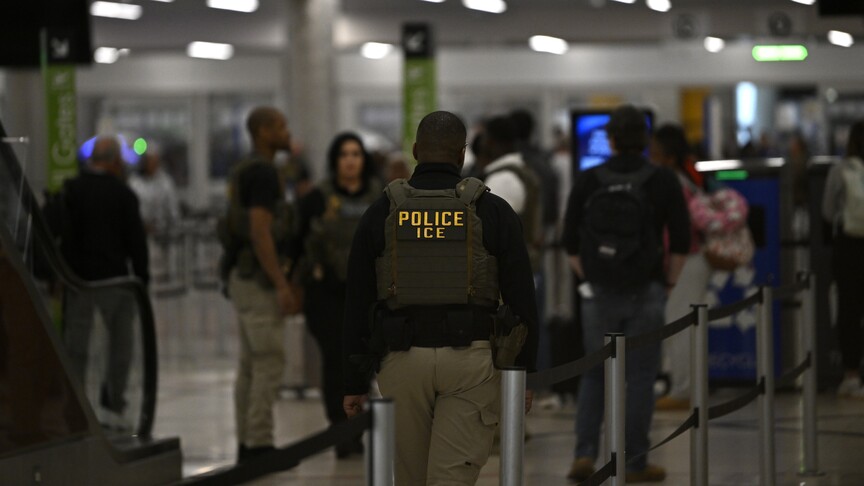
A controversial proposal by the Trump administration to pull customs officers from international airports in so-called sanctuary cities could effectively shut down overseas flights at some of the country's busiest travel hubs, triggering alarm across the aviation industry just ahead of the FIFA World Cup.
Although the plan has not been formally adopted, US Homeland Security Secretary Markwayne Mullin recently outlined the strategy as a way to pressure local governments that limit cooperation with federal immigration enforcement.
The proposal would not close airports outright or prevent planes from landing.
Instead, by withdrawing US Customs and Border Protection (CBP) officers responsible for processing arriving international passengers and cargo, airports such as Newark Liberty International Airport would be unable to legally handle international flights.
That could force airlines to cancel or reroute hundreds of overseas flights each day, disrupt cargo shipments worth billions of dollars and create major travel headaches for millions of passengers.
The threat has provoked sharp criticism from airlines, travel groups, state officials and policy experts, who warn that using airport operations as leverage in an immigration dispute could have far-reaching economic and political consequences.
The proposal is the latest in a long-running dispute between the Trump administration and sanctuary cities, which limit cooperation with federal immigration authorities. In practice, this means local police do not hold individuals longer than necessary for local offenses merely because immigration officials request extra time, unless there is a proper legal basis.
Supporters of sanctuary city policies argue they improve public safety by encouraging immigrants to report crimes and cooperate with local police. Critics say they make immigration enforcement more difficult.
Colleen Putzel-Kavanaugh, an associate policy analyst at the Migration Policy Institute, told Anadolu that the idea to pull federal customs officials from airports emerged following clashes outside the Delaney Hall Immigration and Customs Enforcement detention facility in Newark, New Jersey.
She said it was another attempt to find “creative ways” to pressure local jurisdictions to comply with federal demands. The Trump administration has repeatedly targeted sanctuary cities, attempting to withhold federal funds and initiating lawsuits, although Putzel-Kavanaugh noted that many of these efforts ultimately failed.
Mullin argued that the federal government should not continue processing international arrivals for cities that refuse to cooperate with immigration enforcement.
“Nothing about that makes sense to me,” he said while presenting the new proposal, stating that the department is drafting plans to target cities where "local radical left Democrats" prevent federal agents from doing their jobs.
The proposal has faced criticism from both Democrats and Republicans.
Transportation Secretary Sean Duffy publicly opposed the idea, saying: "We shouldn't shut down air travel in a state that doesn't agree with our politics."
New Jersey Gov. Mikie Sherrill called the proposal "completely ridiculous," warning it could cripple Newark Liberty International Airport just as the US hosts the FIFA World Cup, whose final will be played in New Jersey on July 19.
The aviation and travel industries have vocally pushed back, warning of severe financial consequences.
US airlines have already faced a mix of operational shocks and cost pressures in recent months, largely due to staffing disruptions caused by shutdowns and jet fuel-price spikes due to the Iran war. Industry advocates argue that this politically motivated policy would severely worsen an already fragile operational environment.
A coalition of 16 trade organizations, including the US Chamber of Commerce and the National Retail Federation, urged the Department of Homeland Security to abandon the plan.
Airlines for America, a trade association representing major US carriers, warned that reducing customs staffing at major airports would have a "devastating effect" on the airline and tourism industries and significantly disrupt passenger and cargo traffic.
The US Travel Association called the proposal a “self-inflicted” economic wound, estimating that suspending international operations at Newark alone could cost $8 billion annually in visitor spending and threaten nearly 50,000 jobs.
Cargo traffic could also be severely affected, the association warned, which would increase shipping costs for US businesses and raise prices for American consumers. According to the Port Authority of New York and New Jersey, more than half of Newark's freight throughput comes from international shipments, including more than $30 billion in imported goods each year.
Industry leaders also emphasized that American citizens would bear the heaviest burden. While the policy targets immigration, the travel association noted that the consequences would impact more Americans returning home than international visitors, with customs officers at Newark alone processing 5 million Americans returning home annually.
Adding to the urgency, the US Travel Association emphasized the reputational damage the country would suffer on the global stage.
With the FIFA World Cup days away, the organization warned "the damage to America’s reputation as a welcoming destination would be significant and lasting."
Aviation experts say the proposal would be extremely difficult to implement.
The International Air Transport Association (IATA) noted that Newark handled more than 103,000 international aircraft movements recently, averaging 284 flights per day.
Douglas E. Lavin, IATA's vice president for North America, said redirecting that volume of traffic to nearby airports would be nearly impossible because of capacity and slot restrictions.
Putzel-Kavanaugh described the potential disruption as a "logistical nightmare," saying the scale of airport dysfunction could resemble that seen after the Sept. 11 attacks. However, she emphasized that unlike past emergencies, this measure would be a "purposeful kind of pullback" of essential personnel.
Lavin also raised a legal and diplomatic concern regarding international treaties. He warned that suspending customs services at a major hub like Newark would "restrict the ability of foreign airlines to exercise their traffic rights" established under existing US Open Skies Agreements.
Policy experts anticipate swift and fierce legal challenges if the administration attempts to implement the travel restrictions.
Putzel-Kavanaugh said that the move "would certainly face litigation" from the various affected entities, including airports, airlines and other businesses.
While the homeland security secretary aims to pressure immigrant-friendly municipalities using “creative” methods, analysts warn the strategy carries significant political risks.
Putzel-Kavanaugh noted that Mullin has previously tried to keep immigration enforcement controversies out of the headlines, but weaponizing airport security would be a major gamble.
She suggested the policy would prove highly unpopular among the general public due to its widespread repercussions. Ultimately, alienating the business community and restricting the freedom of movement for US citizens could severely damage the secretary’s tenure.
The proposal remains at an early stage, but the scale of opposition from the travel industry, business groups and elected officials suggests it would face significant resistance if the administration attempts to move forward.
CBP, the FAA and the Department of Transportation have not responded to Anadolu's requests for comment.
news_share_descriptionsubscription_contact