Two more Khmer Rouge cadre charged in Cambodia
Officials charged with crimes against humanity, other atrocities despite PM Hun Sen warning of civil war if court proceeds
By Lauren Crothers
PHNOM PENH, Cambodia
Two mid-level Khmer Rouge officials were charged Tuesday with crimes against humanity and other atrocities by an international judge investigating the ultra-Maoist period that killed more than 1.5 million people.
Both were charged in absentia, a move that a court monitor told The Anadolu Agency was simply aimed at showing that the trial was proceeding though neither suspect will be arrested.
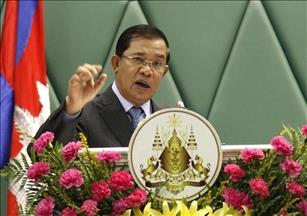
The suspects are part of what are known as cases 003 and 004 at Cambodia’s Khmer Rouge tribunal -- vehemently opposed by Prime Minister Hun Sen, who has insisted for years that they will never see the light of day.
In his most recent protest last week, he reiterated an oft-repeated threat that the country would descend into civil war if the court proceeds with either.
Despite this, in two separate announcements, Judge Mark Harmon charged Meas Muth, a former Khmer Rouge navy commander, with numerous crimes including: homicide, extermination, enslavement, imprisonment, persecution on political and ethnic grounds and other inhumane acts against Cambodians and foreigners.
He also charged Im Chaem, a former Khmer Rouge district commander, with “homicide… the Crimes against Humanity of murder, extermination, enslavement, imprisonment, persecution on political grounds, and other inhumane acts” at two crime sites.
While the tribunal is a hybrid court, Judge Harmon’s national counterpart -- Judge You Bunleng -- has not been involved in the cases since 2012 and repeatedly locked horns with Harmon’s two predecessors – who both cited disagreements with Bunleng as contributing factors in stepping down.
The statements from Harmon also pave the way for the legal teams for Meas Muth and Im Chaem to now have access to their client’s case files — an issue that has been a bone of contention as lawyers argued their clients should be able to see the mounting cases and receive relevant advise.
Both of Meas Muth’s lawyers, Cambodian Ang Udom and American Michael Karnavas, have a history with Harmon, whose attempt to have them removed in January 2014 was overturned by the court’s pre-trial chamber the following July.
Asked about the legality of the charges -- issued by only one of the two co-investigating judges -- Karnavas told AA by email that Harmon “obviously is of the opinion that he can go it alone.”
“The entire process thus far has been opaque. Now at least we can see what he has been doing for all these months,” Karnavas said. “We certainly will be diligent in scrutinizing his work, particularly given that he is a career prosecutor by profession with no previous experience in the French legal system that is the basis of the legal proceedings in Cambodia and at the ECCC.”
He added: “The [pre-trial chamber] overturned Harmon's decision to have me disqualified. Hopefully the submissions and decisions on this matter can now be available to the public to see what really went on behind the scenes.”
Meanwhile, Udom told AA by telephone that the legal team plans to hold a series of meetings over the coming days to discuss how to move forward, refusing to comment further until then.
Long Panhavuth, a court monitor with the Cambodia Justice Initiative, said the charges actually point to Harmon’s weakness.
He said that charging the suspects in absentia “is a wake up call to the U.N. and the special advisor to the secretary general on the tribunal, David Scheffer, that the court is not independent and there is interference.”
Saying that the charges were aimed at justifying the proceedings, he added: “It’s a hybrid court, but rather than make it standing up to the principle of a fair and independent tribunal, he [Harmon] seems to be under political influence.”
The court monitor expressed his belied that the next step -- the judge issuing an arrest warrant or detention order – would either not happen or be an exercise in futility as local authorities had previously been unhelpful in apprehending the suspects.
An attempt to summon Im Chaem to the court for questioning last year fell flat, because the local authorities “refused,” Phanavuth said.
However, a Khmer Rouge survivor and executive director of the Documentation Centre of Cambodia expressed a differing view, telling AA the charges were a clear sign that the court was doing its best to come across as an independent institution.
Youk Chhang said that “the message is that the public could perceive and give the court more credibility, and also from the international community” -- despite the government’s opposition to further trials taking place.
“I hope it can benefit the survivors and the public,” he said of the charges, “because it’s taking so long, and there have been high expectations from the beginning.”
Meas Muth has been the sole suspect in Case 003 since Khmer Rouge air force commander Sou Met died in June 2013. Two other suspects in Im Chaem’s Case 004, Ta Tith and Ta An, remain under investigation.
The Khmer Rouge tribunal is currently hearing the second phase of Case 002, which was split into two trials in 2011.
Defendants Nuon Chea and Khieu Samphan were found guilty of crimes against humanity in August 2014 and are now being tried on genocide charges.