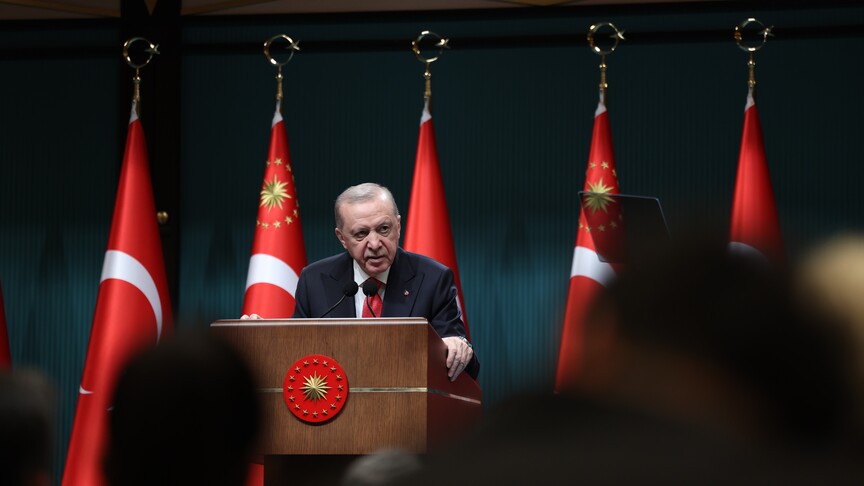
Turkish President Recep Tayyip Erdogan on Wednesday said Ankara will continue supporting Turkish Cypriots and announced new infrastructure projects for the Turkish Republic of Northern Cyprus (TRNC).
"No initiative that ignores the sovereign equality, rights and legitimate interests of Turkish Cypriots in the Eastern Mediterranean can succeed," Erdogan said after chairing a Cabinet meeting in the capital, Ankara.
Recalling last week's commemoration of the 52nd anniversary of the 1974 Cyprus Peace Operation, Erdogan described July 20, 1974, as "a historic turning point" that secured the existence, freedom and security of Turkish Cypriots.
He said Türkiye, acting under its rights and responsibilities as a guarantor power under international agreements, had ended the suffering of Turkish Cypriots and “led the establishment of peace and stability on the island.”
He said the Cyprus issue extends beyond a technical power-sharing dispute between two communities and centers on the recognition of the Turkish Cypriots' sovereign equality and equal international status.
"We are closely monitoring every step by those seeking to make Cyprus part of new military alignments and geopolitical calculations," he said.
Türkiye supports Guterres' peace efforts
Erdogan also welcomed UN Secretary-General Antonio Guterres' recent visit to the island – the first by a UN chief in 16 years – saying Türkiye has consistently supported his peace efforts and will remain in close consultation with him.
He added that proposals seeking to reduce Turkish Cypriots to minority status had repeatedly failed and that only a fair, lasting and sustainable settlement could ensure lasting calm on the island.
Reiterating Ankara's longstanding support for Turkish Cypriots, Erdogan said: “Türkiye will never abandon Turkish Cypriot brothers and will never allow past suffering to be repeated, whatever the cost.”
He said Türkiye would continue major infrastructure investments on the island.
Erdogan said Ankara was strengthening cooperation to help the TRNC become a regional leader in tourism, higher education, technology and digital transformation, while promoting development across all sectors and making the Eastern Mediterranean a center of stability and prosperity.
"As we solved Turkish Cypriots' water needs in the past, we will continue implementing various projects, especially a subsea natural gas pipeline," Erdogan added.
Regional conflicts
Addressing broader regional issues, Erdogan said Israel is "gradually occupying Palestinian territories" by disregarding fundamental human rights and international law.
He said Israel's occupation, illegal settlements, and what he described as policies of displacement, intimidation and oppression against Palestinians in the occupied West Bank, as in Gaza, were the main source of instability in the region.
He said that not only Palestinian and Lebanese people but the entire region and its diverse faith communities are “paying the price.”
Economy and support measures
Erdogan said the Cabinet meeting reviewed a wide range of issues, including the economy, foreign policy, energy and the government's "terror-free Türkiye" initiative, while also assessing Türkiye's strategy to become an energy hub.
On the economy, Erdogan said Türkiye was "taking determined steps to make the country a regional hub for production, logistics, transit trade and technology," while successfully managing "multiple shocks" despite an increasingly unstable global environment.
He added that Türkiye's economy remained resilient despite regional conflicts and that the government was working to minimize the impact of war-related costs.
Pointing to the economic effects of regional conflicts, Erdogan said disruptions had triggered one of the biggest shocks in the history of global oil supply, while prices of natural gas, fertilizers, diesel and petrochemical products had also risen sharply.
Highlighting government support measures, Erdogan said the daily rediscount credit limit for exporters was raised from 4.5 billion Turkish liras (about $95 million) to 5 billion liras (about $105.5 million), while the volume of subsidized investment loans increased from 500 billion liras (about $10.6 billion) to 750 billion liras (about $15.8 billion).
He also said an additional 250 billion liras (about $5.3 billion) in favorable financing had been allocated to the manufacturing industry, bringing the total support package for production, investment, exports and employment introduced during the period to 1 trillion liras.
To protect jobs in the tourism sector, Erdogan announced a monthly support payment of 3,500 liras (about $74) per employee at licensed tourism facilities. He also said the government had created an additional 60 billion liras in financing backed by Treasury guarantees and would continue employment support for labor-intensive sectors, including textiles, apparel, leather and furniture.