BANGKOK
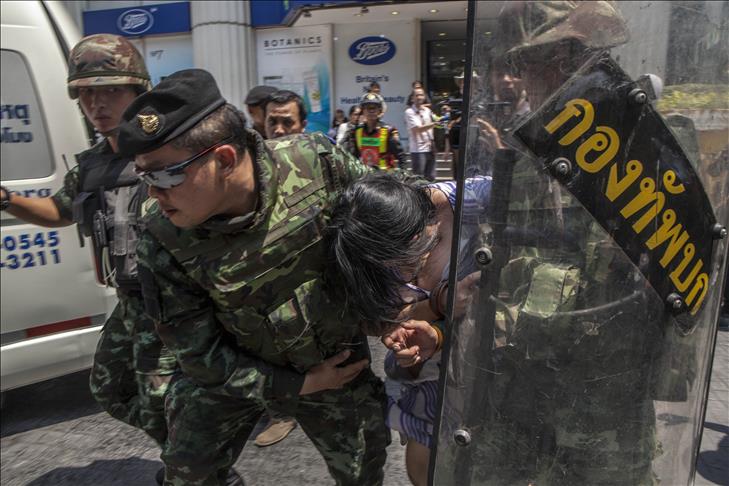
The Thai junta released two detained journalists Friday, bringing the number of people still unreleased from the military's original “summons” to 253.
Pravit Rojanaphruk, an outspoken journalist for The Nation newspaper, and Thanapol Eawsakul, manager of Fah Diaw Kan magazine, were released after five and seven days respective detention in a military camp.
Prior to reporting to the military - as ordered - last Sunday, Pravit had sealed his mouth with black tape, covered his ears and closed his eyes in a public gesture of protest. Thanapol was arrested May 23 during an anti-coup demonstration.
The men's detention sparked condemnations from international press organizations Reporters Without Borders and Southeast Asia Press Alliance.
All of those released have had to sign documents – “memoranda of understanding” – agreeing to not engage in political activities and to request authorization before travelling abroad or even within the country.
It is not clear whether those still detained have refused these conditions.
A worker at a human rights organization compiling data on detentions told the Anadolu Agency “Altogether 362 people have been detained... summoned through either published lists or direct phone calls.”
The worker did not wish to be named out of fear of reprisals.
“Of these, 109 have been released as of Friday evening,” he added. “According to our understanding, people are released when the seven-day period, prescribed in the martial law, is coming to its end.”
Each day, however, the Thai military publishes new lists of people to report to them, while military raids on homes and detentions continue in the north of the country - a "Red Shirt" stronghold - without being made public.
In a letter seen by AA, a Thai academic in the northern city of Chiang Mai who has gone underground with the military in pursuit wrote: “at a provincial level, searches and raids are random and arbitrarily done with no warning or any official document. It is very threatening.”
Most of those targeted in Chiang Mai are not Red Shirts - supporters of the overthrown government of Yingluck Shinawatra - but academics and social activists.
In northeastern Nakhon Ratchasima province, 16 Red Shirt leaders and six members of the Puea Thai Party, headed by Yingluck, have been ordered to report to the Army Club in Bangkok by Friday evening.
Purges also continue within ministries and the police department, with people associated with the government dissolved by the May 22 coup being transferred to inactive posts.
The Thai ambassador to the United Kingdom, Pasan Teparak - a former consul general to Dubai deemed to be close to former Prime Minister Thaksin Shinawatra - has been ordered to report as soon as possible to the Foreign Ministry in Bangkok.
Thaksin, Yingluck’s elder brother who has been living in exile in Dubai since a 2008 conviction for abuse of power, has been a divisive figure in Thai politics since he became prime minister in 2001 only to be overthrown in a 2006 coup.
During a press conference Thursday, a military spokesman told media that it was “impossible to hold an election at the moment” as protests continued. He said that that the junta did not intend holding onto power, but gave no idea when it will allow elections to be held.
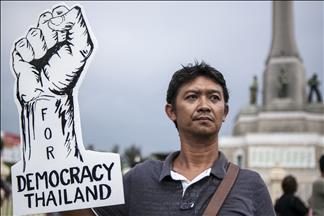
Demonstrations against military rule appeared to have been brought to a halt Thursday, after 1,300 soldiers and policemen were deployed in an area in northern Bangkok favored by protesters.
Further demonstrations, however, have been called for Sunday. On Friday, a new protest gesture saw some people gathered in front of Bangkok department stores, while ostensibly reading books such as George Orwell's critique of totalitarian society “1984” and “A Guide to Civil Resistance.”
The military seized power May 22 after seven months of political deadlock that has seen protesters take to the streets, voters bullied, elections annulled and 28 people killed.
It has said that it had to act to restore order, in the process overthrowing a government that had won a 2011 landslide election victory.
Army Chief Prayuth Chan-ocha has appointed himself prime minister, his military dissolving the Thai Senate, shutting down some news outlets and exerting censorship on those permitted to resume.
www.aa.com.tr/en