By Karim Adel El-Sayed
ANKARA
Last week, student radicalism in the United Kingdom returned to where it started, the London School of Economics and Political Science, 120 years after the university first opened its doors to students.
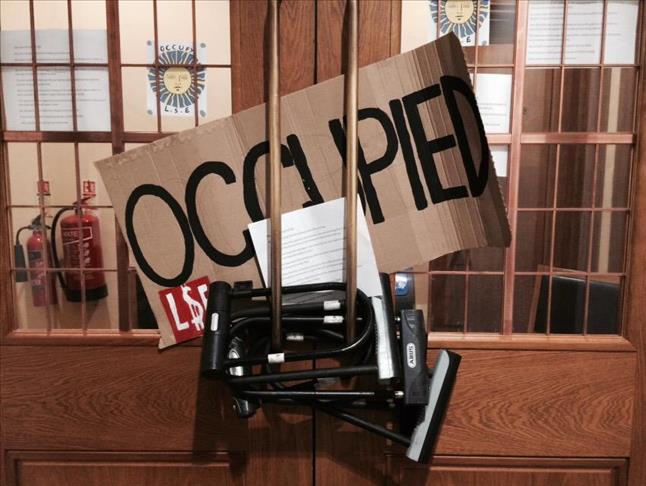
On Tuesday evening, March 17, 2015, a group of 20 to 25 mainly postgraduate students occupied the LSE’s Vera Anstey Suite -- the central meeting room of the university administration -- in protest against the neoliberalization of higher education.
Their demands are as varied as they are radical. They include: free and universally accessible education, better protection of workers’ rights on campus, an elected staff-student council to run the university, divestment from fossil fuel companies and those that profit from Israel’s occupation of Palestine, as well as demanding that police not be allowed on campus.
“We didn’t have any problems with security. They didn’t try and get in and they didn’t call police. They basically just left us to it, so I guess we were quite surprised about that, but obviously very relieved,” said Natalie Fiennes, one of the spokeswomen for Occupy LSE.
“We believe that when a university becomes more like a business and more intent on making money rather than being a service to students and giving back to society, then something about the genuine nature of education is lost,” the 23-year-old MSc Political Sociology student said.
The idea for the occupation came soon after a protest at Senate House, the administrative center of the University of London, regarding the reappropriation of International Women’s Day.
“Anyone can come in, except administration… We’re organizing lectures and meetings, not just coming and going,” said Jade Jackman, another spokeswoman for the occupation.
The 21-year-old law and anthropology student, now in her final year, cited the University of Amsterdam protests as inspiration. The Netherlands’ largest university has recently seen mass protests advancing similar complaints against the marketization of university education.
“I think that was something that did inspire us, in the same way that now UAL has occupied,” Jade said.
Soon after the LSE declared its occupation, students at the University of the Arts London occupied the reception area at Central Saint Martins in protest against swingeing cuts to foundation courses. Within a week of the UAL occupation, students at King's College London also started their own occupation against the neoliberalization of their university.
“It was really more specifically the occupation at the London School of Economics which inspired us to occupy,” said Rebecca Livesey-Wright, a 22-year-old third year BA Criticism, Communication and Curation student at CSM, UAL.
“We proactively plan on staying here until some negotiation happens and we feel as if we’ve come to an agreeable end point with the management,” she said.
Jade proposed a similar end-scenario. “We need to come into a dialogue with our school and once we feel satisfied with the way the conversation is going, then the occupation will move.”
The LSE spokesperson said it would continue to seek dialogue, stating that there was, “common ground between the institution and its students, including… in improving participation in decision-making.” The statement confirmed that the LSE Students’ Union was not involved in the occupation.
This was, in comparison, a more promising response than that of UAL.
“We had one or two e-mails from our vice-chancellor. He sort of acknowledged that we’re here and acknowledged what our concerns are but… he’s just been sort of trying to tell us that some of our information is incorrect,” Rebecca said.
The last time the LSE found itself in the headlines was in 2011, when then-director Howard Davies resigned over the university’s links to the Gaddafi regime in Libya.
Reaction and solidarity
“The fact is even if everyone did agree with all of the demands, or even one of the demands -- if every student at LSE believed in free education -- we would still not have the power to do so… The whole causes behind the occupy movement are a frustration that our voices aren’t being heard,” said third-year BSc Philosophy and Economics student, and president of the Palestinian Society, Haneef Chowdhury, backing the occupation’s demand for an elected staff-student council to run the university.
Stephanie Nina Menggu, a second-year BSc Government and Economics student and president of the Women in Business Society, said, “I feel like they did a great job in pointing out where LSE is right now: that it seems very much like a degree factory, it treats its students like human commodities… We try and remind our members that there is more to LSE than applying for internships.”
General Secretary of the LSESU Nona Buckley-Irvine took a dimmer view of the protests, “I feel like if they wanted a successful outcome, they could be a bit more specific about their aims.”
She broadly sympathized with the occupation’s demands and said that, “The workshops that they’ve been holding have appealed to quite a lot of people.”
She maintained, however, that, “They are more of a fringe movement. They don’t represent a majority of students.”
Deborah Hermanns, an organizer for the National Campaign Against Fees and Cuts, or NCAFC, backed each and every demand put forward by Occupy LSE.
“There are students’ unions which are under the political leadership of left-wingers, which are much better than the NUS (National Union of Students),” she said. “For example, the UAL Students’ Union is actually really involved in the current occupation there… whereas the LSE Students’ Union is kind of not really doing anything – they’re not really against it but they’re not really for it either.”
The NCAFC are far from the only organization to show solidarity with Occupy LSE.
The Polytechnic Students Committee of Struggle-Revolutionary Student Union in Mexico, the Union of Students in Ireland and 84 Irish academics, the Marxist Youth of Venezuela, the LSE branch of the UCU (trade union for higher education professionals) and UNISON-affiliated cleaners have all publicly declared solidarity with Occupy LSE.
Two members of the University of Amsterdam occupation even hitchhiked from the Netherlands to London to show solidarity in person, as have members from the far-left Syriza party in Greece and Podemos party in Spain, according to Occupy LSE’s Facebook page.
2010: ‘Institutional memory’
Charlotte Gerada was general secretary of the LSE SU during 2010, when the coalition government effectively tripled the cost of higher education by raising the cap on tuition fees to £9,000.
Proud of the key role LSE played in the organization of mass demonstrations at the time, she said the 2010 protests united and energized the student movement.
“Even if we didn’t get the outcome we wanted, it gave them (students) a taste of direct action,” she said.
On the question of whether to seek change through the students’ union or direct action, she saw no inherent conflict between the two.
“It’s every student’s right to take action into their own hands and I wouldn’t ever view an occupation as being in opposition to the students’ union. In fact, it’s very often times complementary,” she said.
She was supportive of Occupy LSE, saying, “An occupation is just an excellent space to bring people to together to kick-start ideas.”
Just as with the 2010 protests, she added that, “these sorts of events really have institutional memory. These experiences will be passed down to other student years.”
2003: ‘It’s a very, very international university’
To find the last period of pre-2010 student unrest in the UK, one must go back twelve years to the build-up of the Iraq war.
After the quiescent nineties, the political inactivity fuelled by Fukayama’s End of History narrative stubbornly carried itself over uninvited into the early years of the new millennium.
But with the intensity of national debate rising in September 2002, the LSE, true to its roots, stirred from its slumber.
James Meadway studied his master’s degree at the LSE between 2002 and 2004.
The now 34-year-old economist said international issues tend to be more keenly felt at the LSE because, “it’s a very, very international university. There’s a good two-thirds of people there from overseas.”
“Universities in Britain now are so internationalized anyway. This is partly how, to be blunt, most university management see most overseas students as a cash cow. They turn up and kind of produce money and they don’t cause as many problems as domestic students do,” he said.
Anti-war student activists were winning close votes in huge, weekly Union General Meetings hosted by the LSESU, he said.
Backing up Charlotte’s view that students’ union activity and direct action need not necessarily be in conflict with each other, James recalled the LSE student occupation of the Old Theatre on Oct. 31, 2002, as part of the Stop the War Coalition’s day of direct action.
With regards to institutional experience, he said, “A lot of the people involved in the anti-Iraq war protests are now scattered throughout the rest of civil society. I think it was a learning experience for people who are now campaigners in lots of different fields.”
“I’ve seen their demands. What they’ve raised is ambitious, to say the least,” he said, commenting on Occupy LSE.
He was, however, supportive of the movement, “I think these things tend to be valuable in and of themselves.”
The Sixties: ‘We took it over’
Part of the reason why the occupation’s claim that, “LSE is the epitome of the neoliberal university” is so damning is not just the blunt language used, but the history of the university it is aimed at.
Founded by late Victorian era socialists for “the betterment of society,” the LSE solidified its reputation as a hotbed of student radicalism during the 1960s, when the appointment of Walter Adams as director led to historic turbulence.
Adams was previously the governor of a university in Rhodesia, “which was at the time an apartheid state. It was a settler state like Israel or South Africa,” Jonathan Neale said.
Neale came to the LSE at the age of 18 from the U.S. to study between 1966 and 1969. To protest Adams’ appointment, LSE students started a sit-in.
“We were in the national newspapers. It was a completely new idea, which we took from the United States, from the civil rights movement at that time,” the 66-year-old said.
Adams survived the occupation and decided to erect a series of gates, so that in the event of another sit-in he could divide the students from each other.
The student union voted for another sit-in and physically took down part of the gates. Celebrating afterwards in the pub, university students were identified to police by staff.
“I was an honest and decent liberal myself at the time and this was regarded by us as an appalling way for professors to behave towards their students,” Neale said.
In response, LSE students occupied the entire university. “All of it. We took it over. No more classes – nothing,” he said.
“Now the idea that students are involved in politics is very widely accepted,” Neale said, adding that at the time, “It was new, so the authorities were taken aback.”
“The reason why things kicked off first at the LSE was because there was -- at an intellectual and social level -- already a very radical vibe. It was the college founded by the Fabians, by the Webbs and by Shaw. Major thinkers in Britain on the left, like Harold Laski and Ralph Miliband -- the (Marxist) father of the current leader of the Labour party -- these were people who taught at the LSE,” Neale said.
Though the students won the battle, history has made clear that Adams won the war.
“In the 80s and 90s (directors) had a vision of LSE as a much larger, very successful, international corporate university. And they made this a reality,” Neale said.
Feeling a heavy dose of nostalgia upon hearing of Occupy LSE, he said, “That it happened at LSE made me feel proud in the way you’re proud of your football team. It made me feel good about my life.”
“I think the increasing levels of activity that we’re seeing, they’re like the first birds who come in the spring,” Neale said of his view of Occupy LSE. “What I want is for a new generation to remake the world.”
“The most important thing that’s happening in Occupy LSE is the conversations that are happening between the people in the occupation,” he said.
“I think the questions you’ve been asking me, they’re asking each other.”
news_share_descriptionsubscription_contact

contact_the_ombudsman
is_there_an_error_in_this_story