ISLAMABAD
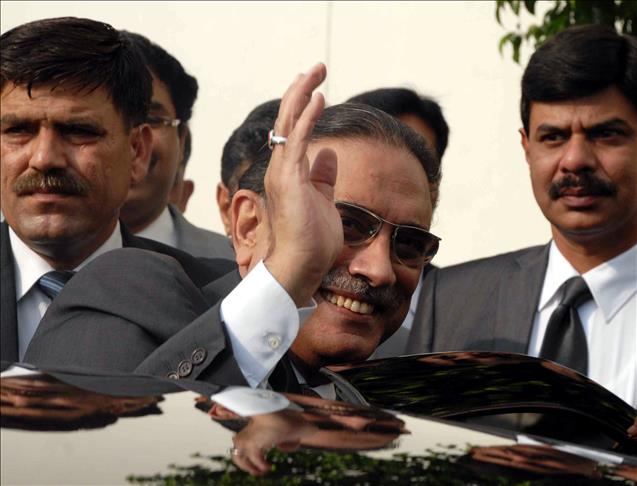
Pakistan's former president Asif Ali Zardari appeared before the accountability court on Thursday in corruption cases following the withdrawal of the immunity he had enjoyed during his five-year presidential term.
Encircled by security personnel, the former president disembarked from his bullet proof vehicle amid slogans by dozens of his supporters gathered outside the court.
Judge of the accountability court adjourned the hearing until January 18 after his lawyer submitted a request to present arguments on the allegations against his client.
Zardari's defense lawyer Farooq H. Naek, former chairman of the Pakistan's Upper House, told reporters that the court postponed the hearing.
Zardari is the first ever civilian president who completed his five-year term in the 66-year checkered political history of this South Asian nuclear Muslim country, which had been ruled by military dictators for over 30 years.
Zardari is facing trial in five corruption cases. National Accountability Bureau (NAB), an anti-corruption body set up in 2002 by former military dictator General Pervez Musharraf, ordered reopening of the cases in October just few weeks after Zardari stepped down on completion of his five-year term.
Although he was summoned by the court in December, Zardari, widower of slain prime minister Benazir Bhutto and incumbent chairman of the main opposition Pakistan Peoples Party (PPP) , did not attend the first three hearings due to security concerns.
The former civilian president’s appearance before the court is widely viewed in the context of Musharraf's consistent defiance in avoiding appearing before the court since the beginning of a high treason case against him from December 24.
Musharraf, who ruled Pakistan from 1999 to 2008 after toppling the elected government of Prime Minister Nawaz Sharif in a bloodless military coup, is currently being treated at an armed forces hospital for a “heart attack” which he suffered on his way to court on January 2. He is being tried for imposing a state of emergency in the country and holding the constitution in abeyance on November 3, 2007.
If found guilty, Musharraf may face the death penalty or a life sentence.
englishnews@aa.com.tr