by Rafiu Ajakaye
LAGOS
It was a moment of national pride.
At last, Nigeria could boast that – along with being Africa's most populous nation, with nearly 170 million people – it also represented the continent's largest economy, with a gross domestic product (GDP) of $510 billion.
The impressive new figure, almost double South Africa's, means the local economy has grown by 7 percent, making Nigeria a choice destination for foreign investors.
The good news, however, appears to end there.
The noteworthy economic indicator fails to strike a chord with average Nigerians, including many who say the figures lack any concrete value for the struggling country's increasingly poor citizens.
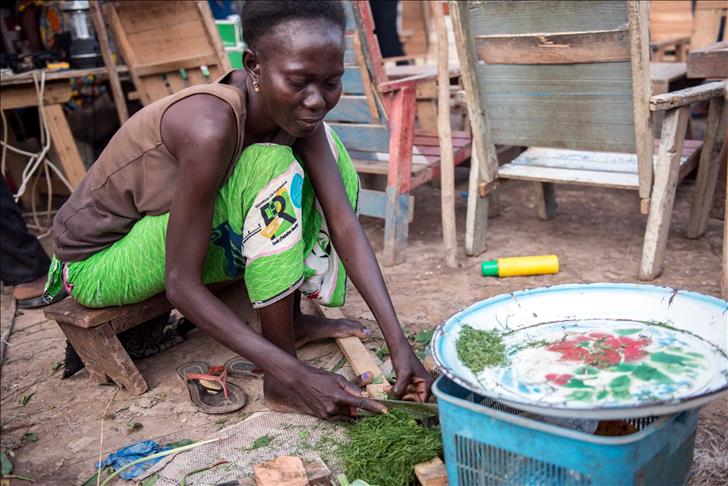
"Am I supposed to start dancing because our leaders have added some figures together and declared that we now have the biggest economy in Africa?" Madara Hawwa, a middle-aged woman who sells bean cake, asked in comments to Anadolu Agency on Monday.
"I can celebrate anything if it relieves the burden of educating our children or lessens the burden of survival," she said.
"I pay for everything, including… a security guard employed by the community," she added. "Will the [new economic] data change that?"
Hawwa is angry that "our leaders don't seem to understand the volume of the challenges faced by the people at the grassroots."
On Sunday, the Nigerian government put the country's 2013 GDP at some 80.3 trillion naira (roughly $510 billion).
The "rebasing" of the economy, as it is called, follows months of recalculating existing and new sectors of the Nigerian economy, such as telecommunications and the entertainment industry.
Dr. Yemi Kwle, Nigeria's chief statistician, said the telecoms industry currently accounted for 8.7 percent of national GDP compared to only 1.2 percent in 1990, when the country last calculated its GDP.
The entertainment industry, particularly the popular "Nollywood" movie sector and burgeoning music sector, is worth $7 billion annually, according to the new data.
The industry, which contributed nothing to national GDP in 1990, now accounts for some 1.42 percent of GDP.
In 1990, Nigeria's GDP was estimated at $264.4 billion.
Private broadcasting houses now number in their hundreds, up from zero in 1990.
Private mobile telephone lines have jumped from barely 100,000 to well over 100 million in the same period.
The aviation sector, which was dominated by a state monopoly in 1990, now has several private operators, with scores of jets flying different routes.
Private jet ownership has also soared in recent years.
The new figures make the Nigerian economy Africa's largest, even surpassing South Africa, which recorded a GDP of around $370 billion as of December 2013.
-Irrelevant-
David Iyajon from the central Kogi State could not care less about the new GDP announcement.
"I don't even understand what you are saying. Maybe I would appreciate what you mean if the government had given me the opportunity of basic education," he told AA.
When told of Nigeria's new position as Africa's biggest economy, a disinterested Iyajon said in the local Ebira dialect: "I think they are just mocking themselves."
"How would that provide me with the breakfast that I haven't taken today?" he asked.
The statistics bureau recently owned up to the fact that the poverty rate had risen from 51.6 percent in 2004 to 61.2 percent in 2010 – a figure many believe is conservative.
Various United Nations development agencies, for their part, say about 70 percent of Nigerians currently live on less than two dollars per day.
Kenny Bashir, a law student at the University of Ibadan, laughed off the rebasing as an exercise in self-denial.
"What is the use of the biggest economy that provides no job?" he asked.
Unemployment currently stands at 23.9 percent of the total population, with youth unemployment estimated at a whopping 60 percent, according to the statistics bureau.
"Nigeria is the largest producer of crude oil in Africa," said Bashir. "We have four refineries, all operating below capacity and are to be sold."
"How does this rebasing take away the fact that we run an unsustainable consumer economy?" he added.
Tunde Akanni, a university lecturer and social rights activist, said the rebasing meant little to the man on the street.
"How does this translate to the slightest improvement in the lives of the ordinary Nigerian?" he told AA. "The brighter picture painted by this rebasing is in absolute conflict with the realities."
"The character that marks out this government is corruption," he said. "Have we forgotten… that these same people painting a rosy picture of the economy told us a few months back that the economy will collapse if they pay university lecturers the money being asked for?"
-'Self-glorification'-
For others, Nigeria has no basis to compare itself with South Africa. They point to Nigeria's lack of basic infrastructure – a functional rail system, human capital development, stable electricity, good roads, efficient healthcare and accessible education – required for any modern economy.
Balogun Kingsley, a teacher at a government-run secondary school in Lagos, said that, while the statistics could be genuine, he did not see how they might make an investor pull out of South Africa or Ghana and invest in Nigeria.
He believes that, for Nigeria to achieve its full potential, effort must be made to build needed human capital, which is currently lacking.
"You need a dynamic and well-trained human infrastructure to build and sustain a healthy economy," Kingsley told AA.
"The U.N. recently said more than 10 million Nigerian children of school age are roaming the street," he said, adding that the figure was likely much higher.
Esther Adio, a banker, said comparing Nigeria's economy to South Africa's was a "joke."
"I laughed when I read the report about the rebasing," she told AA. "No economy survives without stable electricity. It is not a luxury."
"South Africa has a population that is below a quarter of our 170 million," Adio said. "It generates 40,000 megawatts of electricity, while we generate less than 4000."
"Isn't electricity a sine qua non for industrialization?" she asked.
Bashir, the law student, dismissed the rebasing as another government exercise in "self-glorification."
"I cannot imagine a nation boasting of being the biggest economy in Africa and the 26th biggest in the world, yet 70 percent of its masses are fed on less than a dollar [a day]," he said.
"I weep for a nation where a region is wearing death like a crown of thorns," he added, "yet we are claiming honors even fools would have rejected."
englishnews@aa.com.tr
news_share_descriptionsubscription_contact

contact_the_ombudsman
is_there_an_error_in_this_story