NATO should build a shared ecosystem, not just share burdens, says Turkish foreign minister
Türkiye is 'taking necessary steps' to resolve issue of CAATSA sanctions with US, says Turkish Foreign Minister Hakan Fidan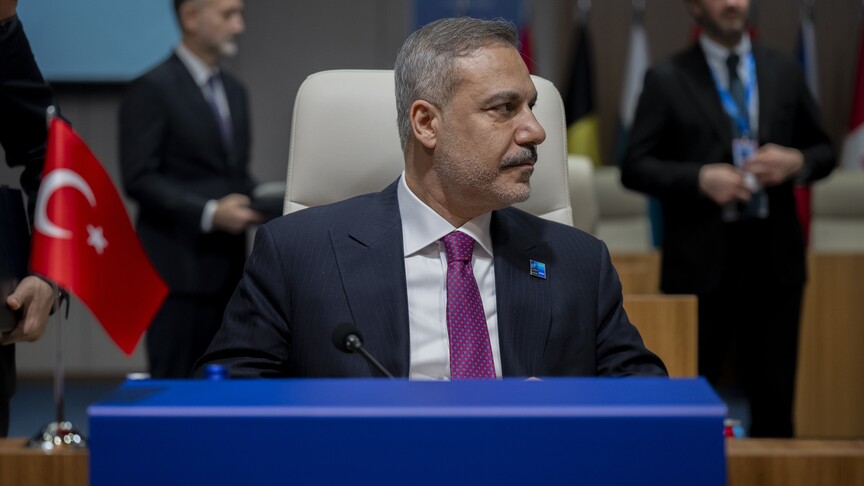
- 'If alliance members come together with this understanding and build a defense industrial ecosystem, there will be no problems either in supply or in market access,' Fidan says
- 'A solution can be reached by the weekend to resolve the differences' over transit through Strait of Hormuz, says foreign minister
- Fidan says Ankara is working tirelessly to end Russia-Ukrain
Turkish Foreign Minister Hakan Fidan on Friday stressed that NATO members should focus not only on burden-sharing but also on building a shared ecosystem.
Fidan told Turkish public broadcaster TRT that the concept of burden-sharing in NATO "has ceased to be merely a concept and has now become an implementable policy." This is the most important outcome of the NATO summit Türkiye hosted in its capital Ankara this week, he said in an interview.
The summit was an “extraordinary achievement” of the Turkish foreign policy pursued under the leadership of President Recep Tayyip Erdogan, he added.
Fidan stressed that the defense industry is now just as important as military capabilities and is no longer viewed merely as a supporting element but as a core component of security.
Fidan added that defense industry agreements within the bloc are "of tremendous importance for the future of our defense industry."
He also noted that resilience is among the most widely discussed topics.
Fidan underscored that NATO's future must be decided collectively by all alliance members.
He noted that every country's industrial self-reliance had been widely discussed, but said it is now clear that no single country can sustain this ecosystem on its own.
“Building a shared ecosystem among alliance members is just as important as burden-sharing,” he said.
NATO 3.0
Fidan said he had attended a small-group meeting at the invitation of US Secretary of State Marco Rubio, where participants discussed the importance of turning the defense industry ecosystem into a new policy area through the participation of allies with strong industrial capabilities.
Noting that NATO is still widely associated with its Cold War-era role, Fidan said: "But in modern times, the question has become how the alliance and its member states can maintain both their military capabilities and their defense industrial capabilities in the face of evolving threats." The alliance has now entered the “NATO 3.0” era, he added.
During bilateral talks between Erdogan and US President Donald Trump, the two leaders reaffirmed their commitment to advancing Türkiye-US relations across all areas, including dispelling, and resolving existing issues, Fidan said.
On the US’ Countering America's Adversaries Through Sanctions Act (CAATSA) sanctions on Türkiye, he said: "We are taking the necessary steps to resolve these issues. Hopefully, we will reach a conclusion soon. I don't think there will be any problem."
On the issue being raised during the meeting between Trump and Erdogan, and Türkiye's expectations, Fidan said Ankara has maintained that there should be no sanctions between allies. "Such matters should not be decided through political or administrative measures.”
Fidan said some countries have been lobbying against Ankara in Washington.
“We are entering a period in which US policymakers will have to balance Türkiye's strategic importance against the efforts of actors seeking to undermine it.”
Strait of Hormuz, Ukraine
On the impact of rising NATO defense spending and the alliance's new procurement agreement on Türkiye's defense industry, Fidan said that if these decisions are implemented effectively, “we will see very positive results.”
“If alliance members come together with this understanding and build a defense industrial ecosystem, there will be no problems either in supply or in market access. That would enable the industry to sustain itself. Otherwise, it would require continuous subsidies, and that is not something any country can shoulder on its own,” he explained.
On the $50 billion in procurement agreements recently signed among NATO allies, Fidan said such deals are “extremely important” for the future of Türkiye's defense industry.
Türkiye's defense industry focus on technologies and weapons of high strategic importance, such as air defense systems, missile systems, fighter jets, next-generation unmanned aerial vehicles, drone swarms, and cyber capabilities, he said.
“Developing these within a collective framework would reduce the financial burden while strengthening defense resilience,” he added.
Fidan said countries are changing their positions toward Türkiye, citing its role as a reliable, strong, and influential partner. He added that Ankara would not compromise on national security and will seek alternatives if allies hinder its efforts to develop key capabilities.
He also said "a solution can be reached by the weekend to resolve the differences" between the US and Iran over transit through the Strait of Hormuz in light of recently heightened tensions.
He said that Türkiye is working tirelessly to end the Russia-Ukraine war.
Fidan said Türkiye is closely monitoring developments, warning that attacks on commercial vessels are rising and the war is expanding in scope, posing a growing risk to regional security and trade.