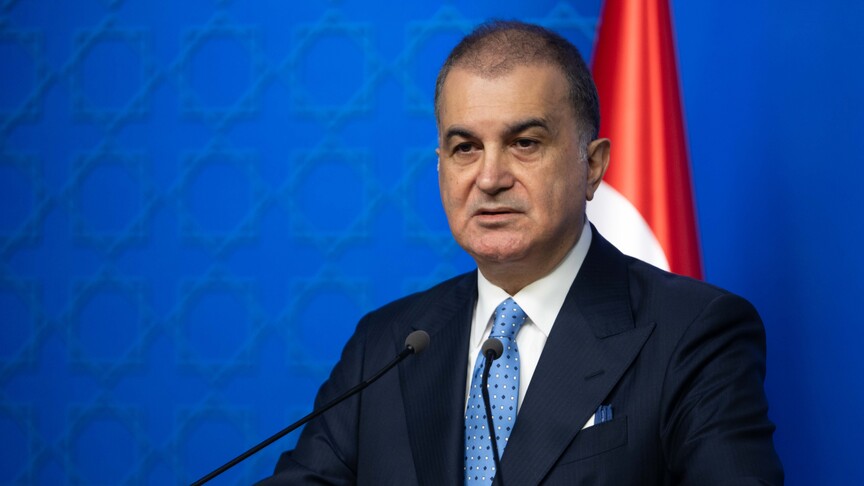
The spokesperson for Türkiye's ruling Justice and Development Party (AK Party) said Türkiye had reached the most important stage of the two-year Terror-Free Türkiye process following the submission of a new legislative proposal to parliament.
Speaking after a meeting of the AK Party’s Central Decision and Executive Board, chaired by President and AK Party Chair Recep Tayyip Erdogan, Deputy Chair Omer Celik said Erdogan had reviewed the progress made so far and issued instructions on the political, institutional, and administrative steps required to bring the process to a successful conclusion.
Celik said the Bill on Strengthening National Solidarity and Social Cohesion represents a critical turning point because it establishes a legal framework for the disarmament and dissolution of the terrorist group PKK/KCK and its affiliated structures.
He said the process aims to ensure that the group ends all armed activity and that its legal and illegal branches and extensions in Türkiye, Syria, Iraq, Iran, and Europe are all brought to an end.
Celik described the initiative as more than a domestic security policy.
He said the “Terror-Free Türkiye and Terror-Free Region” objective should also be understood as a regional response to attempts to divide societies along ethnic, religious, and sectarian lines.
He argued that terrorist groups have long been used as proxies by external powers seeking to destabilize the region and turn neighboring communities against one another.
Such projects aim to create fragmented societies in which Turks, Kurds, Arabs, and different religious communities are pushed into conflict, Celik said.
Türkiye’s approach, he said, is intended to replace confrontation with cooperation and to build a regional future in which communities act together rather than against one another.
“The ultimate owner of this process is Türkiye’s 86 million citizens,” Celik said, stressing that the initiative is being carried out within the framework of the constitutional characteristics of the state and the shared values of society.
Paid a heavy price in decades-long fight
He said Türkiye had paid a heavy price in its decades-long fight against terrorism and praised the sacrifices of security personnel, veterans and those who lost their lives.
The current process, he added, was made possible by the state’s experience, institutional capacity, and sustained struggle against armed groups.
Celik said the proposed framework law would provide both legal safeguards and a clear institutional mechanism for overseeing the process.
Under the planned system, the law would take effect only after the surrender of weapons had been verified and officially confirmed.
This would then be followed by a decision of the National Security Council.
Parliament would monitor developments through a special commission, while a separate board chaired by the vice president would coordinate the relevant administrative and institutional work.
Celik said this structure showed that the process would be managed through legitimate state institutions, parliamentary oversight, and the rule of law.
He described the proposal as a legal “navigation system” that would guide the authorities through the disarmament and dissolution process while ensuring that the necessary security conditions are met.
Removing the armed threat from Türkiye’s political agenda would have consequences extending far beyond security, he added.
He argued that terrorism put long-term pressure on democratic institutions, political debate, and public life. If the process succeeds, he said, Türkiye would enter a new political climate in which democracy could deepen and expand.
“The removal of terrorism from the agenda will create a political environment that embraces all 86 million citizens,” he said.
New focus on development, regional peace, and national goals
Celik said the end of armed terrorism would positively affect parliament, the economy, civil society, and relations between different social groups.
It would also allow the country to focus more effectively on development, regional peace, and its long-term national objectives.
He described the legislative proposal as a historic step and a potential turning point in the history of the republic.
If successfully completed, he said, Türkiye’s approach could become a reference model for other countries facing similar security challenges.
Celik also rejected proposals for an international monitoring mechanism or a foreign “third-party observer.”
He said Türkiye has the political will, institutional experience, and democratic capacity to resolve the issue independently.
“Türkiye does not need a third eye,” Celik said. “The national eye overseeing this process is the entirety of our 86 million citizens.”
He added that the objective is to permanently remove terrorism and armed groups from the country’s agenda and to start a new era based on security, democratic politics, and social unity.
Türkiye's Communications Director Burhanettin Duran said the initiative would strengthen Türkiye’s internal unity and constitute a historic step toward the Terror-Free Türkiye objective.
“This step, which will further strengthen our home front, reinforce national solidarity, and mark a historic threshold on the path toward our goal of a Terror-Free Türkiye, will become one of the most important milestones of the Türkiye Century vision set out under the leadership of President Recep Tayyip Erdogan,” Duran said on the Turkish social media platform NSosyal.
Duran also expressed his gratitude to all political party groups, members of parliament, and others who helped draft the bill and supported Türkiye’s determination to fully free itself from the shackles of terrorism.