ANKARA
Turkey will never forget the massacre against Muslim Bosnians in Srebrenica in July 1995, Turkish Foreign Minister said on his Twitter account on Friday, for the 19th anniversary of the Srebrenica genocide in Bosnia.
During the ethnic war in Bosnia, Srebrenica, which had been declared as safe zone by United Nations, was captured by Bosnian Serbian troops under the command of Gen. Ratko Mladic on July 11, 1995. Dutch soldiers serving under UN command left the area, leaving the the Bosniak Muslims at the mercy of Mladic's troops.
More than 8,000 Bosnians were massacred in forests, fields, factories and warehouses. The bodies of victims were buried in mass graves across the region, and some are still being found and identified to this day.
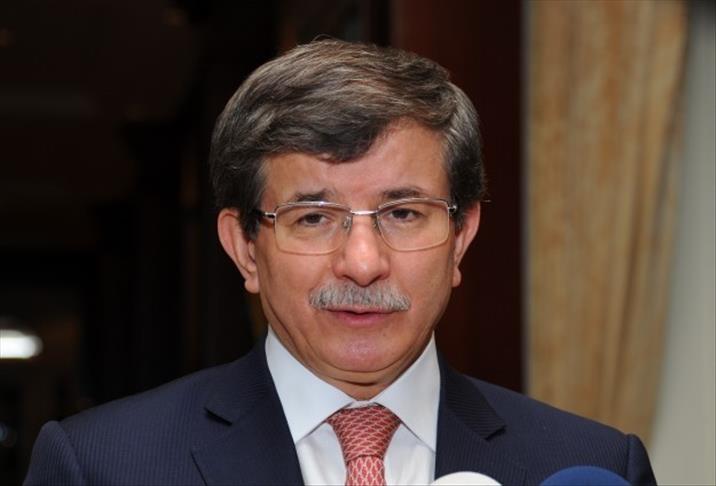
"I commemorate all martyrs with mercy at the anniversary of this inhumane massacre of the twentieth century in Srebrenica. Even though everyone forgets the Srebrenica massacre, we will not forget it," FM Davutoglu said during his official visit to Uzbekistan.
The minister also underlined that Turkey will learn lessons from the international community's past mistakes and continue to work for peace and stability in the Balkans.
We should take a lesson from Srebrenica: Turkish minister
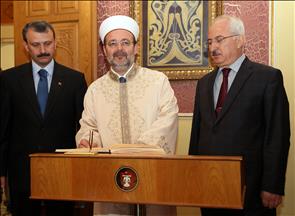
Bekir Bozdag, Turkish justice minister, marked the 1995 massacre in Serbrenica as lesson the world must remember in order to prevent other similar occurrences.
“We all should take a lesson here. Actually, Srebrenica is an object lesson that shows what kind of terrible outcomes emerge in case of insensitivity against humanity, failing to take measures.” Bozdag said at the funeral ceremony for 175 newly identified Srebrenica victims.
“We wish no pain like this happens again, neither in Bosnia-Herzegovina nor in another place in the world.” Bozdag said, noting that, even now, some families could not find their children's bodies or hold their funerals.
“We see that international society didn’t take the lesson when we look at incidents in Gaza, the West Bank, Syria and Iraq.” he said. He described the Srebrenica massacre as a genocide perpetrated by Bosnian Serbs and said it took place as the world looked on, under the supervision of UN, in the center of Europe.
“Human life is very important. If people are dying, killed somewhere, there should be no calculation of interest. First deaths should be prevented,” he added.
“We can’t say we took a lesson when we look at the past," he said. "Because there are blood and tears everywhere.”
Emrullah Isler, Turkish deputy prime minister, said on Twitter that the world must work to prevent similar massacres from happening again.
“There are big tasks for all humanity not to experience pains and massacres today like in Srebrenica 19 years ago,” he tweeted.
Srebrenica bodies to be buried at commemoration
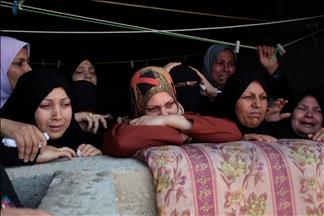
Newly identified bodies of 175 Srebrenica victims were buried in Potocari cemetery Friday, on 19th anniversary of the massacre.
British Foreign Secretary William Hague and German Foreign Minister Frank-Walter Steinmeier released a joint statement calling the massacre an act of genocide of a scale unseen in Europe for decades, and a tragedy that should never have been allowed to occur.
“Today, we, the U.K. and Germany, renew our lasting support for those affected and commitment to the people of Bosnia and Herzegovina. We will never forget these events,” the statement said.
“We reject entirely the efforts of those who seek to alter history, to deny Bosnia and Herzegovina’s rich and diverse ethnic make-up, or that work to undermine the territorial integrity of this country,” the ministers said. “The redrawing of borders in the Balkans is over.”
During the ethnic war in Bosnia, Srebrenica, which had been declared as safe zone by United Nations, was captured by Bosnian Serbian troops under the command of Gen. Ratko Mladic on July 11, 1995. Dutch soldiers serving under UN command left the area, leaving the the Bosniak Muslims at the mercy of Mladic's troops.
More than 8,000 Bosnians were massacred in forests, fields, factories and warehouses. The bodies of victims were buried in mass graves across the region, and some are still being found and identified to this day.
Mladic, 70, is now on trial in The Hague, Netherlands, accused of committing war crimes, crimes against humanity and genocide.
Serbian President Tomislav Nikolic apologized last year for "all crimes committed by Serbs" during the war in Bosnia. But he refused to call the massacre in Srebrenica "genocide."
Among the newly identified bodies, the youngest victim was 14 years old, Senad Beganovic. Hurem Begovic, the oldest, was 79.
Parts of the body of Senad Beganovic, the 14 year old, were found in four different mass graves and pieced together after DNA analysis. Besides Beganovic, there are 14 victims under 18, among the newly identified bodies.
At last year's commemoration, 409 Srebrenica victims were buried.
Fatima Muhic, the youngest victim of the massacre, was buried last year. She died on the day she was born. Hava Muhic, her mother, wanted her child’s name on a grave stone, rather than reposing under a "nameless" stone.
After the latest burial in Srebrenica, 6,241 bodies are buried in Potocari cemetery. Research is still being done by organizations like the Missing Persons Institute of Bosnia-Herzegovina and the Mothers of Srebrenica to find and identify the missing bodies of about 2,000 remaining victims.
Thousands of people who gathered from various different countries walked for more than 100 kilometers over three days, from town of Nezuk to Potocari cemetery, near Srebrenica.
The "Peace March" has been organized annually for 10 years, between July 8 and 11.
The survival walk of Bosnian civilians in 1995 was called the "Death March." Only about 3,500 people were able to reach safety in the village of Tuzla, after a seven-day walk. The "Peace March" takes place on the same route, according to information provided by Kemal Hajdarevic, a survivor of the massacre.
news_share_descriptionsubscription_contact