By Burcu Arik Ozer/ Servet Gunerigok
ISTANBUL
Muslims all around the world are ready to welcome the holy month of Ramadan which will begin on Saturday, June 28 and will continue for 30 days.
Ramadan is believed to be a time of intense spirituality, when the believers are surrounded by angels, the gates of heaven are open, and Allah's blessings and mercy are abundant. But it is also a time of great excitement, filling the cities, especially Istanbul events calendar with jubilant festivities bringing the city to life when the sun goes down.
Fasting, held from sunrise to sunset during Ramadan, is one of the Five Pillars [fundamental religious duties] of Islam. It is a time of self-examination and increased religious devotion.
The city really springs into life as people prepare for the Iftar (evening meal) and the true feasting begins. During Ramadan, Istanbul municipalities will organize mass iftar meals -free meals consisting of things such as soup, stew, pudding and juice- and street festivals such as clown and shadow puppet shows for locals.
Many districts across Istanbul - Eminonu, Fatih, Kadikoy, the old Galata Bridge over the Golden Horn, Uskudar and Kagithane -- host colorful stalls selling candy floss, toys, kumpir (baked potatoes), kebabs and much more, while over on the historical peninsula, free entertainment takes the form of Sufi music shows, whirling dervishes, shadow puppet (Karagoz-Hacivat) theatre, jazz festivals and other street performances.
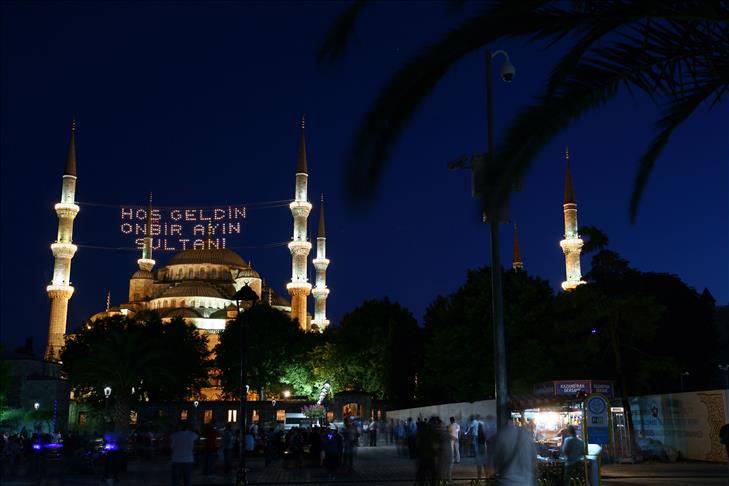
The garden of the Blue Mosque is another uniqe place worth checking out. Istanbul residents flock to the Sultan Ahmet neighborhood to break their fasts. The mosque square hosts exhibitions and fairs during the holy month. The centuries-old Tastes and Arts exhibition includes marbling art, glass art, calligraphy, rose pudding and baklava.
Welcoming the holy month of Ramadan, Muslims across Istanbul also rush to mosques to perform Tarawih prayers, an extra prayer specific to Ramadan, according to the practices of Prophet Mohammed, performed by Muslims following the obligatory night prayer known as 'Isha. The Blue Mosque is a symbolic space for these prayers. The first Tarawih, special prayers which are held in mosques every night of the month, will begin on Friday, June 27.
One of the most spectacular aspects of Ramadan in Istanbul is its mahya – messages of goodwill in the form of coloured lights which adorn the city’s mosques.
Mahya has a longer history: it is an Ottoman tradition. The ruling dynasty began adorning mosques with mahyain the early 1600s. Some claim that it was an imam’s assistant of the Fatih Mosque, the calligrapher Hâfiz Ahmed Kefevi, who hung the first mahya between two minarets of the Blue Mosque in 1616 or 1617.
Apart from the Ottoman capital, Istanbul, Mahya were also hung in mosques in Bursa and Edirne, which also served as Ottoman capitals. Yet Mahya remains a distinctly Istanbul art form.
Moreover, Ramadan drummers, who used to wake people up for the pre-dawn meal by drumming during the Ottoman times, will once again be in the streets of Istanbul with traditional Ottoman outfits such as fez hats.
In a tradition dating back to the days before alarm clocks, drummers awaken the faithful in many Istanbul neighborhoods during the holy month of Ramadan so that residents have time to eat a large meal before the day-long fast.
There is also a holy night during Ramadan called Laylat al-Qadr, which means 'Night of Power', when the first verses of the Qur'an were revealed to the Prophet Muhammad.
Muslims are instructed to seek the Night of Power during the last ten days of Ramadan, particularly on the odd nights. It is reported that the Prophet said, "Whoever stays up (in prayer and remembrance of Allah) on the Night of Qadr, fully believing (in Allah's promise of reward) and hoping to seek reward, he shall be forgiven for his past sins."
www.aa.com.tr/en