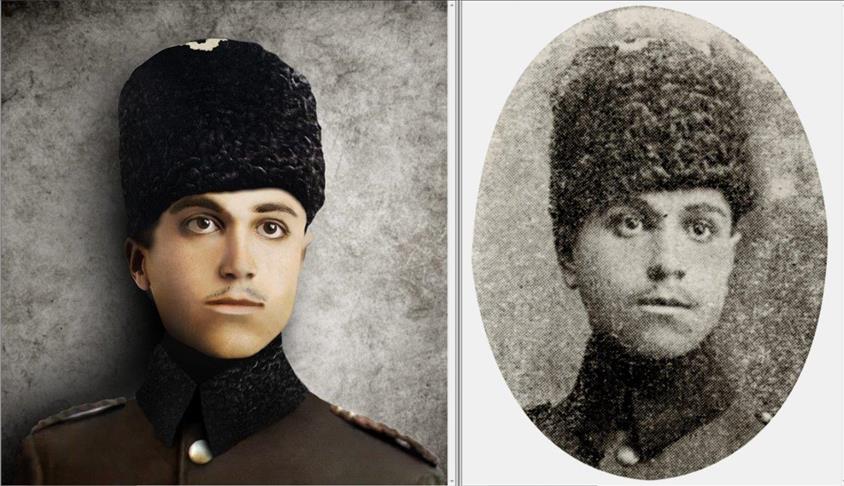
By Ayse Humeyra Atilgan
ANKARA
"Whoever finds this notebook should send it to the address above out of respect to a martyr."
This poignant diary entry from May 24, 1915, was written by a 21-year-old Turkish officer who fought and died in the Gallipoli Campaign 100 years ago.
Clearly Lieutenant Ibrahim Naji from Istanbul had already accepted the possibility of being killed at Canakkale; his only two remaining fears were "passing away without being able to fight enough against the enemy," and failing to deliver his diary to his family.
Described by his company leader – one Commander Bedri – as a slim man with bright eyes, Naji's diary reveals him to be a sensitive, observant youth.
This harrowing document – unearthed in 2012 by a keen collector of wartime materials, Seyit Ahmet Silay – avoided the military censorship of the era to give us a living, breathing account of conflict, loss and the emotional turmoil of a young man locked in deadly combat.
Like all wartime diaries, the profound is often mixed with the mundane: “The weather was pretty warm, then it clouded up, and it even rained at times. At 1:40 p.m. we arrived at Sirkeci," the first day of our martyr’s diary reads.
Naji was there as Ottoman soldiers made their way to the Canakkale battlefield from Istanbul, boarding ferries at Sirkeci (a coastal neighborhood in the present-day district of Eminonu.)
Even Naji’s journey to the fighting was dangerous: "Then we heard gunfire. An enemy submarine had fired a torpedo at one of the ships... Soldiers got out of the ferry..."
These troops were going to fight against the Allied soldiers who had landed on the shores of the Gallipoli peninsula – known as Gelibolu in Turkish. The troops were there as part of a plan to open the Dardanelles Strait on Turkey's Aegean coast to Allied fleets, allowing them to threaten the Ottoman capital, Istanbul.
Initially, soldiers were being transferred from Istanbul to Canakkale by sea. However, when Allied submarines began attacking, "especially in the second week of May," transfers were made by train to the Uzunkopru district of Edirne province from where soldiers then marched to Gallipoli – a dangerous one-day journey by foot.
"Passing through the area, we could hear gunfire on the road... We were ordered to move to the port of Akbas (in Canakkale) within five days and would later cross to the Anatolian side by ferry."
Naji could not have imagined that Akbas would later be home to a martyrs' cemetery where hundreds of Turkish soldiers are now buried.
Day 7, May 30, 1915: Naji and his comrades arrived at Yerlisu village in the morning:
"I ate a loaf of bread with yoghurt, and drank tea. I slept for a while, and when I woke up, my adjutant delivered an order. He wanted soldiers to wash their feet and the injured ones should get their feet immersed in the salty water... There were over 30 soldiers with wounded feet. Some of them were really in bad condition. However, there was nothing that could be done..."
The soldiers marched on to arrive at Gallipoli.
"Marching was so slow. We set up a military camp 3 kilometers away to the north of Bolayir at 6:30 p.m. Meals were not brought tonight; soldiers were given cheese."
Although, it is commonly believed that the Turkish army had trouble with providing enough subsistence to the soldiers, it is understood from what Naji noted down in his diary that there was not much trouble.
"Subsistence was perfect. Soldiers sometimes had a meal three times a day."
Day 10, June 2, 1915: Finally they reach the Dardanelles:
"...Oh! What luminescence the sea had. The bluish still water of Dardanelles deeply touched my soul. The off-white waves reminded me of Istanbul, of the beautiful Sariyer (coastal district)...
How far I am now from there, from my acquaintances!
I saw the ship of Sirket-i Hayriye (a Turkish maritime organization). The ship, which I had left in the Bosporus, appeared right in front of me again in the Dardanelles after eight days. I do not know why, but it aroused a unique excitement..."
Naji does not hide his feelings and writes about the longing and sadness of being separated from his loved ones.
"In the afternoon, I lay down for a while. In my dream, I saw two beloveds. I do not want to write about them in my diary because when I think of them, my heart squeezes. I feel like drowning..."
After they arrive at Gallipoli, Naji goes to the town. And here is how he describes a city which has been gripped by war:
"The city was charming but gloomy. There was nothing apart from the soldiers, cars and animals on the white and dusty streets of the city... Few shops, two restaurants, one or two coffee houses were open. All the remaining shops were closed. The houses were partially occupied by the army and there were a few people who insisted on staying at their own places."
Day 11, June 3, 1915: "Beautiful Canakkale was ruined. The enemy had burnt and demolished many parts of the city. The rest was empty or closed. Few shops were open..."
Naji thinks it was clear that a major battle had been going on in Seddulbahir "because there was constant and endless artillery fire."
At night the battle escalated. As it was silent at night, it could be well heard... We could hear the sounds of rifles. The more we climbed up the hill, the better we could hear the sounds."
Day 14, June 6, 1915: "The wind was so strong. Our 15- and 20-centimeter cannons began to fire at the enemy... Just now, the major told us that the enemy was repelled and that 17 machine guns were captured..."
One day later, Naji was ordered to make a copy of a Gallipoli map.
"I worked from 8:30 a.m. till 5:00 p.m. It just was not possible, because the curves, roads, walkways, telegraph lines on the map were so complicated... I would rather go to the battle instead of this duty!"
Soldiers were often reminded by the officer class of the holiness and significance of their duty – fighting against the enemy.
Naji has a mixture of feelings. He feels the weight of "the great responsibility put on my shoulders," as well as a deep longing for someone he calls “E.N.”
"Although I am so far from her, why can I not forget those dark black eyes and the fire hidden in them? Why do I still long for her, although she probably does not think of me?"
He stops writing there; and starts again a few hours later. "I am weak, I have been standing for hours listening to cannon shots."
Day 20, June 12, 1915: They are now in Eceabat (Maidos) – the European side of Canakkale today –, where "all buildings were destroyed and burned by the enemies' cannonballs."
This Rumelia [the Balkans] had been experiencing so many disasters for two years. What was the fault of these poor Muslim lands?... The assaults left thousands of women without children and thousands of men without food and medicine..."
Day 21, June 13, 1915: "The battle continues uninterruptedly under all types of weather...
The enemy airplanes are flying above us. When we see an airplane, we immediately lie down."
With "a wide field full of dead bodies" in front of him, Naji feels a new pain.
"Letters! A letter from Istanbul would relieve all tears of my heart; heal the anxiety of my soul. Yes, all my pain and sorrow would go away."
The letter he was waiting was likely from his beloved E.N., whose love made him feel sorrow all the time.
On a quiet Sunday afternoon, Naji looks around; "olive trees and almond trees on each side, and the strait shining like a mirror."
"It is hard to believe that the disaster of the battle on March 18 happened here," he writes, referring to the victory of Ottoman forces after having suffered huge losses defending Turkish shores from the invading Allies.
Day 23, June 15, 1915: Now, on their way to a good place to set up their tents, Naji saw some new graves, some of which did not have any marks on.
He reads the names of the martyrs killed in the battle. With his fellows buried just in front of him, and cannons firing around him continuously, Naji thinks about his own destiny.
"If I become a martyr, will they bury me just like this? Under some trees with pale leaves, and then leave me there?...
What about my beloved ones that I left in Istanbul? What will happen to my mother, sister, relatives?..."
In between the explosions of hundreds of cannons, Naji finds a mirror.
"How much weight did I lose? My cheeks are hollowed, my eyes sunken into their sockets. A yellow ring around my eyes makes me scared..."
Day 25, June 17, 1915: An airplane is coming!
"It was an airplane with black wings and a white tail. It flew over our headquarters... We could clearly see the plane dropping bombs. They exploded making a terrible sound... No losses."
Day 26, June 18, 1915: "Among all this beautiful scenery, I can see the coldness of death."
Day 27, June 19, 1915: "Gunfire continued here and there... Airplanes are flying continuously..."
At midnight: "I woke up with the terrible resonance of bullets flying above us. The enemy's cruiser was firing. All night long, cannon and infantry fire continued."
Day 28, June 20, 1915: "I opened my notebook with the grief of the idea that I felt yesterday.
I am recording my painful memories. However, I do not know if my family will ever read these lines..."
"We are in the battle; millions of cannons and guns exploded. My first corporal has just been wounded. Farewell," says Ibrahim Naji, finalizing the last sentence of his 29-day diary at 11.15 a.m. on Monday, June 21, 1915.
news_share_descriptionsubscription_contact

contact_the_ombudsman
is_there_an_error_in_this_story