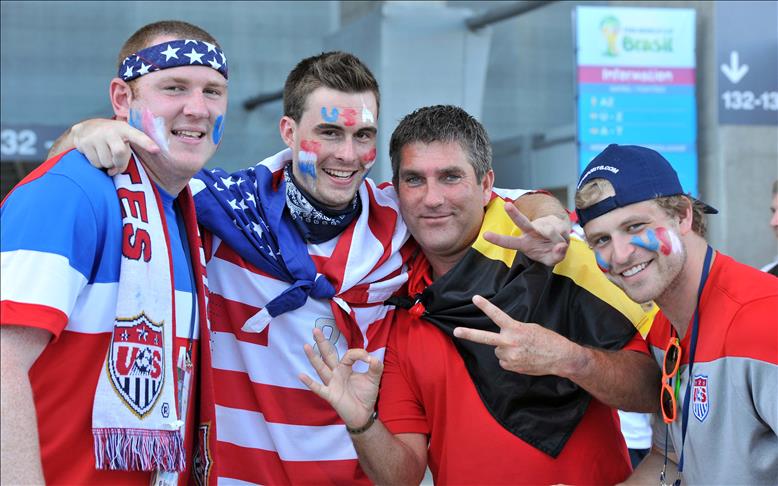
When the U.S. meet Belgium in Tuesday's World Cup group, round 16 knock-out match, they will be cheered on in the stadium by some 6,000 fans who have made the long trip to Salvador from the U.S., and a potentially record-breaking TV audience at home.
For most other teams in the tournament, this would be nothing unusual. But not long ago, it was hard to find a bar in the U.S. that would have showed international football matches.
That is changing, say experts and fans alike. Long side-lined by sports like baseball and american football, “soccer” is becoming increasingly popular in the U.S.
This year, U.S. fans bought far more World Cup tickets than any other country bar the host Brazil. Almost 200,000 tickets were sold in the U.S., with Argentina, Brazil’s neighbor and a notoriously football-mad country, coming in a distant second with just over 60,000 tickets sold.
The U.S. team’s tense June 22 game against Portugal drew in a record 13.8 television viewers in the U.S., and 10.8 million watched the U.S. play Germany, which saw them qualify for round 16 despite a 1-0 loss.
“This summer with the World Cup here in Brazil, the number of tourists here from the U.S. has been pretty amazing,” said Euan Marshall, a football writer and co-author of A to Zico: an alphabet of Brazilian football. “In the U.S. it’s always going to have to compete with massive sports they have there like baseball and basketball, but you can certainly see that with the popularity of the men’s soccer team and their improving results year by year the popularity of the sport is increasing.”
Part of the reason, Marshall believes, is simply that the U.S. team is getting much better – and U.S. fans prefer to root for a team with at least a fighting chance of taking home the trophy.
“I think the U.S. has quite a similar mind-set in some ways to Brazil: for both of them the really important thing is winning, and it’s not so much about the sport itself,” he told the Anadolu Agency (AA). “That can be reflected in its growing popularity: they are getting closer to winning something, so there is an increased chance of glory and therefore more interest.”
Football is even reaching the political realm: U.S. President Barack Obama is reported to have watched the U.S. team play last week from Air Force One, while ultra-conservative pundit Ann Coulter recently declared a growing interest in football to be “a sign of the nation’s moral decay,” and said “No American whose great-grandfather was born here is watching soccer.”
Evan Smith, 27, a life-long football fan from Los Angeles in Brazil for the World Cup, attributed the surge in football enthusiasts in part to a new generation of fans who saw the USA host the tournament at a formative age.
“People of my generation are now coming of age, people who were kids when the U.S. hosted in 1994,” Smith told AA. “That really exposed a lot of people to soccer and let them see how exciting it could be first-hand.”
Marcell Hilliard, 30, visiting Brazil from New York City, said that he saw in football an opportunity for a particularly American type of camaraderie.
“It’s kind of typically American to really believe we are better than the other countries,” Hilliard told AA. “We like rooting for our country, and we like being the underdog, and we don’t really have other chances to do that than with soccer.”
Despite its new legion of fans, the U.S. team will face a tough game against Belgium later today. But they are still in with a chance, says Marshall, despite a gruelling schedule that has seen them play in some of Brazil’s hottest cities, and travel thousands of miles.
“From my own calculations they are the team that have travelled the most and Belgium the least so we’ll see if makes a difference,” Marshall said. “But from what I’ve seen in the tournament the most encouraging thing about the U.S. side is that they’re really fit, probably the fittest team in the tournament.”
“They’ve certainly got a chance, and they might well be more accustomed to the heat today than Belgium, who have played mainly in the cooler southeast.”
www.aa.com.tr/en