TEHRAN
Iranian President Hassan Rouhani said on Sunday the nuclear deal sealed in Geneva between Iran and the six world powers -- US, Britain, Russia, France, China and Germany -- on its nuclear program showed that Tehran's "nuclear rights" have officially been recognized.
"Iran's right to uranium enrichment on its soil was accepted in this nuclear deal by world powers," Rouhani said during a live broadcast on state Press TV.
Welcoming the agreement reached after decade-long efforts, Rouhani said the negotiations were "tough and complicated," but noted that the Iranian negotiation delegation managed to "prove the Iranian nation’s rightfulness on the international scene."
He highlighted that Iran is eager to start talks immediately on a comprehensive nuclear agreement.
"Talks on a comprehensive agreement will start immediately," said Rouhani, emphasizing that Iran had a strong will towards further talks.
Rouhani also spoke well of the easing of the sanctions against Tehran as mentioned in the deal.
"World powers have come to the conclusion that sanctions and pressures will prove futile, and as Iran stated from the very beginning, there is no way to reach agreement but through mutual respect and respectful negotiations."
"The structure of the sanctions against Iran has begun to crack," argued the president of the Islamic republic, saying the sanction policies failed with the fresh nuclear agreement.
Rouhani added that stage was set for taking further steps toward safeguarding the Iran’s technical and economic development.
In a letter, the Iranian president attributed the success of the talks with the P5+1 group -- five permanent members of the UN Security Council plus Germany -- to the guidelines set out by Iran’s supreme leader, Ayatollah Khamenei, praising Iranian nation’s backing of the Tehran administration.
"Undoubtedly, this breakthrough is the result of God's blessings, the Leader's guidelines and unwavering support of the Iranian nation," he said.
The Iranian leader also remarked that the deal was possible due to "Iranian people’s vote for moderation," referring to the June presidential election that brought him to power.
"Constructive engagement [and] tireless efforts by negotiating teams are to open new horizons," Rouhani also said on his Twitter account right after the announcement of the agreement.
He also argued that the claims saying Iran wants nuclear weapons were "a historical joke."
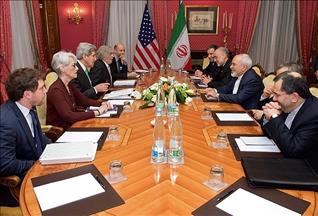
After more than four days of intense negotiations at the third round of nuclear talks, Iran and the P5+1 penned an interim deal in Geneva of Switzerland on Sunday morning to freeze Tehran's nuclear program in exchange for limited sanctions relief to secure that its nuclear power could be used only for peaceful purposes.
The historic agreement requires Iran to halt or scale back parts of its nuclear infrastructure, the first such pause in more than a decade, foreseeing an initial six-month period that brings boundaries to Tehran’s nuclear program.
The main aim of the accord is to give international negotiators time to pursue a more comprehensive pact to roll back much of Iran’s nuclear program.
Tehran's next-generation centrifuges and the Arak reactor, which could begin to produce plutonium as early as 2014, would be halted, along with new international inspections to be implemented throughout the nuclear program.
In exchange, Tehran would receive limited sanctions relief, which would add roughly $1.5 billion in revenue from suspended sanctions "on gold and precious metals, Iran's auto sector, and Iran's petrochemical exports".
An additional $4.2 billion would be transferred to Iran in installments from Iranian oil sales and Iran will be allowed to transfer $400 million in tuition assistance for Iranian students to international educational institutions.
englishnews@aa.com.tr