By Ayhan Simsek
BERLIN
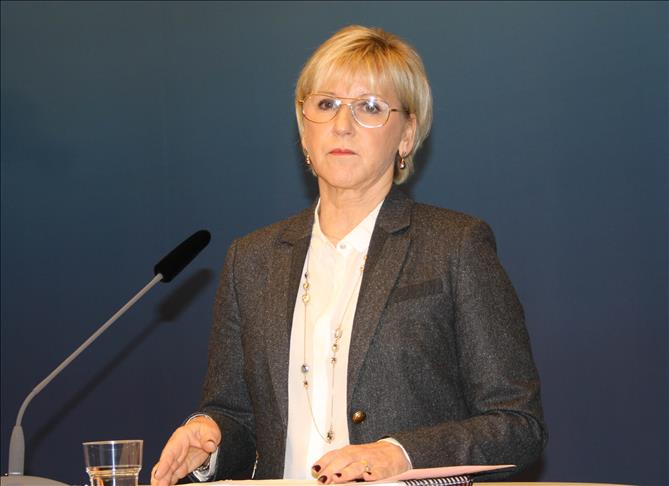
Sweden’s Foreign Minister Margot Wallström has expressed hope that her country’s move to recognize Palestine as a state last week will strengthen moderate forces among Palestinians and help resolve the Middle East conflict.
Wallström said on Wednesday in Berlin following talks with Germany’s Foreign Minister Frank-Walter Steinmeier: "Too many Palestinians have to either accept the current desperate situation on the ground or to take to violence. Instead we want to support the moderate forces in Palestine under the leadership of President Abbas."
Wallström dismissed criticisms directed by Israel and several Western countries of the recognition of Palestine before a solution to the Middle East conflict is agreed.
“It is not a matter of being too early, but it is rather the risk of being too late. Because we see escalation of violence, we see radicalization, we see very problematic situations on the ground, not least in Gaza,” said Wallström.
“What we believe is that by doing this (recognizing Palestine), we can create a less unequal situation for the two parties that we want to get back to the negotiation table,” she said.
Raised expectations
Sweden’s move raised expectations among Palestinians that some other European countries would follow in recognizing Palestine as a state.
However, EU’s political and economic heavyweight Germany announced last week that it would only recognize a Palestinian state after a peace deal was agreed among the parties.
Swedish Foreign Minister Margot Wallström underlined that, despite differences in the recognition debate, both Sweden and Germany support a two-state solution and efforts to revive the Middle East peace process.
“We accept and respect the fact that there are countries who have a very different approach for historical or other reasons,” Wallström said.
“We knew that we would get both applause and criticism and this has also been the case. What we see is that this will probably help a debate, even a more lively debate about the future for the Middle East. We give full support to the efforts for the Middle East peace process,” she said.
'Serious negotiations'
Steinmeier acknowledged disagreements between Sweden and Germany on recognizing Palestine and underlined the need for a sustainable ceasefire between Israel and Palestinians to revive the peace process.
“ We don’t lecture each other. We try, each on its own way, taking into account our respective histories, we try to make a contribution towards finding and realizing a two-state solution,” Steinmeier said.
“We try to lend support and make contributions towards finding a sustainable and permanent ceasefire, as a consequence of the third war in Gaza. Of course we must avoid a fourth war in Gaza. We must prevent that,” he added.
“In the long run, a ceasefire will only be sustainable if it actually ends up in serious negotiations on the two-state solution,” he said.
www.aa.com.tr/en