By Hassan Isilow
JOHANNESBURG
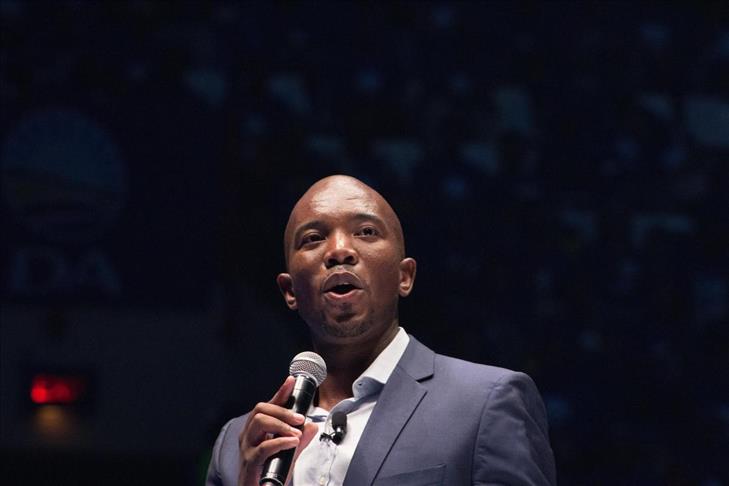
The election of a young black politician as leader of South Africa's main opposition party will help it win more support among the black majority and challenge to the party that has ruled the country since the end of the apartheid regime in 1994, experts believe.
"The Democratic Alliance (DA) is now a more legitimate opposition party than it was in the past," Professor Dirk Kotze of the University of South Africa (UNISA) told Anadolu Agency in an interview.
Musi Maimane, 34, was elected on Sunday by the DA's national congress to replace Helen Zille, who had stepped down last month as party leader.
He defeated party chairman Wilmot James for the top job during the party's elective conference held in Port Elizabeth, one of the largest cities in South Africa, situated 770km east of Cape Town.
Professor Kotze believes that with Maimane's election, winning will be harder for the ruling African National Congress (ANC) in the 2016 upcoming local government polls and the 2019 general elections.
"There is going to be genuine competition since the DA is no longer considered a white party," he said.
Shadrack Gutto, another political analyst, agrees.
"I think the election of Maimane is historic," he told Anadolu Agency. "It shows the Democratic Alliance is revolving."
Gutto expects Maimane leadership to boast the DA's support base among black voters.
"The election of Maimane as federal leader is very important but let's watch the space and see how white and black voters respond," he said.
The DA, which used to be viewed as a white-oriented party, has attracted young black professionals, and business people who are impressed with its level of accountability and professionalism.
Maimane joined the DA in 2009 and in a two-year time rose to the rank of national spokesman before becoming parliamentary leader in 2014.
In the 2009 general elections, the DA won 2.9 million votes.
Five years later, it garnered over 4 million votes, representing some 22 percent of the total cast votes.
The DA has increased its support among black voters from 0.8 percent in 2009 to approximately 6 percent in 2014, with 40 percent of these votes won in Gauteng province.
About 760,000 black South Africans voted for the DA in the 2014 parliamentary elections.
The DA has 89 seats in the 400-member National Assembly and is the only opposition party that governs one of South Africa's nine provinces.
Zille, the party's former leader, is currently serving her second term as premier of the Western Cape Province.
-Youthful leaders-
Many believe that the election of 34-year-old Maimane ushers in a new generation of youthful leaders in South Africa.
"The youth are rising in South Africa's political field," said Gutto, the analyst.
"The Economic Freedom Fighters Party (EFF) is led by Julius Malema who is also in his 30s and now the DA is being led by Maimane," he noted.
Malema was the former leader of the ANC youth wing, before defecting and forming his own party.
Gutto said the ruling ANC now needs to rethink its strategy in terms of getting young people into leadership positions.
"People are tired of veteran politicians who keep reminding them of the role they had played in the country's struggle," he noted.
"We are now 21 years into democracy and need to move on," said the expert.
The ANC mainly gets its support from the country’s black majority, primarily because of the role it had played in liberating South Africa from the white minority rule.
Successive governments have built free houses and offered grants to millions of South Africans who view this as an ANC program and in return vote for the party.
-Crossroads-
Political analyst Andre Duvenhage believes the DA is at crossroads and needs to redefine itself.
He believes Maimane's first strategic target will be to win the major metropolis in the 2016 local government elections.
Duvenhage also agrees that the ruling ANC party will face more competition from the new opposition leader.
"The ANC is going to feel some heat," Duvehage, who teaches politics at the University of Northwest, told Anadolu Agency.
Maimane was born in 1980 in Soweto, a township of Johannesburg where late president Nelson Mandela and Archbishop Desmond Tutu once lived.
Married to a white woman, he is viewed by many as a person who can unify South Africans of all ethnic backgrounds.
A message Maimane was keen to reinforce in his acceptance speech.
"We are guided by our values. It is our values that unite us," said the young opposition leader.
"I want to tell you today: it is our values that will lead us to victory," he added.
He said the people who share these values cannot be defined by race or by class.
"We must triumph over the evil of apartheid by building a new bridge into a new future," Maimane insisted. "We must not remain victims of our yesterday, we must believe in tomorrow."