By Michael Hernandez
WASHINGTON
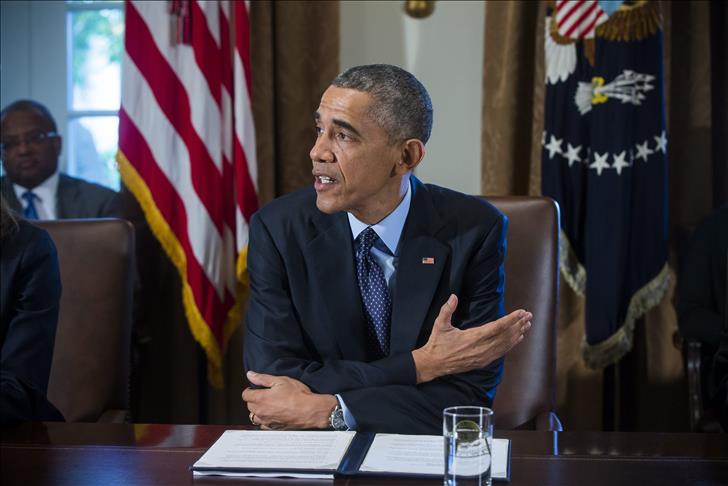
Lawmakers are bracing for a showdown with President Barack Obama as a new Republican-controlled Congress is set to convene Tuesday.
The 114th Congress will be comprised of 58 new faces in the House of Representatives, and 13 in the Senate. Of those in the House, 43 are Republicans, increasing Republican control there to 234 of 434 representatives – the largest majority they have held since the early 1930s.
In the Senate, 12 of the 13 incoming lawmakers are Republicans, switching majority control to Republicans for the first time since 2006.
Seeking to advance their own agenda, lawmakers will also be faced with an American public that has grown dismayed by congressional performance, and is hungry for lawmakers to overcome partisan divides and take action.
A poll conducted by Gallup on Dec. 11, 2014, showed public opinion of the federal legislature sitting at just 16 percent. And some estimates show the preceding Congress to have been the second least-productive in history.
"They are under tremendous pressure. And this is something that I don’t think has fully sunken in to most Republicans," said John Hudak, a fellow at the Brookings Institution.
Douglas Farrar, an associate at the Aspen Institute, said Congress will likely attempt to make progress on small issues like infrastructure spending and changes to America’s tax code, but doubted that the American people will be satisfied with piecemeal accomplishments.
"It’s hard to say. There’s a lot of big issues before the United States, and I think it will be hard for Congress to address all of them," he said.
But with control of both houses of Congress, Republicans now have a greater opening to drive policy than at any other time in Obama’s tenure.
To date, Obama has vetoed legislation only twice. With Republicans taking control of the Senate, that is likely to change in the final two years of his presidency.
Democratic control of the Senate previously shielded the president from Republican legislation that could have forced a veto.
With that gone, Obama will now have to fend off potential advances from Republican lawmakers seeking a rollback in his hallmark health care overhaul, approval for a controversial energy pipeline, and a reversal of the president’s executive actions on immigration reform.
"If Republicans seek to take health care away from people who just got it, they will meet stiff resistance from me. If they try to water down consumer protections that we put in place in the aftermath of the financial crisis, I will say, no," Obama said during an end-of-year press conference in December.
A key battle rapidly approaches as Republicans seek to leverage funding for the Department of Homeland Security, the agency largely responsible for border security, to get Obama to change course on his executive actions that could shield roughly 5 million undocumented immigrants from deportation.
Unlike all other departments, last year’s spending bill funded Homeland Security only through the end of February. The short-term spending measure was largely seen as giving Republicans an opening to leverage the department’s funding.
"It could be something that ends up being much ado about nothing, or it could be perhaps the most aggressive fight that we see in 2015," Hudak said.
But a major fight could prove costly for lawmakers who would have to assure the public that restricting funding would not jeopardize national security.
"I don't think the American public, beyond the Republican base, is going to make much of a distinction between holding up certain types of funding for a specific portion of an immigration service, and all of the funding for the department," Hudak added.
Major foreign policy showdowns loom large as well as a final deal with Iran over its nuclear program is scheduled for no later than July 1, 2015, and the Obama administration pursues an ongoing détente with longtime foe Cuba, and congressional approval for military action against the Islamic State of Iraq and the Levant.
Hudak said that there will be a "surprising" number of foreign policy areas that Republicans and Obama will be able to find common ground on, but Iran is not likely to be one of them.
"They will certainly make this one of the central divisions that the Congress has with the president," he said. "It's going to have a lot more to do with politics than it is going to do with policy, and whenever that’s the recipe, it’s going to be a pretty drag out process."
Farrar, the Aspen associate, said that Obama is likely to prioritize a tangible outcome from the oft-delayed negotiations despite unwavering congressional opposition.
"There’s a lot of work to be done there by the State Department and the president to create a plan, and come up with a deal that’s acceptable to the American people and to Congress," he said. "It will be tough sailing for them to do that."