Nazli Yuzbasioglu
17 June 2026•Update: 17 June 2026
A panel focusing on the upcoming NATO summit in Türkiye, as well as the alliance's current state and future amid evolving global security challenges, was held in the Netherlands on Tuesday.
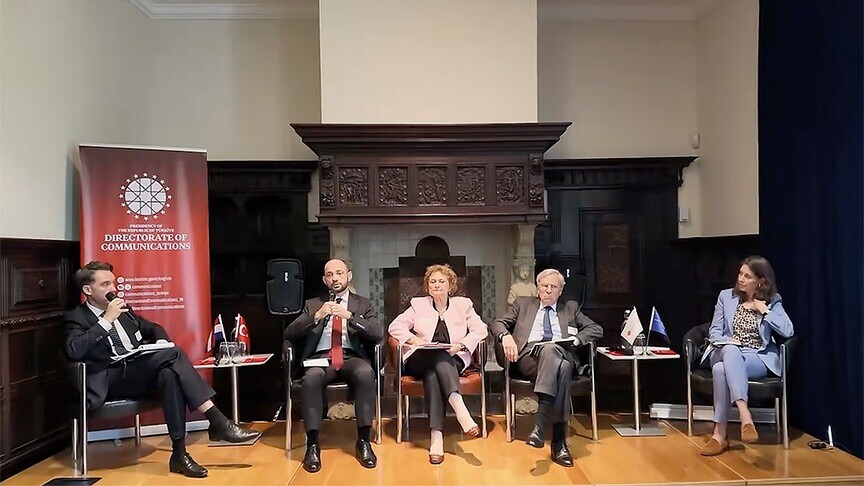
The panel "From The Hague to the Ankara Summit: NATO's Future in a Transforming Global Security Environment" was co-organized by Türkiye’s Communications Directorate, the Turkish Embassy in The Hague, and the Dutch-based Clingendael Academy.
The panel was held as part of a series of events previously organized by the directorate in Madrid, Paris, London, Warsaw, Washington, Rome, Brussels, Helsinki, and Berlin.
The panel was attended by ambassadors and diplomats from over 20 countries, representatives of various international organizations, officials from Dutch public institutions, and academics from Dutch universities.
Hosted at Clingendael's headquarters, the panel opened with remarks by Turkish Ambassador to the Netherlands Fatma Ceren Yazgan and Martijn Pluim, director of the Clingendael Academy .
Their remarks were followed by a video message from Burhanettin Duran, the head of Türkiye's Communications Directorate.
The panel – moderated by Bart Van Den Berg, the head of Clingendael's security and defense program – included remarks by former NATO Secretary General Jaap de Hoop Scheffer, Netherlands Atlantic Association Director Anna van Zoest, Turkish Presidential Security and Foreign Policy Council member and National Intelligence Academy faculty member Nursin Ateaoglu Guney, and Murat Aslan, a faculty member at Hasan Kalyoncu University in Gaziantep, Türkiye and senior researcher at the Foundation for Political, Economic and Social Research (SETA), a think tank based in the Turkish capital Ankara.
Yusuf Ozhan, deputy director general and editor-in-chief at Anadolu, also delivered remarks during the panel.
Pivotal NATO summit next month in Türkiye
The panel discussed such problems as the evolving security environment, the rise of hybrid threats, the impact of artificial intelligence on security, and NATO’s capacity to adapt to such challenges.
Türkiye’s importance within the alliance, stemming from its possession of NATO’s second-largest army and its operational experience in the field, was also highlighted.
Attention was also drawn to Türkiye’s advancing defense industry technologies and its strategic value for NATO and European security.
It was noted that next month’s NATO summit, hosted in Ankara on July 7-8, would be held at a critical juncture in the current global security environment.
NATO’s future is closely linked to its ability to adapt to hybrid threats, strengthen its defense capabilities, and maintain a comprehensive approach to security, said the panelists.
Türkiye’s geostrategic position, mediation capacity, and defense capabilities were also emphasized, while its importance was underlined not only for NATO’s southern flank but also for the alliance’s overall security.
The panel further highlighted Türkiye’s active and constructive role within the alliance and stressed that the Ankara summit is expected to be a historic gathering where significant decisions will be taken.
As part of the event, a separate meeting with members of the press was held under the auspices of the Turkish Embassy in The Hague.
At the meeting, attended by national and international journalists based in The Hague, Guney, Aslan, and Ozhan took questions on the Ankara summit and Türkiye’s contributions to NATO.
Alongside evolving global security threats, the alliance’s security ecosystem, and Türkiye’s significance for NATO and EU security, the need to strengthen the defense industry was also discussed.