By Lauren Crothers
PHNOM PENH, Cambodia
On April 17, 1975, a 14-year-old Youk Chhang was home alone when his world began to fall apart.
Battle-weary Khmer Rouge soldiers, who had been engaged in fierce and intense fighting with soldiers from Cambodia’s ruling Lon Nol regime, began filing in to the capital city to a rather jubilant reception.
The Lon Nol soldiers -- despite being backed by the United States -- had been unsuccessful in their bid to thwart the advance of the wild-eyed guerrillas who began stripping them of their weapons and marching them in the direction of the Olympic Stadium.
But the jubilation was short-lived, as the Khmer Rouge quickly began issuing an order that came from above: that inhabitants needed to leave the city immediately, as the U.S. was planning to bomb Phnom Penh. People were told they would be able to return in a few days.
In reality, the evacuation -- during the hottest month of the Cambodian calendar -- was the first in a series of policy decisions by the ultra-Maoist regime that completely shattered the country and its people over the following three years, eight months and 20 days.
It was also based on a falsehood; instead, the new rulers wanted to drive people out of urban centers to kick-start a brutal, agrarian nightmare in which rice production and dam construction were key components.
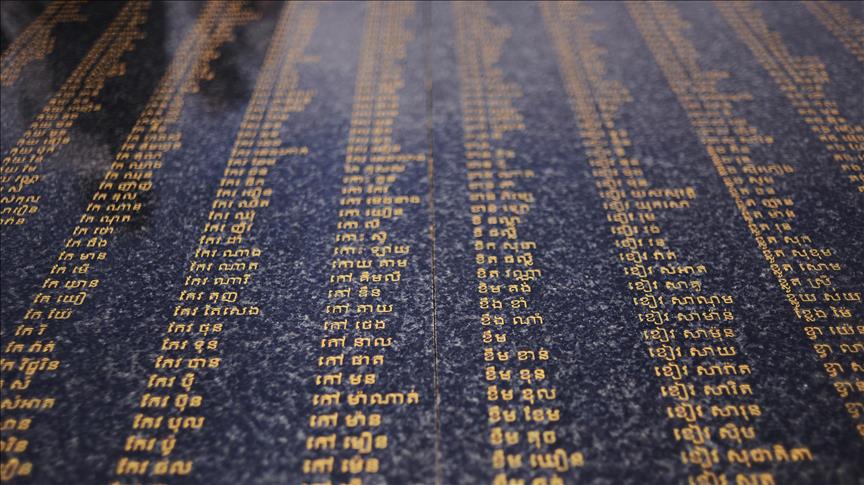
Around 1.5 million people perished.
On Sunday, Chhang, now the director of the Documentation Center of Cambodia (DC-Cam), left his house at 8 a.m. to make the same journey -- this time by car -- in what has become something of a regular pilgrimage to connect to the boy who took several weeks, alone and afraid, to reach his destination.
It’s a journey he has been making almost every other year since the Khmer Rouge fell in 1979.
“It’s to see the memories of my life,” he told Anadolu Agency by phone Sunday from Takeo province.
“They are not always good things; sometimes they are bad. Memories have a double role. The positive memory has been discussed widely, so I want to experiment now with confronting the bad memories I faced 41 years ago when I was evacuated.”
What he has discovered through this process, he said, is that by looking back, it has given him “the strength to move forward”.
Today, it is still as sweltering as it was back then when, with only a bicycle, pair of jeans and some books, he set out on that exodus -- one of around a million people to do so.
The sheer number of people clogging up the roads out of the city meant that a journey of a few kilometers could take up to a day.
It was several weeks before he reached his mother’s village, only to find that she was not there.
It would be six months before he could reunite with her.
“I faced the same heat today,” he said. “It was very hot and imagine back then -- millions of people walking in the heat with babies, women who were pregnant, forced to leave -- you just cannot imagine.”
Under Khmer Rouge rule, similar evacuations were being carried out around the country’s other urban centers.
The forcible movement of people from Phnom Penh, however, formed the basis of the first case heard against the regime’s former head of state, Khieu Samphan, and “Brother number two,” Nuon Chea, which started in 2011.
The trial chamber judges at the Khmer Rouge tribunal found both octogenarians guilty of crimes against humanity and sentenced them to life in prison in Aug. 2014.
Both have appealed before the tribunal Supreme Court Chamber, and are now being tried on genocide charges for their roles in the years that followed the evacuation.
Chhang told Anadolu Agency that the most fitting punishment would be for both to “walk barefoot” in the April heat along the same roads that so many had to all those decades ago.
“Punish them to their last breath, because they will never understand the human condition,” he said.
As the director of DC-Cam, Chhang has had the duty of serving as custodian of so many of the country’s memories; film reels, photographs, diaries and documents make up the library’s contents. DC-Cam is a key source of information on the regime.
Today, he is still passionate about connecting the youth to the crimes of the past, in order for them to understand the Cambodia of today.
“Without understanding the past, we can’t connect to the current situation,” he said. “The journey helps me bridge these two sides.”
Chhang has spent all these years learning about what the experience meant to him and how it ultimately shaped him.
Even today, he said, he finds it hard to believe that his 14-year-old self had the resilience to make the journey and survive what came afterward.
“Only 41 years later do you understand that they couldn’t destroy humanity completely,” he said. “They failed.”