BANGKOK
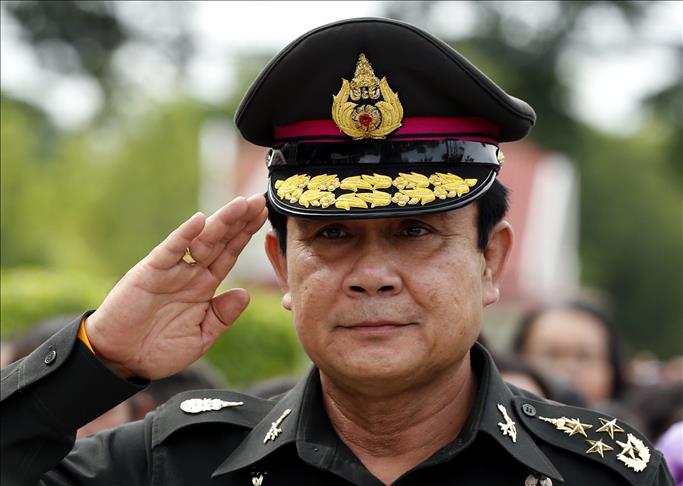
The Thai junta was facing international and domestic backlash Friday over its decision to give absolute power to junta chief-cum-Prime Minister General Prayuth Chan-ocha.
The lifting of martial law Wednesday saw it replaced with article 44 of the interim constitution -- a decree that the European Union claimed in a late statement Thursday "does not bring Thailand closer to democratic and accountable government."
The United Nations, United States and local media organizations also condemned the move, particular disdain reserved for a clause that allows civilian courts to be substituted for military courts in national security cases.
“Military courts should not be used to try civilians," stated the EU. "As a friend and partner of Thailand, the EU reiterates that the rule of law and the protection and promotion of human rights should underpin progress towards full restoration of democratic governance in Thailand."
Martial law had been imposed across Thailand since the May 22 coup that overthrew the government of Yingluck Shinawatra. In the coup's wake, hundreds of activists, politicians, journalists and academics were arrested and detained in military camps, in most cases for the maximum seven-day period allowed.
On Wednesday, Thailand’s 87 year-old King Bhumibol Adulyadej approved Chan-ocha's request to lift martial law, except in three insurgency-plagued Muslim provinces in the remote south.
Chan-ocha immediately enacted article 44 of the interim constitution, which gives him the power to issue orders in any fields without executive, legislative or judicial oversight, and military officers above the rank of lieutenant to conduct searches and arrests without court warrants.
A few hours before the EU statement, the U.S. State Department registered its concern.
"It is important that any new security measure end the practice of trying civilians in military courts, end detention without charge, and allow individual to freely exercise fundamental rights, including the rights of freedom of expression and peaceful assembly," it said.
"We are concerned that moving to a security order under article 44 will not accomplish any of these objectives," it added.
But the strongest reaction came from the United Nations High commissioner for Human Rights, Zeid Raad al-Hussein, who issued a stinging rebuke saying that martial law had been replaced "with something even more draconian."
Article 44, he said, "leaves the door wide open to serious violations of fundamental human rights and annihilates freedom of expression."
"In effect, this means the sweeping away of all checks and balances on the power of the government, rendering the lifting of martial law meaningless."
Inside Thailand, opponents were more reserved, media outlets being careful not to overstep an undefined line that states that media reports "causing fear or misunderstandings" could be banned.
The four main media associations -- from both print and broadcast news -- issued a statement asking the junta to define the scope of the order.
"Article 44 gives the military sweeping powers without setting out clear criteria on which reports represent threats to national security," it stated.
Not everyone was critical, however. The move received applause from the Thai business sector, which said it expected the new measures to gives some momentum to the sluggish economy.
"If the prime minister can use article 44 to improve the economic situation as a whole, it would be beneficial because article 44 means that executive approval and economic stimulation should be faster,” Supant Mongkolsuthree, chairman of the Federation of Thai Industries, told The Nation.
Analysts say tourism, which makes up around 10 percent of Thai GDP, should rebound as the imposition of martial law was preventing foreign insurance companies to offer travel protection to policyholders visiting Thailand.
Political scientist Thitinan Pongsudhirak appeared to have the final words.
"The risks of missteps and mistakes will likely increase because the onus will now be on the prime minister as the omnipotent and omnipresent source of authority," he wrote in a Bangkok Post editorial.
"If [Chan-ocha] has learned any lesson in the 10 months since he staged the May 22 coup, it’s that absolute power cannot win every battle, especially the economic one."