Mauritian president, new Turkish ambassador explore avenues to expand cooperation


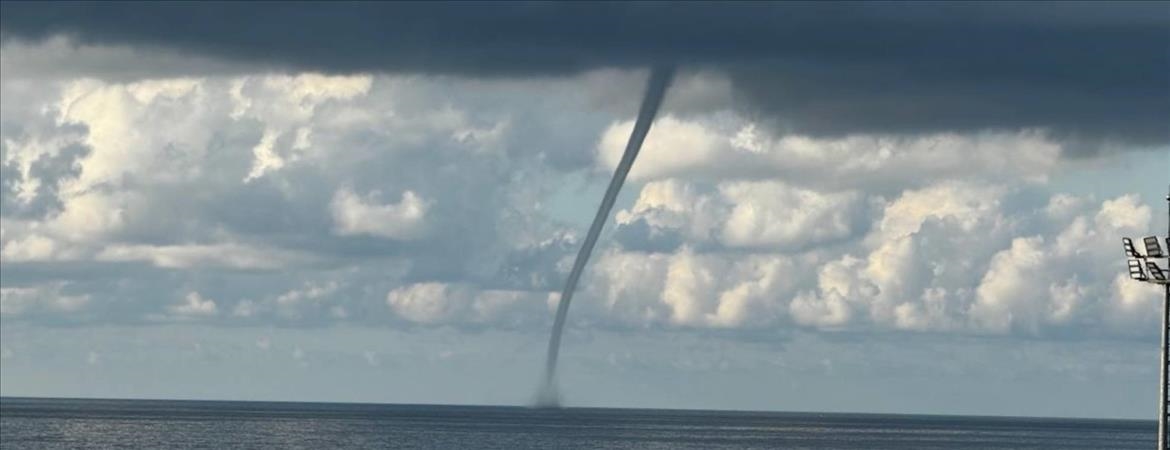
Tornadoes, whose number and intensity increase with climate change, affect agricultural production, especially greenhouse farming.
Board member at Bogazici University’s Center for Climate Change and Policy Research, professor Murat Turkes evaluated the formation conditions of tornadoes, the increasing trend in Türkiye, and their impacts on agriculture for Anadolu.
Explaining that tornadoes originate from supercells or mesocyclones, which are the most powerful thunderclouds, Turkes said, "A tornado is a narrow but destructive column of air extending from the base of a well-developed electrically charged cloud (cumulonimbus) to the ground, around which very strong winds rotate. It is called a 'tornado' when it occurs over land and a 'waterspout' when it occurs over a body of water."
Noting that despite their small spatial scale, tornadoes can cause great destruction in a very short time, Turkes said that this places them among the extremely dangerous weather events, especially for agricultural production.
Explaining that tornadoes were observed mostly around the southern and central parts of the US and the Gulf of Mexico, Turkes stressed the fact that these weather events have significantly increased in the Mediterranean Basin and Türkiye in the last 20 years.
Turkes underlined that this increase cannot be explained solely by the improved observation capabilities and that climate change has made atmospheric conditions favorable for tornado formation more widespread.
Highlighting the fact that climate change makes the atmosphere warmer and more humid, Turkes said, "As the amount of water vapor in the atmosphere increases, thunderstorms produce more energy. This causes systems that only created downpours in the past to now turn into supercells and produce tornadoes."
Turkes explained that warm and humid air masses accelerate this process even more, especially in regions where sea surface temperatures are high.
Stating that the tornado risk has increased especially in coastal regions in Türkiye, Turkes noted that tornado formations are observed over land and sea along the Mediterranean coast, Antalya and Iskenderun bays, Northern Aegean, Izmir surroundings, Sea of Marmara, Eastern Black Sea, and occasionally in Northeastern Anatolia.
He said that sea-land interaction, topography, and warm sea surface conditions support tornado formation in these regions.
"There is a 50-60% increase"
Turkes stated that assessments based on the records of international meteorological centers indicate a significant increase in the number of tornadoes.
"When we compare the past 20 years with the previous 20 years, it can be said that there is a 50-60% increase in both the number of tornadoes and the number of areas where tornadoes are seen in Türkiye. Climate change has played a major role in this increase," Turkes said.
He added that station-based, long-term tornado records are still limited, international severe weather databases constitute an important reference.
"Greenhouse farming is highly vulnerable to such severe weather events"
Emphasizing that the effect of tornadoes on agriculture is not limited to their rotational movement areas, Turkes said:
"The main damage comes from strong winds, heavy precipitation, and hail produced by these systems. Greenhouse farming is very sensitive, that is, highly vulnerable, to such severe weather events; supercells causing tornadoes can produce very strong winds, downpours, and hail within an hour. This bursts greenhouses, blows off roofs, and directly damages plants."
He added that not only greenhouses but also the products inside them can be completely lost in a short time.
"No matter how strong the greenhouse is, it is defenseless against tornadoes"
Underlining that indoor farming is increasingly moving away from being a safe option amid the climate crisis, Turkes said: "Greenhouse structures have to be lightweight by nature. If built very thick and heavy, they lose their effect. Therefore, it is not possible to build a greenhouse fully resistant to a storm producing a tornado. No matter how strong the greenhouse is, it is defenseless against tornadoes."
Turkes noted that measures that can be taken in greenhouses can reduce the risk but cannot completely eliminate it, which makes greenhouse farming exposed to climate-related disasters.
Turkes noted that valleys and coastal belts frequently affected by tornadoes are well known to local communities, and producers with traditional knowledge should choose production areas by taking these risks into account.
He said certain valleys and coastal areas act as "atmospheric corridors" for tornadoes, making greenhouse farming in these areas particularly perilous.
Turkes stressed the importance of closely monitoring severe weather warnings issued by the Turkish State Meteorological Service and international meteorological centers. "If there are warnings for thunderstorms, strong winds, and hail, the possibility of a tornado must also be kept in mind," he said.
He added that early warning systems play a critical role in allowing producers to reinforce greenhouses and take emergency measures.
Crop insurance plays a critical role against tornado risk
Stressing that tornado risk cannot be completely eliminated, Turkes said crop insurance plays a critical role and that insured production has become a necessity rather than a choice under climate change conditions.