Experts say waste, water crises require concrete action at COP31 in Türkiye


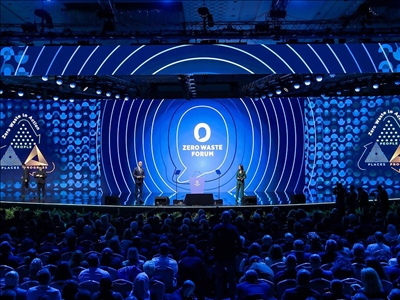
As Türkiye has recently intensified its engagement in international fields such as environment, circular economy and sustainability diplomacy, it has also assumed an active role in key negotiation and decision-making processes related to waste management and resource efficiency. While institutional structures that support policy development stand out in these processes, the Zero Waste Foundation contributes to the advancement of sustainable environmental policies through waste reduction, recovery and awareness initiatives aligned with national priorities.
Speaking to Anadolu, president of Zero Waste Foundation, Samed Agirbas evaluated the foundation’s activities in 2025 and outlined its future objectives.
Agirbas said that the zero-waste approach was no longer merely an environmental preference last year, but had become more firmly positioned as a comprehensive policy-making tool in areas such as development, resource management and social responsibility.
Agirbas emphasized that the vision put forward by Emine Erdogan, founder of the “Zero Waste Movement” and Honorary President of the Zero Waste Foundation, has guided this process.
“2025 was a productive period in which multi-layered efforts, from awareness to implementation and from local to global, were supported by concrete outcomes. Thanks to collaborations established between universities, local authorities, public institutions and civil society, zero waste was transformed into measurable and scalable practices,” he said.
Agirbas stressed that combating climate change, protecting natural resources, preventing waste and building a culture of sustainability were at the core of their efforts, adding that publications, reports and training programs prepared during this period also strengthened the intellectual and ethical dimensions of zero waste.
He noted that the past year had also been an intensive one for the foundation, stating that zero-waste practices were expanded through collaborations with public institutions, local authorities, universities and civil society partners throughout the year.
“In addition to projects implemented at the national level, we increased the global visibility of the Zero Waste Movement through international programmes. These efforts created a strong foundation for our 2026 goals,” he said.
Education, policy and environmental diplomacy to stand out in 2026
Stating that sustainability education and youth participation will be among the main topics of 2026, Agirbas said they aim to support young people’s innovative ideas and promote a culture of sustainability with the International Zero Waste and Sustainability Competition.
He noted that sustainability workshops from local to global level would transform experiences gained from local practices into national policy recommendations.
Agirbas added that research on combating food and water waste will also continue.
“Through efforts to spread waste reduction, recovery and upcycling models, we aim to contribute to decision-making processes in both the public and private sectors,” he said.
COP31 efforts
Agirbas highlighted the significant role of environmental diplomacy and international impact projects in the 2026 agenda, with the zero-waste vision to be made more visible throughout the processes of the 31st Conference of the Parties to the UN Framework Convention on Climate Change (COP31) and on international platforms.
Describing the COP31 process, over which Türkiye will assume the host role and presidency, as a strategic opportunity, Agirbas said preparations are being carried out with a science-based, multi-stakeholder approach.
“We are preparing data-driven analyses and reports that demonstrate the role of zero-waste practices in combating climate change. We aim for these efforts to provide technical and scientific contributions to Türkiye’s negotiation position,” he said.
Agirbas stated that best practices within the country are being analyzed and translated into policy briefs, adding that they also value creating platforms that build a bridge between the scientific world and decision-makers.
Emphasizing that national and international collaborations are among the cornerstones of the 2026 roadmap, Agirbas said joint studies with public institutions, local governments, universities and research centers will be increased ahead of COP31.
At the international level, he added, cooperation with UN bodies and global civil society networks will be strengthened.
“Our aim is to powerfully convey to the international public that the zero-waste approach offers a concrete and applicable solution in the fight against climate change,” he said.
Agirbas stated that monitoring, modeling and adaptation strategies would be addressed through a data-driven approach this year.
“We are developing methodologies that monitor indicators such as waste reduction, recovery rates and carbon footprint. We will also continue modeling studies that analyze the impacts of circular economy–based scenarios on climate risks. We aim to develop implementation models with local governments that enhance climate resilience. Our objective is to position the Zero Waste Foundation as a reference institution that produces data-driven, applicable and inclusive solutions against climate change.”