Reviving lake in central Türkiye sees birds return amid drying wetlands


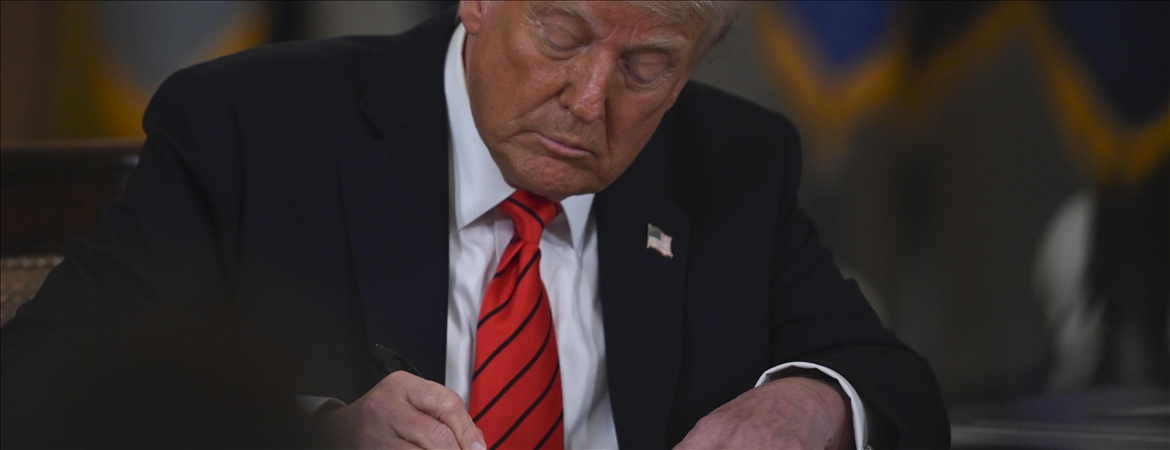
Trump began his second presidential term on Jan. 20, 2025, after a one-term break.
Anadolu compiled Trump's key decisions affecting the fight against climate change on the anniversary of his return to office.
As in his first presidential term, Trump withdrew the United States from the Paris Climate Agreement on the first day of his second term. On the same day, he signed an executive order titled “Declaration of a National Energy Emergency,” prioritizing the construction of oil and natural gas pipelines.
Regulations facilitating the leasing of federal lands for oil and gas production entered into force, while federal wind energy leases and permits and offshore wind energy projects were suspended.
Trump also terminated the conservation goal known as “30x30,” which aimed to protect 30% of land and oceans by 2030, and approved the removal of a significant amount of climate-related data and content from federal agency websites.
Return to plastic straws
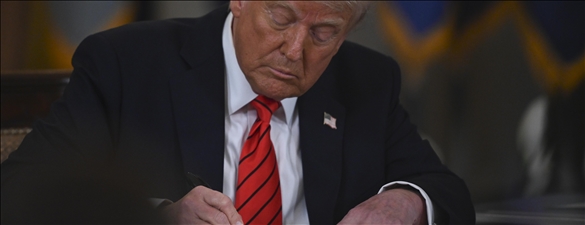
In February, one of the most discussed topics in the environmental field was the Trump administration's "plastic straw" decision. After Trump signed an executive order ending the federal government’s purchase and use of paper straws, they were banned across federal institutions and plastic straws were reintroduced.
In March, U.S. Environmental Protection Agency (EPA) Administrator Lee Zeldin announced plans to review and potentially roll back 31 environmental regulations. Zeldin said steps would be taken to reconsider regulations entered into force under the previous administration, including the greenhouse gas reporting program and the Mercury and Air Toxics Standards (MATS).
In the same month, Trump signed an executive order aimed at increasing timber production and lumber manufacturing in the United States. Federal agencies were instructed to take steps to boost domestic timber output in national forests and public lands. Environmental groups warned the move could weaken certain conservation protections and pave the way for expanded logging.
In April, Trump signed an executive order aimed at reviving the U.S. coal industry, emphasizing coal’s importance for energy security and economic objectives. During the same period, the EPA granted temporary exemptions from air pollution regulations to several coal-fired power plants, allowing them to operate under fewer environmental restrictions.
In May, the National Oceanic and Atmospheric Administration (NOAA) announced it would no longer update its “billion-dollar weather and climate disasters” database beyond 2024. The database, used since 1980 to monitor extreme weather events causing billions of dollars in damage, has been archived and frozen.
In June, the U.S. Department of the Interior loosened regulations on public lands, opening the door to expanded mining activities. Under executive orders issued by the Trump administration, federal agencies were instructed to boost mineral production, easing the development of mining and energy resources on public lands.
Claim that renewable energy sources harbor “unreliable risks”
In July, the U.S. Department of Energy released a comprehensive report on the climate impacts of greenhouse gas emissions. The roughly 140-page report sparked controversy in scientific circles for portraying the economic impacts of emissions as more limited and less harmful than widely accepted scientific assessments.
That same month, Trump signed an executive order titled “Ending Market‑Distorting Subsidies for Unreliable, Foreign‑Controlled Energy Sources.” The order instructed federal agencies to phase out subsidies for wind, solar and other renewable energy sources, citing claims that these sources harbor “unreliable risks” to national security and grid stability.
In August, EPA Administrator Zeldin canceled the “Solar for All” program, a roughly $7 billion grant program launched under former U.S. President Joe Biden to expand access to solar energy for low-income households and reduce energy costs.
While the Trump administration moved to terminate or cut funding for satellite-based carbon dioxide monitoring missions, the EPA announced it would no longer update greenhouse gas emissions databases used in emissions calculations. The decision affected federal emissions monitoring and supply chain analysis data flows.
On Sept. 23, during his speech at the United Nations General Assembly, Trump said that climate change is “the greatest con job ever perpetrated on the world,” and criticized countries adopting renewable energy policies.
Despite the federal government shutdown on Oct. 1 due to budget disputes, some energy and natural resource activities continued.
No high-level participation in climate summit
In November, no high-level U.S. official attended the 30th Conference of the Parties (COP30) to the UN Framework Convention on Climate Change (UNFCCC), held in Belem, Brazil. However, several U.S. local governments opposed to Trump participated in the summit.
In December, following U.S. military action against Venezuela, Trump’s remarks on Greenland shifted attention to the Arctic region. As global warming accelerates ice melt and opens new trade routes, increasing the region’s strategic importance, Trump said, “If we don't do it, Russia or China will take over Greenland. And we're not going to have Russia or China as a neighbor.”
Trump’s decisions affecting the fight against climate change continued without slowing down in the first days of 2026. The U.S. president signed an executive order providing for withdrawal from 66 international organizations, including 31 affiliated with the United Nations.
Among them were the Intergovernmental Panel on Climate Change (IPCC) and the Intergovernmental Science-Policy Platform on Biodiversity and Ecosystem Services (IPBES), both of which play a direct role in global efforts to address climate change.