One-third of global food is wasted as millions face hunger


US-based investment bank JPMorgan’s report, titled “Climate Intuition: Food security: The fates of farming and food in a warming world” has been released.
According to information compiled by Anadolu from the study, if current population growth and consumption trends continue, the world will need to produce 80% more food calories than in 2010.
While approximately half of arable land is already used for agricultural activities, the report estimates that the additional caloric needs cannot be met by expanding cultivation into non-agricultural land. Meeting future demand will therefore require a combination of innovation and effective management.
The increase in agricultural production since the 1960s has largely been driven by industrialization and yield-enhancing agricultural technologies. China, India and Brazil have played a leading role in this increase, while gains in the US and the EU have remained relatively limited.
Increases in total output have been supported by inputs such as land, fertilizers and machinery. Over time, the gap between inputs and outputs, referred to as “total factor productivity” (TFP), has increased, allowing more production to be achieved with fewer resources per unit.
Public and private spending on agriculture has neared all-time-highs, supported by rising venture capital investments. While part of this funding has focused on input technologies developed during the Green Revolution and modernizing operations, the past decade has seen a shift toward new farming technologies aimed at improving production constrained by local climate conditions.
Soil health degradation
According to the study, four main environmental risks threaten total factor productivity: soil degradation and erosion; reductions in water quality and quantity; pesticide resistance and emergence of new pests; and climate change altering regional climate.
Indicators of soil health show widespread degradation across major global agricultural output regions. Loss of organic carbon and topsoil erosion have been linked to recent declines in production, with losses in US corn-growing regions reaching 6%.
In the EU, an estimated 60–70% of soils are degraded, costing approximately €50 billion annually.
Continued degradation of water resources could further reduce productivity, increase costs and exert long-term pressure on land asset values. In regions where groundwater levels are falling, delays in agricultural loan repayments are becoming more frequent.
Increases in food price
Reports cited in the study identify extreme weather events as one of the main drivers of rising food prices.
In the United Kingdom, potato prices rose by 22% in January–February 2024 period following a wet winter. In the EU, olive oil prices increased by 50% in January 2024 due to the 2022–23 drought. In the western United States, vegetable prices jumped by 80% in November 2022 after drought conditions, in Japan, rice prices rose by 48% in September 2024 following an August heatwave.
“Climate change directly affects soil health”
Speaking to Anadolu, professor Erhan Akca, a member of the Soil Science Society of Türkiye, said soil could be considered the world’s largest freshwater lake due to the amount of water it holds.
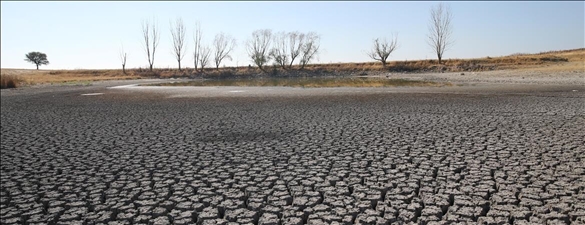
Akca noted that soil health degradation becomes evident when soil can no longer support healthy plant growth or effectively filter water. “Climate change directly affects soil health because climate-driven changes lead to the loss of soil moisture,” he said. “The Earth operates as a system of cycles. Once soil moisture is lost, even small disruptions in these cycles can destabilize the entire system. Climate change disrupts the water component of this system, which we describe as drought.”
He emphasized that loss of soil organic carbon and erosion are among the most serious threats to soil health, noting that erosion leaves soil vulnerable. Organic carbon in soil functions much like blood in the human body, retaining water and enabling nutrient uptake, Akca explained.
He added that climate projections show soil degradation will be particularly severe in Mediterranean climate regions. “Tropical forests look very productive, but since the soils are acidic, most nutrient elements there are insufficient; they lack calcium. According to projections, a 1-degree increase affects coastal Mediterranean areas slightly, but at 2 degrees, regions stretching from Aydin to Osmaniye and toward Mardin and Sirnak will be heavily affected,” he said. “Precipitation per square meter could decline by about 100 millimeters, meaning 100 liters less water per square meter, which is 10 tons less each year.”
As water and biological activity decline in soils, fertilizer use increases, Akca noted, weakening plants’ natural defense mechanisms. The chemicals used to offset yield losses, he added, contribute to environmental pollution and threaten human health.
Food production can be increased with innovative agriculture
Highlighting the benefits of innovative agricultural practices, Akca said precision irrigation, drone technologies and proper fertilizer use can significantly improve outcomes.
“Excessive chemical, synthetic inputs and over-irrigation have caused degradation,” he said. “In some parts of Central Anatolia, maize is irrigated for 24 hours, but sensors show six hours is sufficient. With the right balance of water, fertilizer and biologically based inputs, innovative agriculture can increase efficiency.”
“We need to increase food production by 50–60% over the next 20–30 years, but soils are being depleted. Innovative agriculture offers a way forward,” Akca said, noting that the difference between producing 2 kilograms versus 10 kilograms of output with the same amount of water underscores the importance of such approaches.