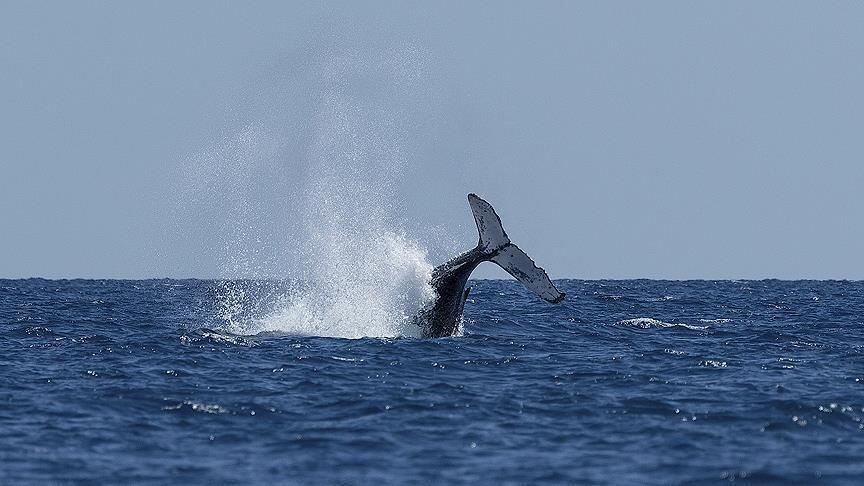
Whales have long captured human imagination as the giants of the ocean. But these marine mammals do more than just inspire awe – they play a crucial role in fighting climate change.
Through their nutrient-rich excrement, migration patterns, and feeding habits, whales help sustain entire marine food webs while locking away carbon from the atmosphere.
At the heart of the whale ecology is a process scientists call the “whale pump,” a natural nutrient recycling system that connects deep feeding grounds with sunlit surface waters.
“The whale pump refers to ways that whales naturally fertilize the surface ocean through their poop,” Heidi Pearson, professor of marine biology at the University of Alaska Southeast, told Anadolu.
Pearson explained that whale excrement is high in nutrients that phytoplankton -- microscopic marine plants -- need to grow.
Like land plants, phytoplankton absorb carbon dioxide during photosynthesis. When they die and sink, some of that carbon is transported into deep waters, where it can remain stored for centuries.
“Think of phytoplankton almost like grass… except in the ocean,” Matthew Savoca, a marine scientist at Stanford University, explained.
“When they grow… they’re sucking in carbon dioxide and incorporating that into their cells,” Savoca said.
When they die, they sink into the deep ocean, where the carbon it contains is effectively locked away for hundreds to thousands of years before it can return to the atmosphere.
Scientists and policymakers are exploring ways to enhance the natural process where marine plants like phytoplankton absorb carbon dioxide from the atmosphere, helping to mitigate climate change.
Zooplankton such as krill feed on phytoplankton, fish feed on zooplankton, and whales feed on krill and small fish higher up the food chain.
Savoca described zooplankton as an “elevator.”
“You can almost think about the krill… as an elevator,” he said, referring to daily vertical migrations that carry carbon-rich material deeper into the ocean, increasing the likelihood of long-term storage.
Whales reinforce this cycle by fertilizing the phytoplankton that krill depend on.
“It’s almost like whales are gardeners in a way,” Savoca said. “Through that process, we think whales might have an impact on climate. But it’s this indirect pathway.”
Beyond nutrient cycling, whales influence marine ecosystems in ways that extend far beyond carbon dioxide.
Scientists often describe them as ecosystem engineers -- species that physically and biologically reshape their surroundings. In some regions, they may even function as "keystone species," meaning their ecological impact is disproportionately large relative to their numbers.
The scale of whales’ ecological influence became clearer after centuries of industrial whaling dramatically reduced global populations.
“We know that if there are more whales, we have healthier marine ecosystems,” Pearson said. “What we’re seeing now in most places around the world, we still have depleted whale populations.”
Savoca noted that removing whales reshaped ocean productivity.
During the 19th and 20th centuries, industrial hunting removed an estimated 90% of large whale populations worldwide. In the Southern Ocean, scientists observed unexpected shifts in ecosystem productivity following those declines.
"What we saw was that in general, a lot of these ocean ecosystems changed fundamentally, like different species compositions changed, but also in general, it seems like … overall productivity declined," Savoca said.
One unexpected observation came from research in the Southern Ocean near Antarctica, where whale declines were followed by drops in krill population, despite krill being a primary food source for whales.
“Because the whales were acting like gardeners… if whales can grow more phytoplankton, then there can be more krill,” Savoca said. "And that's what we realized only after we removed all the whales by basically killing them all in the Southern Ocean in the 1900s."
Scientists said such dynamics highlight how tightly marine systems are interconnected -- and how removing a single large species can ripple through entire ecosystems.
Whales accumulate significant amounts of carbon in their biomass throughout their lives.
When they die, they sink to the seafloor -- a process known as a “whale fall.”
Through this process, much of the carbon remains trapped on the deep ocean floor for hundreds of years, preventing its release into the atmosphere.
According to the World Wide Fund, a single large whale, such as a blue whale, is estimated to store around 30 tons of carbon in its body. This carbon remains locked on the seafloor through the whale fall. By comparison, an average tree is thought to hold about 1 ton of carbon.
Pearson said that the blue whales are "the largest animal to ever exist on earth," explaining that their sheer body size means they have a "big impact on the environment… they eat a lot, which means they poop a lot and they can have a big effect.”
"The whale pump, because they are so big, they can store a lot of carbon in their bodies," Pearson said.
“So we have this huge gentle giant, basically, that is providing all these ecosystem services simply by being alive,” she added.
Their presence, scientists say, is a living reminder that healthy oceans are central to combating climate change.
news_share_descriptionsubscription_contact