By Selen Tonkus
ANKARA
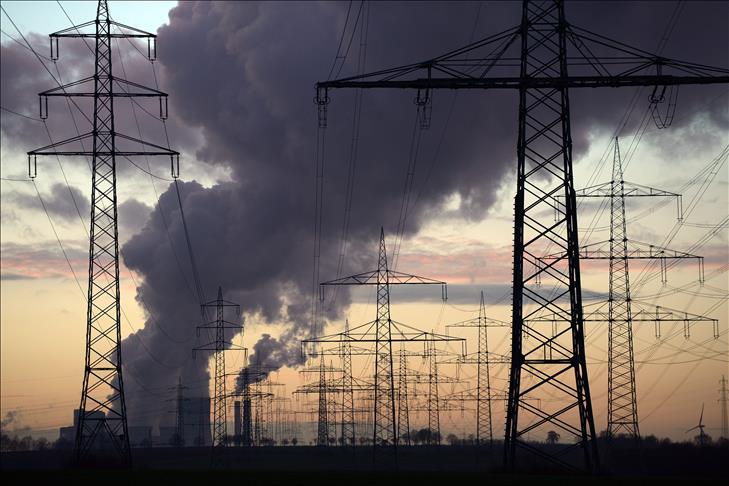
Energy is acting as a "buffer zone" among the players in the Ukraine crisis with the EU and Ukraine dependent on Russian energy, while the Russian economy is reliant on the EU's continuing gas imports as a key source of revenue.
Russian troops invaded Crimea nearly two weeks ago under the pretext of providing security for the region’s ethnic Russians. Crimea is to hold a referendum this weekend on its future with Ukraine. Europe has strongly criticized what they see as Russian aggression in Crimea, which took place after the ousting of the pro-Russian former president Viktor Yanukovych. The EU has offered €11 billion (US$15 billion) to help stabilize the economic and financial situation in Ukraine, and it is also preparing to impose sanctions against Russia as the next step in their response to Russia's military activity in the Autonomous Republic of Crimea.
Nonetheless the complex interdependence among Europe, Ukraine and Russia leads the parties to behave cautiously, say experts speaking to Anadolu Agency (AA) correspondent.
Russia supplies Europe with approximately 40 percent of its energy, and the main natural gas pipelines run through Ukraine, which also meets 60 percent of its gas demand from Russia. On the other hand, Russia depends to a certain extent on on Western markets as a main source of income. Eurostat 2012 data suggests that Russia's exports to the EU amounted to €123 billion, while it imported €213 billion from the EU.
According to Margarita M. Balmaceda, energy politics professor at Seton Hall University, Russia, Western Europe and the Ukraine's energy relations are interdependent.
Balmaceda said all the players have an interest in the smooth functioning of this interdependent relationship, and it is not in any of these players’ interest to have a military conflict.
- "Energy as an economic weapon" -
Dmytro Naumenko, research fellow at the the Institute for Economic Research and Policy Consulting (IER) in Kiev said, "Energy is an economic type of weapon today."
He noted, Russia is proactively using energy prices as a factor to influence geopolitical decisions.
"This is proved by the cancellation of gas discounts for Ukraine after Yanukovich was ousted and Europe's spineless reaction to Russian military invasion in Crimea due to selective gas prices for some Gazprom clients. So, in case of energy interdependent countries, we can observe the dictate of energy suppliers and there is litte room for buyers to resist since even strong EU still can't find a solution," he explained.
Gazprom and Ukraine's Naftogaz signed an agreement to decrease the price of natural gas, and Russia provided economic support for Ukraine by cutting the price of natural gas by one-third to US$268 per 1,000 cubic meters, from about US$400 in December 2013. However, after the ouster of Yanukovich, Russia cancelled the agreement.
- "Russia's cutting gas shooting itself in the foot" -
Amanda Paul from Brussel's European Policy Center said, during the Russia-Ukraine gas crisis in 2006 and 2009, Russia was more than able to cut off the gas, and this time it is also a possibility.
Russia accused Ukraine of illegally importing its gas in 2006 and 2009, and stopped gas flows to Ukraine as a consequence.
"If the EU moves to place economic sanction Russia may decide to the use the energy card. While the EU has taken some steps to diversify its energy resources, and routes as well as create changes in the energy internal market, it would be difficult to sustain a long term cut," she said.
Pointing out the complex interdependence, Paul further said, "If Russia decided to cut gas supplies to Europe, it would be very much shooting itself in the foot too as Russia would almost certainly be hurt in the long run should consumers and governments in the EU look elsewhere for more secure energy sources."
englishnews@aa.com.tr