By Shu'eib Hassen
CAPE TOWN
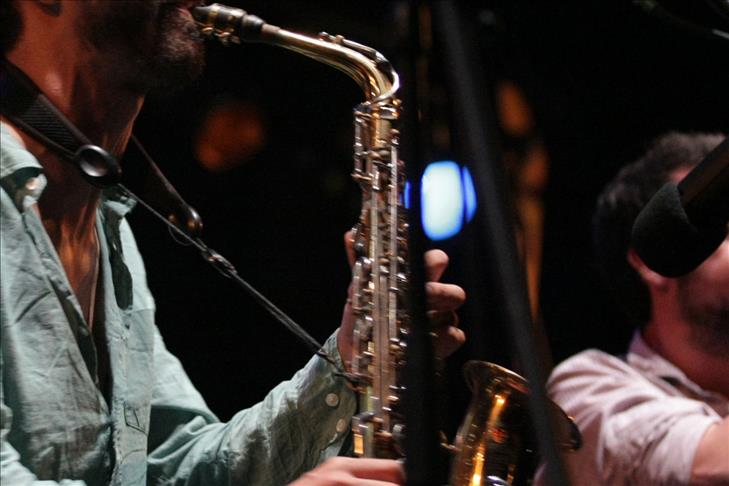
Each year, thousands of music lovers come together for the international Jazz festival in Cape Town, ranked among the top-ten best jazz festivals in the world.
"This is my fourth or fifth year attending the festival," Fabio da Graca told The Anadolu Agency.
"I come here to listen to new and different sounds that are not necessarily my musical taste," he said.
"I get to hear local and foreign musicians – it's a great environment and vibe," added da Graca.
The 16th Cape Town International Jazz Festival (CTIJF), which concluded on Saturday night, drew over 37,000 locals and foreigners over two days.
Commonly referred to as "Africa's Grandest Gathering," it is ranked among the world's best jazz festivals.
The streets were packed, hotels were nearly fully booked, and car-rental dealerships were out of vehicles.
"Cape Town wants to do our part to ensure greater recognition of culture and heritage," Mayor Patricia De Lille said on the festival's opening night on Thursday.
"We want to celebrate what has become an integral part of Cape Town's cultural landscape," she added.
"This event helps to bring us together in creating the kind of future we want for Cape Town – one of communities united in a common goal, love or interest," said Del Lille.
She described the festival as a "common interest that can help us build a truly inclusive city, while also providing a great platform for artists."
For the local tourism sector, the annual festival is enormously lucrative. In 2013, it contributed over $37 million to the provincial economy.
This year's festival, meanwhile, is believed to have brought in over $41 million.
Liberating jazz
The venue was packed when the renowned Hugh Masekela took the stage for the festival's finale on Saturday night.
During the 1950s and 1960s, Masekela's music reflected – and protested against – South Africa's apartheid regime and the everyday struggles of the country's black people.
Jazz has a deep history in the country's struggle against apartheid.
South Africa's jazz culture developed in the 20th century, borrowing much from the American jazz scene.
Under apartheid, many international jazz artists were denied permission to perform by the government. Others refused to perform.
As a consequence, local jazz artists at first imitated international musicians.
The socio-political climate that sculpted the lives of many local musicians gave jazz a more localised identity.
Musical genres – like marabi, kwela and mbaqanga – used local instruments to create novel forms of melody.
It was these localised sounds that were deeply integrated into South African jazz.
Jazz filled the local taverns in the 1950s and 1960s where liberation fighters would gather.
"Jazz – with no lyrics – could not be caught [prosecuted] by the police as 'freedom' songs," noted Kabila Nthoba, a South African jazz teacher.
"It was the music we felt in our hearts that gained momentum in our actions," he told AA.
"The government was oppressive, on bodies and mind, but the music was liberating," noted Nthoba.
Evolving
Nthoba noted that South African jazz was now trying to find a place in the global music market.
"This is not the sound of South Africa. But this cannot be stopped. It is natural for this generation to replace the next, even if something is lost," he told AA.
Andile Tolom, a veteran of the jazz festival, said South African jazz is shedding its roots.
"I am with the older generation that must question younger jazz musicians as to what message they are holding on to," he told AA.
For others, the easier-to-dance-to baselines and happier messages simply show how jazz has evolved.
"Some of the newer artists add electronic music into their jazz," Robert Scott told AA at the festival.
"This music is easier on the youth to listen to. It is more pop. From there, they can make their decision to listen to stricter jazz," he contended.
"Now, all the jazz is about being happy. What is wrong with that?" he asked.
The Cape Town jazz festival has shown how the music genre has changed with South Africa's socio-political landscape.
"The jazz has changed. We can see that at the festival," said Scott. "This is the new sound we share."