By Max Constant
BANGKOK
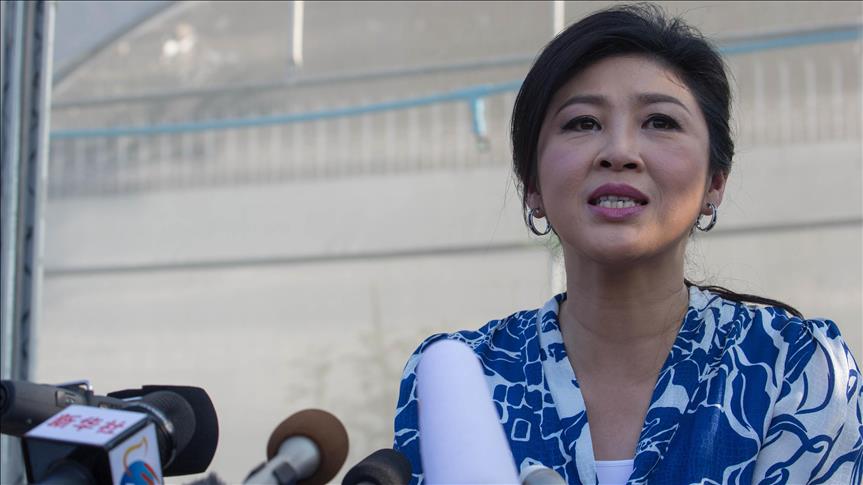
Thailand’s deposed prime minister demanded that the country's ruling junta show a greater respect for her countrymen in a rare interview with foreign media Friday, underlining that a new constitution should primarily be concerned with "people".
Talking to around 30 reporters from a chair in her garden -- surrounded by her bio-organic salad plantations -- Yingluck Shinawatra spoke of the need for a “people-centric new constitution”.
It was the second such invitation to her home this year, after showing off her vegetable garden to media Jan. 8, and then whipping up a salad dressing for the cameras.
“We understand that the situation in Thailand is uncertain, but there must be respect for basic human rights,” she responded to a question posed by an Anadolu Agency correspondent.
On Thursday, an official investigative committee stated that she was guilty of dereliction of duty by not stopping a rice subsidies scheme that caused 15.8 billion losses to the state, but it did rule that the scheme did not cause damages to the state – possibly implying that she might not have to compensate the losses.
The country's Deputy Prime Minister Vishnu Krua-ngam has indicated that the junta was going to issue an administrative order to seize Shinawatra’s assets as compensation for the losses.
She is currently on trial charged with dereliction of duty in relation to the scheme -- dereliction which the military-appointed national assembly used as an excuse to remove her from her position as prime minister in Jan. 2014, months before overthrowing her government.
Commenting on the committee's statement Friday, Yingluck said she was still “confused” about its exact meaning and implications.
“The committee said that at the policy level there was no wrong. They said that the people who implemented the policy did not do any wrong. So how the person who ordered the policy could be wrong?” she asked.
Political opponents have criticized the program saying it was ill-conceived, resulted in massive financial losses to the state and was riddled with corruption.
“The rice did not disappear. And there was in the policy a built-in guarantee concerning the possible deterioration of the rice stocks,” she added.
“Right now, we are not completely clear about the situation regarding the investigation.”
The scheme was just one of many -- others included universal healthcare and subsidies -- put in place to help the rural poor by Shinawatra and her brother, deposed former premier and junta nemesis Thaksin Shinawatra, who himself was removed by a military coup in 2006 and is in self-imposed exile to avoid corruption charges.
Critics, however -- in particular the military junta which overthrew her government -- claim such schemes have bankrupted the nation.
On Friday, Yingluck -- appearing to fear the military summons and detention that have befallen politicians, activists, journalists and academics since the coup -- seemed reluctant to answer questions about politics and the junta’s rule, but did emphasize the importance of elections, because “for the whole world, it would mean that the situation is back to normal”.
“This [elections] would allow the economy to grow and bring back confidence,” she underlined.
According to a new draft constitution written by a military-appointed committee of legal experts, elections should take place in Nov. or Dec. 2017.
But Yingluck -- who with her brother is now banned from standing for government -- expressed concern that holding elections with a constitution “which does not fit with Thailand” would not be progress.
“The constitution must be people-centric and focused on the balance between the three pillars [executive, legislative and judicial powers],” she stressed.
The draft charter, released last month, has been heavily criticized by all political parties and by civil society activists, on the grounds that it allows a non-elected prime minister to lead the country and ignores people’s civil rights, particularly the right to be consulted in projects affecting local natural resources.
Asked for opinions on the ruling junta, Yingluck refused, saying that she must “give the chance to others to handle the country”.
“If you were me, you would be reluctant to speak out. If I speak, there will be complaints that I am the one provoking divisions within the country,” she underlined.
“We keep quiet, but when there are misleading messages [propagated], we have to speak out.”
Since the May 22, 2014 coup, hundreds of politicians, activists, journalists and academics have been summoned and detained – often for a maximum seven-day period – in what the junta calls “attitude adjustment sessions”.
Yingluck and many of her allies were detained in what the junta's National Council for Peace and Order called an effort to "adjust their perception and make them think about the country, think about the Thai people as a whole, not just one particular group."
Today, all political activities, as well as gatherings of more than five people, are banned, and opponents who openly criticize the junta can be charged for sedition and sent to military courts.