By Okech Francis
JUBA
Like many of their South Sudanese compatriots, people living with disabilities had believed that independence from Sudan in 2011 would end years of marginalization and improve their lives.
They were wrong.
"In this country, it is believed that when you are disabled you cannot do office work; you cannot be a leader," Francis Madut, an activist who advocates for the rights of people living with disabilities, told Anadolu Agency.
"They think that when you are disabled, you are also unable," he said. "They consider you an outcast."
South Sudan, one of the world's poorest countries, seceded from Sudan in 2011 after one of Africa's longest civil wars.
Three years on, however, many people feel things haven't changed much, and while the country remains bogged down by an ongoing political-military crisis, people living with disabilities feel they have been discriminated against on every front.
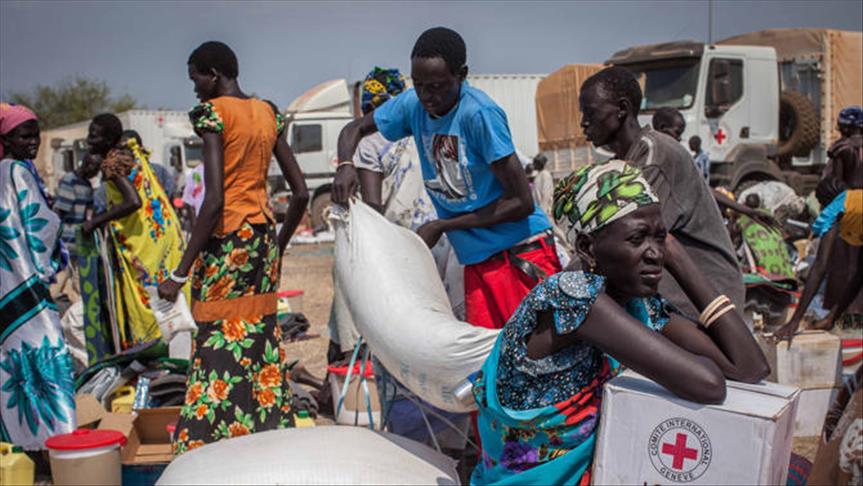
In early 2013, the International Committee of the Red Cross estimated that 50,000 people in South Sudan were physically disabled.
This number has increased since the country was thrown into a new armed conflict one year ago, though there are still no official figures.
"Some 98 percent of us are without jobs to the extent of being discriminated against by the Ministry of Gender and Social Welfare," said the 38-year-old Madut, who uses a walking stick due to his lame right leg caused by polio.
He chairs the National Disabled Organization, a local non-governmental organization that advocates for the rights of people with disabilities.
Madut uses a big tree next to a government compound as an office.
"When we speak on behalf of people living with disabilities, we are hated," he lamented.
John Anthony Omudak, a 45-year-old who must also rely on a walking stick due to polio, also decried stereotypes and misconceptions.
"People think if you are disabled, you are disabled completely – the mind, the production and cannot marry," he told AA.
"The fact that you are disabled, they will not respect you," Omudak lamented. "We feel bad; some people even want to kill themselves."
"People say a disability is a curse," he said. "Our people should stop seeing disabled people as a single people."
He asserted that many disabled people were married and had children that they had to support.
For her part, Olga Achien, a disabled tea seller in Juba, said women living with disabilities were constantly undermined.
"Some of us are raped," she told AA. "Physically fit men take advantage and rape us."
Achien, who lost both legs to a landmine explosion in 2003, lamented that women with disabilities were not even considered for the 25 percent share of leadership positions that the constitution allocates for women.
"No one ever thinks of us when planning on this," she said. "The shares are only given to women without disabilities."
-Institutionalized-
Madut blames the government for promoting discrimination against people living with disabilities.
He cited the example of a deaf information technology professional who, when applying for a job at the Education Ministry, was told to look for work with non-government organizations.
Madut blamed the government for not ratifying the UN convention on the rights of people living with disabilities.
"The president himself is the one who should start employing [disabled people], even if it's only ten in the presidential office, so that other people may follow his example," he said.
Omudak lamented that society did tended to ignore people with disabilities.
He recalled as a case in point a situation he encountered when applying for a job at a financial institution in Juba.
"I realized the office was on the fourth floor when I went for the interview," Omudak told AA. "There was no lift and I knew I would not get the job because of inaccessibility."
Omudak demanded a fair chance for people living with disabilities.
"A law to protect people with disabilities should be enacted; they should be given a fair chance and certain fees removed from their heads," he said, referring to public transport fares.
"People who have papers [professionals] should be employed. Non-governmental organizations should also consider people with disabilities the way they consider women," Omudak insisted.
"Services should be provided to disabled people to make them do things by themselves, because many programs for disabled people are being hijacked now," he said.
"We [disabled people] know exactly the problems of our people and we can handle them better," Omudak asserted.
Achien, for her part, called on the country's leaders to take urgent steps to address the issues affecting people with disabilities.
"These things should come from our leaders," the street vendor told AA. "Leaders should preach to the people to stop discriminating. The assembly [parliament] should advocate for the rights of the disabled."
"We [disabled people] need to have members in the judiciary, legislative and executive branches of government," she said.
-War victims-
South Sudan already has a special commission for people disabled during the decade-long civil war.
"This institution was established because we have a huge number of war disaffected, war disabled, war widows and war orphans," Brig. Gen. Dut Acuek Lual, the commission's director-general of operations, told AA.
"Any disability sustained as a result of war, be it a soldier or civilian who has sustained a disability during the war of liberation, is a beneficiary of this place," he said.
According to Lual, who suffered a leg injury during the war, there are 37,735 disabled people registered with the commission, all from the liberation struggle.
Lual pointed out that victims of the 2012 armed conflict with Sudan, commonly known in South Sudan as the "War of Panthou," along with victims of the current conflict, had not yet been registered with the commission.
"We have not gone down to collect data, but definitely there is a big increase in the number," Lual told AA.
But he insisted that problem represented a challenge rather than a problem of discrimination.
"What disabled people of South Sudan need is training," said Lual. "South Sudan is endowed with agricultural potential, and 90 percent of the beneficiaries of this institution are peasants."
He added: "If they are oriented and assisted with tools and implements, the idea of discrimination will go."
englishnews@aa.com.tr
www.aa.com.tr/en