By Alex Jensen
SEOUL
South Korea’s frustration with Japan was clear Tuesday as Seoul’s Foreign Ministry accused Tokyo of extending the suffering it had inflicted before and during World War II.
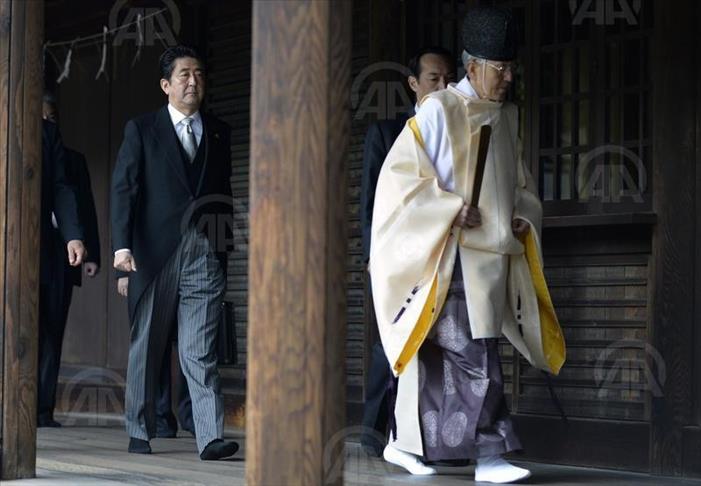
Just as Prime Minister Shinzo Abe had done at the end of last year, five Japanese cabinet members stopped by Tokyo’s Yasukuni Shrine on Sunday.
The ministers dedicated paper lanterns during their visit to the site, which pays tribute to the country’s war dead – including, controversially, several war criminals.
For neighboring countries like South Korea and China, such displays are a sign of Japan failing to atone for its past imperialist aggression.
The entire Korean Peninsula had been under Japanese control for most of the first half of the last century and a number of grievances remain unresolved – elderly former sex slaves, for example, continue to protest outside the Japanese embassy in Seoul every Wednesday.
"The Japanese cabinet members' move to pay homage to the Yasukuni Shrine is seen as a head-on challenge to its neighboring countries that had suffered from Japan's military aggression, as well as to the international community," South Korean Foreign Ministry Spokesman Noh Kwang-il told reporters Tuesday.
Noh then called on Japan’s government to put a stop to "anachronistic" behavior.
Such issues are not limited to politicians - in April, Canadian pop star Justin Bieber publicly apologized after prompting outrage in China and South Korea by unwittingly having a photograph taken at the Yasukuni Shrine.
Regional tensions were heightened further this month when Japan re-interpreted its pacifist constitution, allowing its military to defend allies overseas – fuelling fears of a return to past aggression.
Abe himself has previously defended visiting sites like the Yasukuni Shrine as a way of promoting peace by ensuring the past is not forgotten.
The Yasukuni Shrine is a Shinto - the indigenous faith of the Japanese people - shrine founded in the late 19th century to honor the approximate 2.5 million Japanese who died in various wars.
In 1978 the shrine’s priests secretly inducted 14 “Class-A” war criminals, including World War II leader Hideki Tojo, and about 1000 “Class B and C” criminals. Those convicted of Class-A crimes were accused of instigating and waging a war of aggression; the others of more conventional war crimes such as killing civilians or abusing prisoners.
The attached Yushukun war museum promotes an extreme nationalistic take on WWII, in which Japan's motives are depicted as being totally defensive and its actions designed to rid Asia of Western colonialism.
www.aa.com.tr/en