By Okech Francis
JUBA
Instead of celebrating three years of hard-won independence, many South Sudanese believe the nascent country – currently engulfed by conflict – has failed the test.
"We informed the international community that we wanted to be independent from the north [Sudan]," Kuri Hafiz Kuri, a human rights activist, told Anadolu Agency.
"But within three years, that blessing was over; we have thrown it down and forgotten we are an independent nation," he lamented. "Now we are in a civil war."
South Sudan seceded from Sudan in 2011 after decades of civil war.
But the new country slid back into chaos late last year when President Salva Kiir accused his sacked vice president, Riek Machar – both leaders of the ruling Sudan People's Liberation Movement (SPLM) – of attempting to overthrow his regime.
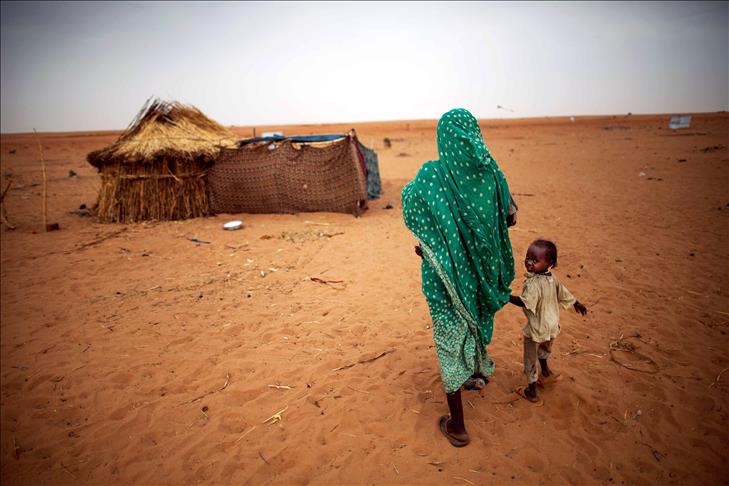
Hundreds of thousands of South Sudanese have been displaced in subsequent fighting, while large swathes of the population remain on the brink of humanitarian catastrophe.
"They want to kill and finish each other… We have failed to preach unity and the people embrace tribalism," said Kuri.
"Some 10,000 people who voted for independence and democracy are now in their graves," he fumed.
The activist added that around 1.5 million South Sudanese were now displaced – both in and outside the country – while their homes had been looted and torched.
"IGAD [the Intergovernmental Authority on Development, an East Africa trade bloc] seems to be failing, neighboring countries are not active in bringing peace, and our own people do not want peace," Kuri lamented.
"What kind of independence can we boast of?" he asked.
Independence celebrations on Wednesday lacked the festive atmosphere that had engulfed the country three years ago after it had seceded from its northern neighbor.
In contrast to its first independence anniversary, which was attended by over 13 heads of state, South Sudan's third anniversary was only attended by a handful of officials.
Wakeup call
Veteran journalist Susan Nyiel Panchol said the country's three years of independence had proven a failure.
"The party that liberated the country has failed them again," she told AA.
"On the streets you see orphans of fallen heroes living in poverty," Panchol said. "The level of injustice is high; people are living in an illusion."
She asserted that nothing had been achieved during the country's three years of independence.
"No proper healthcare and no good education, yet these are the things that the country was fighting for," Panchol noted. "There is nothing to show."
She said the country had let down those who had struggled and shed their blood – even sacrificed their lives – to win independence.
"We have failed our martyrs. It's as if they died in vain," she said sadly, adding that there was a need for a national awaking.
"We encourage more health services, taking care of orphans, and basically providing for the country's needs rather than causing another crisis," said the journalist.
"We need to wake up," she added.
According to Lual Deng, director of the Ebony Center for Strategic Studies, a local think tank, the answer lies in how the country is run.
"First, we have come to know that running the state is no easy thing," Deng told AA. "There are leaders for certain situations, and war leaders may not be appropriate for a developing state."
"We have not learnt from the Malaysian experience between the Malay, Chinese and Indians, but their leaders made sure the country came together," the expert said.
He went on to note that tribalism had played a role in the current crisis.
"We also seem not to have learnt that tribalism is a cancer that should be abolished," Deng said.
He believes that the focus now should be on genuine dialogue.
"People have to sit down – the various groups of stakeholders – and discuss the crisis' underlying issues," Deng said. "This crisis was created from day one in 2005."
"Now there's a need to… come up with a new social contract. The contract of the war [for independence] is over. As we develop, it should not be the living liberators who should enjoy only – what about the dead ones? What about other South Sudanese?" he asked.
"And this cannot come through the ruling league, it has to come like what IGAD is doing, though they are failing, bringing in multi-stakeholders' negotiation – not between the government and rebels only," he said.
Despite the current difficult circumstances, Deng expressed optimism regarding the young country's future.
"Though we have replaced Somalia [as the world's least stable state], we should not lose hope," he said. "Better days for South Sudan still lie ahead."
www.aa.com.tr/en