By Ben Tavener
RIO DE JANEIRO
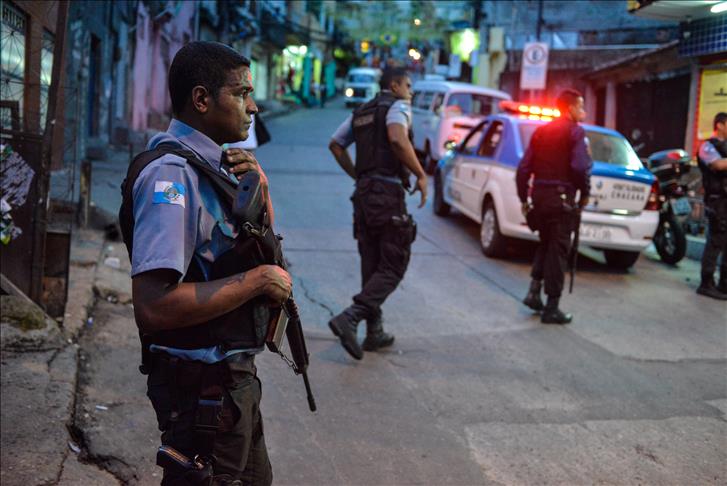
Police in Rio de Janeiro detained 37 people Saturday in connection with an anti-World Cup protest marked to coincide with Sunday's tournament final between Argentina and Germany, the city's investigative civil police confirmed to the Anadolu Agency.
A local judge issued 26 preventive arrest warrants, of which 17 have so far been put into effect on charges of vandalism and "forming an armed group."
Other individuals, found in the company of those arrested under warrants, were also detained and questioned.
At least a further nine people could be detained in the coming hours as part of a Rio authorities operation codenamed "Firewall," in a bid to avoid violent clashes between protesters and police as witnessed during the Confederations Cup final in 2013.
Under Brazilian law, individuals detained for offenses since the 2013 protests can be held for up to five days.
Police acted after a protest was called by the so-called Popular Independent Front for 1 p.m. local time to be held at the famous Maracanã stadium - a location near to the World Cup final venue, just three hours ahead of kickoff.
'Campaign of intimidation by police'
Protesters are using the rally to demand their rights to protest be upheld, and call for an end to what they see as a repressive police force.
Human rights group Amnesty International labeled the arrests as a "worrying repetition of a standard of intimidation that the organization had identified ahead of the start of the World Cup."
In a statement, the organization called on the Brazilian authorities to grant people the right to peaceful demonstrations, adding "no one should be detained or arrested for taking part in a protest and exercising that right."
However, police told the Anadolu Agency they had seized a number of items that support the charges, including a revolver, an explosive device, gasoline, fireworks, protest banners and gas masks.
Protests over government spending on the tournament, as well as police brutality and evictions for World Cup and Olympics infrastructure have been ongoing to some extent since June 2013, when over a million Brazilian tooks to the streets in over 300 cities across Brazil.
Historic security outfit
With heads of state including German Chancellor Angela Merkel and Russian President Vladimir Putin expected to attend the sellout match, along with 79,000 fans in the stadium and an estimated 1 billion-strong global television audience, the local authorities are taking no chances and have mounted the country's biggest-ever security operation, unprecedented in its scale.
Over 25,000 police and security personnel are on duty in the city ahead of the match, with around 11,000 of those in and around the Maracanã stadium. Of those, 250 officers are from 45 countries - including 30 competing in the key football (soccer) tournament.
At least 70,000 Argentinians fans are expected in Rio, according to the City Hall, and while the atmosphere in Rio has been one of friendly long-running rivalry between Argentines and Brazilians, police are on alert for possible trouble, fueled by alcohol and heightened World Cup emotions.
Many Argentinians have come without tickets or accommodation, and have crowded the city's world famous beaches day and night.
It is the first time in 64 years that the Maracanã has held a World Cup final, and the 1950 climax - a thrilling match between Brazil and Uruguay - remains indelibly etched into Brazilians' memories as a national tragedy, as the hosts lost at home.
Sunday's final tie is being fought by Argentina and Germany, who humiliated the Brazilians in a 7-1 semifinal defeat earlier this week. Despite this, correspondents say many Brazilians are set to support Germany, as historical rivalry means cheering for their neighbor remains unthinkable to most fans.
Saturday's playoff saw the Netherlands take home third place, with the Brazilians having to settle for a disappointing fourth position.
www.aa.com.tr/en