By Gabriel Kahn and Turgut Alp Boyraz
MANILA, Philippines
Following 17 years of negotiations, the government of the Philippines and the rebels of the Moro Islamic Liberation Front signed a final peace deal in Manila on Thursday that will open the road to the creation of a new semi-autonomous Muslim region in southern Mindanao.
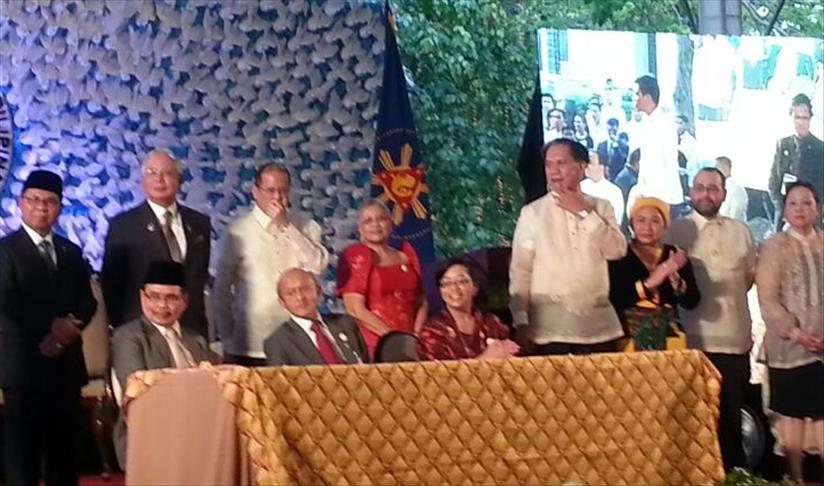
The Comprehensive Agreement on Bangsamoro was signed at 5:30 p.m. local time (0930GMT) in a tent on the grounds of Malacanang Palace. It was signed by members of both negotiating panels and the Malaysian facilitator of the peace process, Tengku Dato.
Witnessing the event were Philippine President Benigno Aquino, Malaysian Prime Minister Najib Razak, Moro Islamic Liberation Front chairman Murad Ebrahim, and the presidential adviser on the peace process, Teresita Quintos-Deles.
"The Bangsamoro agreement brings with it a restoration of identity, powers and resources of the Bangsamoro People," Ebrahim said during the ceremony.
With the signing of deal, the Philippine government and the Moro Islamic Liberation Front, or MILF, hope to put an end to more than 40 years of war that has left at least 120,000 people dead, most of them civilians. The Moro Islamic Liberation Front and several other armed groups have fought to gain independence for the Catholic country’s predominantly Muslim south, determined to earn what leaders on the ground term "a better life" for the country's Muslim population.
The violence has also left large parts of the country’s fertile southern region mired in poverty.
Aquino hailed the agreement as a turning point.
"If we sustain the momentum for peace, by 2016 the MILF will shed its identity as a military force and transform itself into a political entity," he said.
More than 1,000 people were present, about half of them former rebels of the Moro Islamic Liberation Front. Other guests included diplomats, congressional leaders, members of the international contact group, the international monitoring team for the peace talks, and representatives of the Muslim political world -- among them the prime minister of Malaysia, a country that has for 13 years facilitated peace talks between the Philippine government and the Moro rebels.
Najib last visited the Philippines in October 2012 to witness the signing of the framework agreement, which constitutes the core of the peace deal. Among the other dignitaries attending Thursday's signing were Turkey's deputy foreign minister, Ali Naci Koru, Saudi Prince Abdulaziz bin Abdullah and German Minister of State Maria Bohmer.
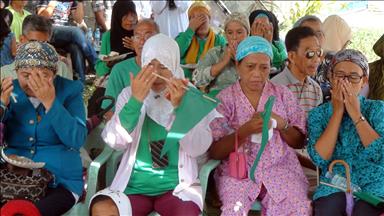
The place of honor was given to Najib, who sat in the middle with Ebrahim on his right and Aquino on his left. In the background was a canvas painted with thousands of white doves heading into a blue sky. More than a thousand people filled the tent while hundreds of Muslim groups gathered in Quiapo -- the Muslim area in the country’s capital -- in anticipation of the historic event.
During the ceremony, Quintos-Deles said the signing would bring peace to the country.
"No more war, no more children scampering for safety, no more evacuees. …no more poverty, no more fear…Tama na (Enough), we are all tired of them," she said in a speech.
The five-page comprehensive deal encompasses the framework agreement signed in 2012 and four annexes that were negotiated later.
The signing sealed the permanent ceasefire between government troops and the 10,000 rebels of the Moro Islamic Liberation Front. Under a plan that is still being adjusted, they will turn over their weapons to a third party while those members of the front who meet the requirements will be able to join the security force for the Bangsamoro territory envisioned in the agreement.
The roadmap toward the creation of the semi-autonomous Muslim region included the creation of the Transition Commission, in December 2013. The commission is in charge of drafting the Bangsamoro basic law that will be submitted to Congress for approval.
Once passed, the measure will be put to voters in a plebiscite by residents of the new region.
The law will compel the dissolution of the previous semi-autonomous Muslim region set up after the signing in 1996 of a first peace agreement between the government of the Philippines and the Moro National Liberation Front, the original rebel group from which the Moro Islamic Liberation Front broke away in 1984.
The new law will also lead to the appointment of a Bangsamoro Transition Authority that will govern the territory until full normalisation takes place with the election of a Bangsamaro government by 2016. The future Muslim region will be a self-governing entity with its own police force, a regional parliament and the power to levy taxes.
Military forces in Mindanao have been on red alert since last Monday due to fear of military action by armed groups opposed to the pact.
"There are many spoilers," Armed Forces spokesman Lt. Col. Ramon Zagala told Philippine Star newspaper. "There is the BIFF, there are those groups who will stand to lose a lot because of the normalization, so we are looking into all of that." BIFF is the acronym for a group called the Bangsamoro Islamic Freedom Fighters.
Under the command of Ameril Umbra Kato, a former commandant of the Moro Islamic Liberation Front who broke away in 2008, the Bangsamoro Islamic Freedom Fighters are fighting for the independence of the Bangsamoro. This breakaway group, which has a few hundred combatants, has vowed to destroy the peace process.
In an attempt to confront the danger, the army took over the Bangsamoro Islamic Freedom Fighters' main military camp in Mindanao in January during an offensive in which at least 37 Muslim fighters were killed.
The Bangsamoro Islamic Freedom Fighters are not the only armed group opposed to the agreement. Feeling betrayed by a peace deal signed without him -- and that will make irrelevant the peace agreement of 1996 -- Nur Misuari, the leader of the Moro National Liberation Front, the second-largest armed group on the island, sent his men to attack the Christian enclave of Zamboanga last September.
During a siege that lasted weeks, hundreds of people were killed and hundreds of thousands were displaced.
Ebrahim, the head of the Moro Islamic Liberation Front, said the agreement would also benefit the Moro National Liberation Front, as well as the other groups in the Muslim southern island.
“I would like to impress upon all of you that the MILF will not and does not ever claim sole ownership to the Comprehensive Agreement on the Bangsamoro. The MILF recognizes … the valiant efforts and sacrifices of countless people for freedom and self-determination," Ebrahim said before the signing.
Some indigenous tribes also fear that the creation of a semi-autonomous Muslim region will rob them of part of their ancestral lands.
It is probable that the constitutionality of the new accord will be tested. A 2008 agreement called the "the memorandum of agreement on ancestral domain" was declared unconstitutional by the supreme court.
While several diplomats said Thursday's signing of the agreement marked a significant step toward peace, they also warned that its implementation will be long and difficult.
The president admonished the armed groups still active in Muslim Mindanao not to threaten the accord.
"May this also stand as a warning to those who whish to derail our path for a final lasting peace, for those who wish to sow divisiveness for self-interest and those who continue to wield arms to pursue their own agendas," Aquino said. "So many people have suffered for so long. So many of our stakeholders have worked so hard to arrive at this point. I will not let peace be snatched from my people again."
englishnews@aa.com.tr
news_share_descriptionsubscription_contact

contact_the_ombudsman
is_there_an_error_in_this_story