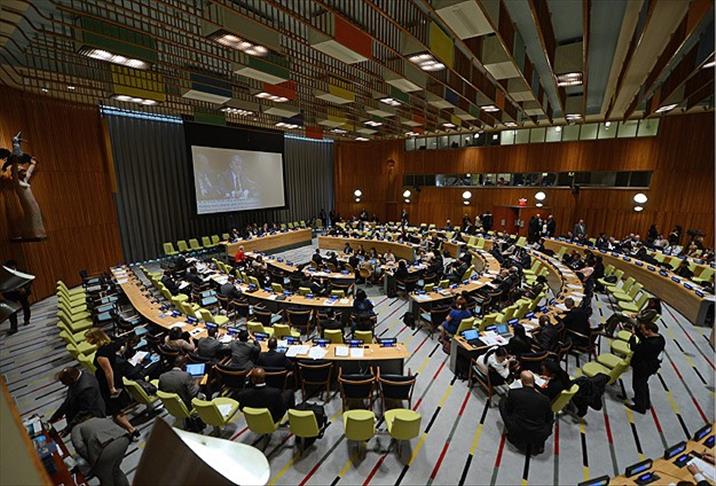
UNITED NATIONS (AA) -- After the early morning election procedure, the UN General Assembly elected five new members to the Security Council on Thursday.
Although some times hotly contested races -- when the election is associated with rivals, this time it was all predictable and the winners were virtually certain at the very beginning.
For Nigeria, Chad, Saudi Arabia, Lithuania and Chile – it was not contested race. It was a full house since 191 out of full UN membership of 193 member states were presented, but everything went pretty fast: Voting was suspended from 10:35 to 11:15 local time – only for votes to be counted.
- Lithuania big winner
President of the 68th UN General Assembly John Ashe read the election results with all winning the game: Lithuania who was elected on behalf of the 23 countries of Eastern European UN members states, which will replace Azerbaijan on that seat from January 1st, 2014, obtained highest number of 187 votes.
Chile from Latin America obtained 186 votes, while the representatives of two countries from Africa, Nigeria got 186 and Chad 184 votes respectively. The least votes were given to Saudi Arabia – 176. For voting to be valid the two third majority votes were required which was 128 votes.
This year, there were initially two candidates for a West African seat but, it was reported last week that Gambia dropped in favor of Nigeria.
- Smooth transition
In 2007, a runoff between Guatemala and Venezuela went 47 rounds before Panama was finally offered, and elected, as the Latin America candidate.
This year Chad, Saudi Arabia and Lithuania are considered as the beginners, since they have never served on the UNSC. Chile and Nigeria have been on the council four times previously. Seats at the UN Security Council are allocated by region, and regional groups nominate candidates. All membership of the United Nations – 193 countries are invited to vote for 10 non-permanent members of the UNSC, with five of them elected every year every October in New York.
The 15-member council includes five permanent members with veto power — the United States, Great Britain, France, Russia and China — and 10 nonpermanent members elected for two-year terms.
- Reforms on hold
Some consider that the needed and very much talked about – the reforms of the Security Council are frozen since 1960s. Although the world has changed and the UN has almost 200 members - the Security Council is still standing at the Cold War level – still counting 15 members. The advocates of changes - the countries like Brazil, Germany, India and Japan, along with Turkey, which also seeks reform of the Security Council of the UN – are urging those reforms to happen but not with very tangible results.
The five winners on Thursday will replace Azerbaijan, Guatemala, Morocco, Pakistan and Togo.
This years winners will assume their posts on January 1st, 2014 and will serve until December 31st, 2015.